How to Measure Performance Marketing Campaign Success
-

- Published Updated
- 3,425 views
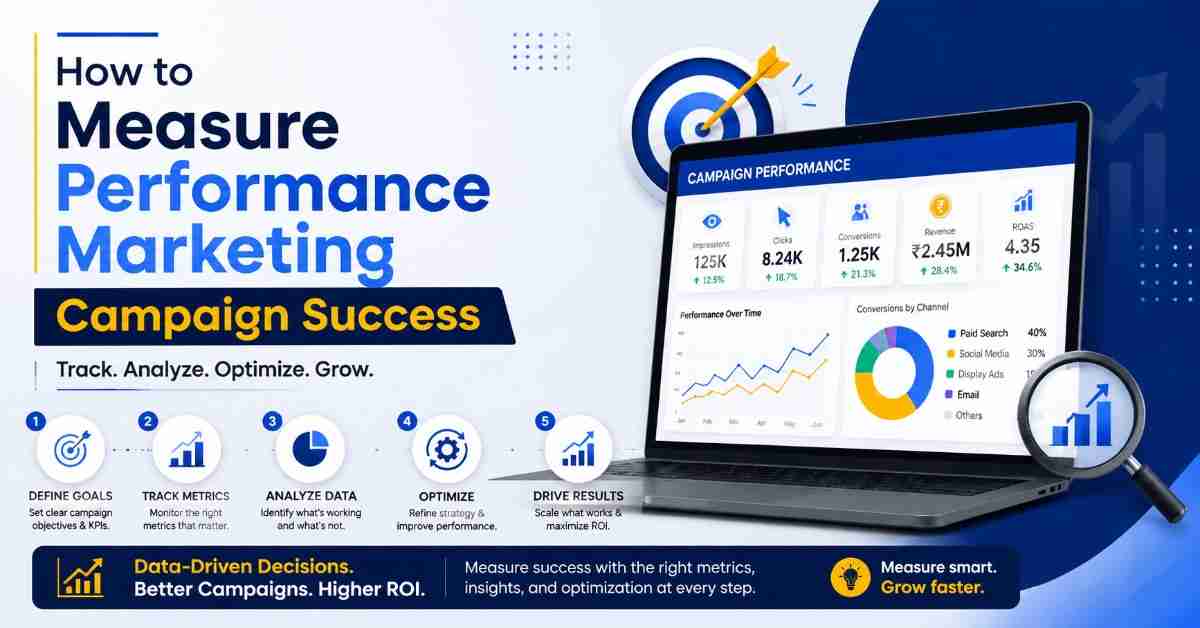
Performance marketing is based on measurable results. Businesses can track clicks, leads, conversions, sales, and revenue to understand whether their advertising campaigns are working effectively. However, measuring success requires more than simply checking the number of clicks or impressions. Marketers need practical Digital Marketing Skills to understand campaign data and connect advertising performance with actual business objectives.
A successful campaign should generate valuable results at an acceptable cost. Metrics such as CTR, CPC, CPA, conversion rate, and ROAS help marketers understand whether their campaigns are reaching the right audience and producing meaningful outcomes.
Start With Clear Campaign Objectives
The first step in measuring performance marketing success is defining a clear objective. A campaign may be designed to generate leads, increase online sales, drive website traffic, increase app installations, or improve customer acquisition.
The measurement process should match the campaign objective. For example, a lead-generation campaign should focus on qualified leads and cost per lead, while an e-commerce campaign should pay greater attention to purchases, revenue, CPA, and ROAS.
Without a clear objective, it becomes difficult to determine whether a campaign is successful.
Track Click-Through Rate and Cost Per Click
Click-through rate (CTR) measures the percentage of people who click an advertisement after seeing it. It can provide an indication of how relevant and attractive an advertisement is to its target audience.
Cost per click (CPC) shows how much the advertiser pays for each click. A high CPC can reduce campaign efficiency, particularly when clicks are not generating conversions.
However, marketers should not focus only on achieving the lowest CPC. A campaign with a higher CPC can still be successful if it generates better-quality leads or more revenue.
Measure ROAS and Revenue
Return on ad spend (ROAS) helps businesses understand the revenue generated from advertising expenditure. It is especially important for e-commerce and sales-focused campaigns.
For example, if a company spends ₹10,000 on advertising and generates ₹50,000 in attributed revenue, the campaign produces a 5x ROAS.
ROAS should be evaluated alongside profit margins, customer acquisition costs, and other business expenses rather than being treated as the only measure of success.
Use Analytics and Conversion Tracking
Accurate tracking is essential for understanding campaign performance. Tools such as Google Analytics, Google Tag Manager, Meta Pixel, and advertising-platform conversion tracking can help marketers identify where conversions are coming from.
This data can show which campaigns, advertisements, keywords, audiences, and channels are generating valuable actions.
For professionals planning a Career in Performance Marketing, understanding analytics and conversion tracking is an important practical skill because businesses depend on accurate data to make advertising decisions.
Analyze Audience Performance
Different audiences can produce very different results. Marketers should compare performance across age groups, locations, interests, devices, placements, and other available audience segments.
If one audience produces leads at a significantly lower cost while maintaining good quality, the marketer can consider allocating more budget toward that segment.
Audience analysis can also help identify segments that consume budget without producing meaningful conversions.
Evaluate Landing Page Performance
Advertising performance does not depend entirely on the advertisement. The landing page also plays an important role in converting visitors.
If an advertisement receives many clicks but produces very few conversions, marketers should review the landing page. Factors such as page speed, headline relevance, content, form length, mobile experience, trust signals, and call-to-action placement can affect conversion rates.
Improving the landing page can sometimes produce better results without increasing the advertising budget.
Use A/B Testing to Improve Campaigns
A/B testing allows marketers to compare different versions of advertisements, landing pages, headlines, images, calls to action, or audience strategies.
For example, two different ad creatives can be tested with the same audience. If one generates a better conversion rate at a lower CPA, it may become the preferred version.
Testing should focus on one meaningful variable at a time whenever possible so marketers can understand what caused the performance difference.
Use AI and Automation for Campaign Analysis
AI is becoming increasingly useful in performance marketing. Marketers can use AI in Digital Marketing for research, data analysis, content variations, reporting, campaign ideas, and automation.
AI can help identify patterns in large amounts of campaign data and support faster decision-making. However, marketers should still verify AI-generated insights and consider business objectives before making major campaign changes.
Monitor Campaign Performance Regularly
Performance marketing campaigns should be monitored regularly rather than only at the end of the campaign. Daily monitoring can help identify sudden changes in spending, CPC, conversions, or campaign delivery.
Weekly analysis can provide a broader view of trends and help marketers decide whether to increase budgets, adjust targeting, change creatives, or modify bidding strategies.
Regular optimization helps prevent wasted advertising spend and keeps campaigns aligned with business goals.
Conclusion
Measuring performance marketing campaign success requires a combination of clear objectives, accurate tracking, relevant KPIs, and continuous optimization. Metrics such as CTR, CPC, conversion rate, CPL, CPA, and ROAS provide valuable information about campaign efficiency.
By combining analytics with testing, audience analysis, landing-page optimization, AI tools, and practical Digital Marketing Course in Pune knowledge, marketers can make better decisions and improve campaign results over time. The ultimate goal is not simply to generate clicks but to create measurable business growth.