7 Ways Product Data Management Boosts Your Sales
-

- Published Updated
- 9,082 views

An effective product data management strategy helps organizations boost sales and marketing efficiency. With the increasing volume and complexity of product data, companies need a centralized and structured approach to manage their product information efficiently.
Imagine running an ecommerce store without product data management in place. You will find yourself struggling with inconsistent listings, low revenue, fragmented data and much more. It is effective PDM that supports smooth customer experience, improved product searchability, high conversions and revenue. PIM for sales growth cannot be ignored anymore because product data works as a commercial asset and not back-office function. Product data quality hits your revenue in a big way.
The revenue impact of product data quality
- 23% revenue loss — poor product data
- 20–50% conversions — rich product data
- 34.2% revenue growth — effective PDM
- 25% fewer returns — accurate product data
Today customers expect reaching the accurate product they are looking for within seconds and for that your product details like price, attributes, variants, specifications etc. Must be accurate and updated. Any lapse and you lose your customer and credibility both. PDM ensures that your product details stay accurate, consistent and updated driving sales. Here are 7 ways PDM boosts sales.
Top 7 ways PDM boosts your sales
Product data management brings multiple benefits to ecommerce platforms. A single source of truth helps organizations optimize their operations. Here are 7 ways it can boost your sales.
Faster product onboarding through structured data pipelines

You have all kinds of products ready to sell and even customers are looking for them but without product data in place your product onboarding gets delayed. And this hits your revenue in a big way. Updating product data manually is prone to errors and time consuming.
And this is where product data management quick onboarding using structured pipelines. Data rules like standardized schemas, normalized attributes and aligned taxonomies prepare product data for faster activation. Automated ETL pipelines and API based ingestion helps with seamless movement of product data to sales channels.
Faster product onboarding improves quick product visibility and demand capture driving high revenue.
Higher marketplace visibility with optimized listings

For a product to sell it must be visible and for that they must appear in marketplace searches. But again, the product data must be accurate, updated and enriched with relevant information. It is important that the products are placed in the right category and subcategory.
Product data management ensures correct categorization through category mapping. It also supports compliance with specific requirements of different sales channels. Product catalog accuracy and ecommerce optimization improves relevance matching between buyer and product. Using AI for product data enhancement makes listings keyword ready for marketplace search algorithms.
Once your products are listed high on
search rankings, you get better CTR, high traffic and increased sales.
Improved conversion rates through accurate product information

Accurate product information is extremely important for any customer to make purchase decision. It builds trust and confidence to click the ‘Buy’ button without any hesitation. The buyer is sure of picking the right product and prevent any return or refund later. Any problem with your product data like pricing error, wrong attributes and your buyer will even stop visiting your store.
Product data management fixes any inconsistencies and inaccuracies in the product data. The availability of domain experts especially helps manage edge cases that automation can miss.
Accurate product information build
customer confidence driving quick purchases and reduced returns. This
eventually improves conversion rate and revenue.
Reduced catalog redundancy with intelligent product matching
 Product
catalog accuracy
plays a vital role in product matching. In large ecommerce listings there are
chances of duplicate SKUs as the product details originate from different
suppliers, regions etc. There are chances of slight discrepancy in attribute
naming, titles or formatting. The difference could be due to regional differentiations
also. But we need consistency to reduce any kind of redundancy.
Product
catalog accuracy
plays a vital role in product matching. In large ecommerce listings there are
chances of duplicate SKUs as the product details originate from different
suppliers, regions etc. There are chances of slight discrepancy in attribute
naming, titles or formatting. The difference could be due to regional differentiations
also. But we need consistency to reduce any kind of redundancy.
AI based product matching algorithms using fuzzy logic, similarity scoring, and rule-based thresholds helps. PDM has modules that compare structured attributes and unstructured data. They also implement automated de-duplication systems that constantly monitors incoming data that takes care of any duplication. Confidence scoring helps identify exact matches resulting in single source of truth for the product catalogs.
A clean catalog improves navigation,
builds trust and smoothens customer experience in your store. This ultimately
drives higher conversions.
Scalable multi-channel commerce without operational bottlenecks
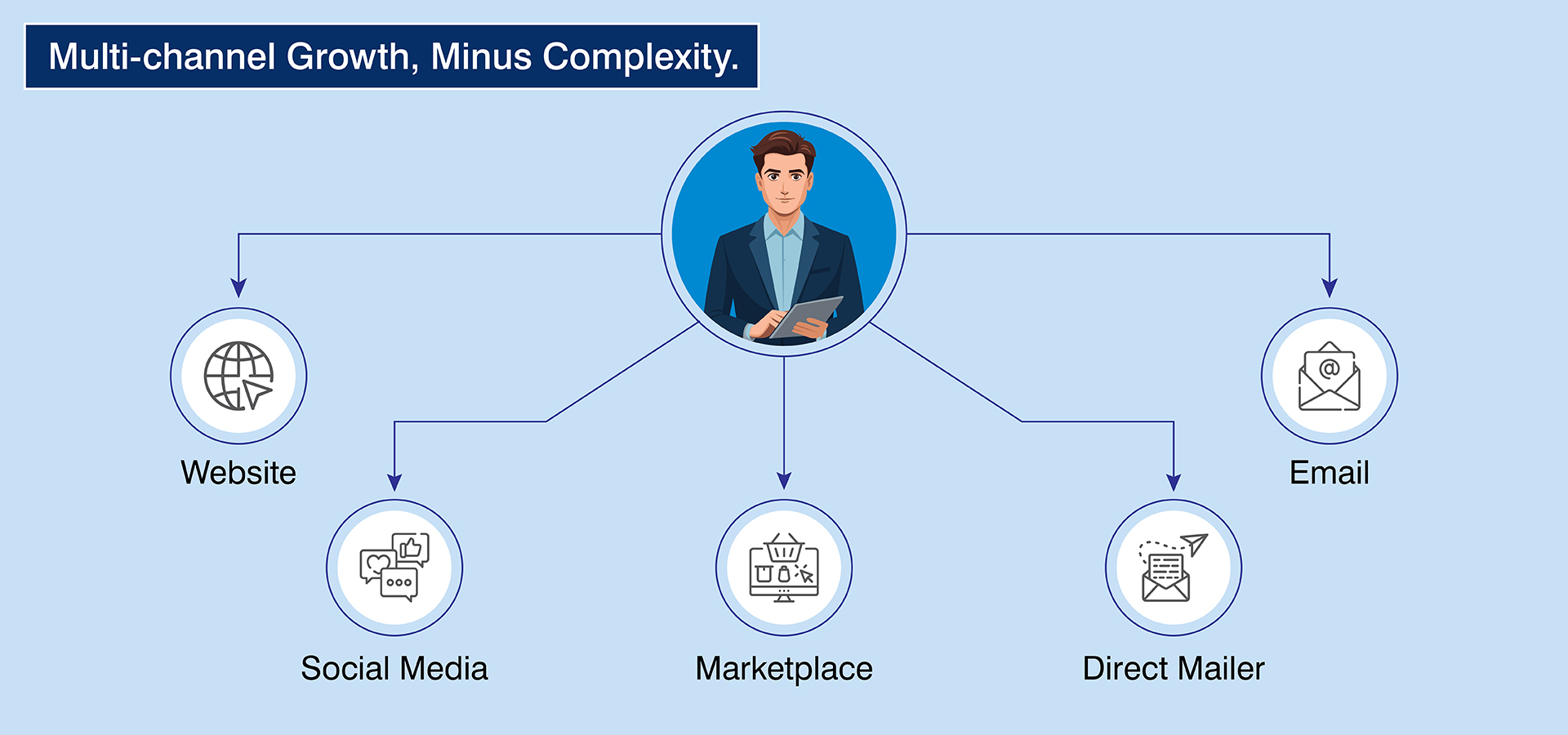 Today customers look for a seamless shopping experience across multiple selling channels be it mobile, website, marketplace, apps or even social platforms. Any inconsistency can put the buyers off your platform. So, to manage products across multiple platforms you must maintain consistency.
And that happens with the support of PDM where you add new products, attributes, new channels etc. without interrupting operations. It enables platforms to manage product data and distribute seamlessly across all channels. There is a master catalog through which the data is aligned and distributed in channel specific formats. Synchronization mechanisms ensure updates and content edits.
This helps reduce any operational cost, lowers complexities enabling quick expansion and broader reach.
Actionable product performance visibility
 Any team handling ecommerce centralised data system must have access to product performance report. They need clear insights to make informed decisions. They can’t be depending on assumptions, they need to know exactly what drives sales, the top performing products, the gaps and much more to drive sales.
Now this kind of reporting is not possible with fragmented and unreliable data. It is PDM that ensures that the product information is accurate, consistent and updated. It is structured data that allows accurate and clear reporting. PDM integrates seamlessly with BI tools and dashboards, enabling real-time visibility into catalog performance.
Clear insights help team make smart decisions driving growth and sales.
Long-term sales growth through data governance and continuity
Ecommerce optimization alone cannot sustain your platform because with the growth happening, the data can get unmanaged leading to errors and inconsistencies. You need to have strong data governance models with workflows, validation rules etc. This is established through strong PDM.
PDM ensures validation checks, constant monitoring, compliance checks and many other checks that ensures that even if the SKUs cross millions there will be no anomalies. Continuous synchronization also helps product stay aligned with suppliers, PIMs, ERPs and marketplaces.
Sustained data accuracy builds customer trust and enables sales growth.