The Importance of Professional Web Development for Business Growth
-

- September 13th, 2026
- 2,068 views

Web Development: Building a Strong Digital Presence for Modern Businesses
In the digital age, a website is more than an online identity. It can act as a communication channel, sales platform, customer service tool, and foundation for a business’s digital presence. A professionally developed website helps visitors find information easily while giving businesses a platform that can grow with changing customer and market requirements.
Web development involves creating, building, testing, deploying, and maintaining websites and web applications. It combines design, programming, databases, integrations, performance, and security to deliver a functional digital experience. The right development approach depends on the business objectives, target audience, functionality, and long-term plans.
Why Is Web Development Important?
A website should provide value to both the business and its users. Professional development helps ensure that the technical foundation supports usability, performance, and future expansion.
Key benefits include:
Better User Experience: A responsive layout, clear navigation, readable content, and intuitive functionality make it easier for visitors to explore a website and take desired actions.
Improved Performance: Optimized code, images, scripts, and server configurations can help pages load efficiently. Better performance can contribute to a smoother experience across different devices and network conditions.
Scalability: Business requirements can change over time. A well-planned website can accommodate new pages, products, integrations, features, and users without requiring a complete rebuild.
Security: Secure coding practices, software updates, access controls, backups, and monitoring can help protect websites and business information from common technical threats.
Search-Friendly Structure: Mobile responsiveness, website speed, logical navigation, and well-organized content provide a useful technical foundation for search engine optimization.
Different Types of Web Development
Web development can take many forms depending on what a business wants to achieve. Understanding these options helps organizations choose an appropriate solution.
Business Websites:
Business websites primarily provide information about a company, its services, products, team, and contact options. They can also support branding, lead generation, and customer communication.
eCommerce Websites:
eCommerce websites allow businesses to showcase products or services and manage online transactions. Features may include product catalogs, shopping carts, payments, order management, customer accounts, and integrations.
Custom Web Applications:
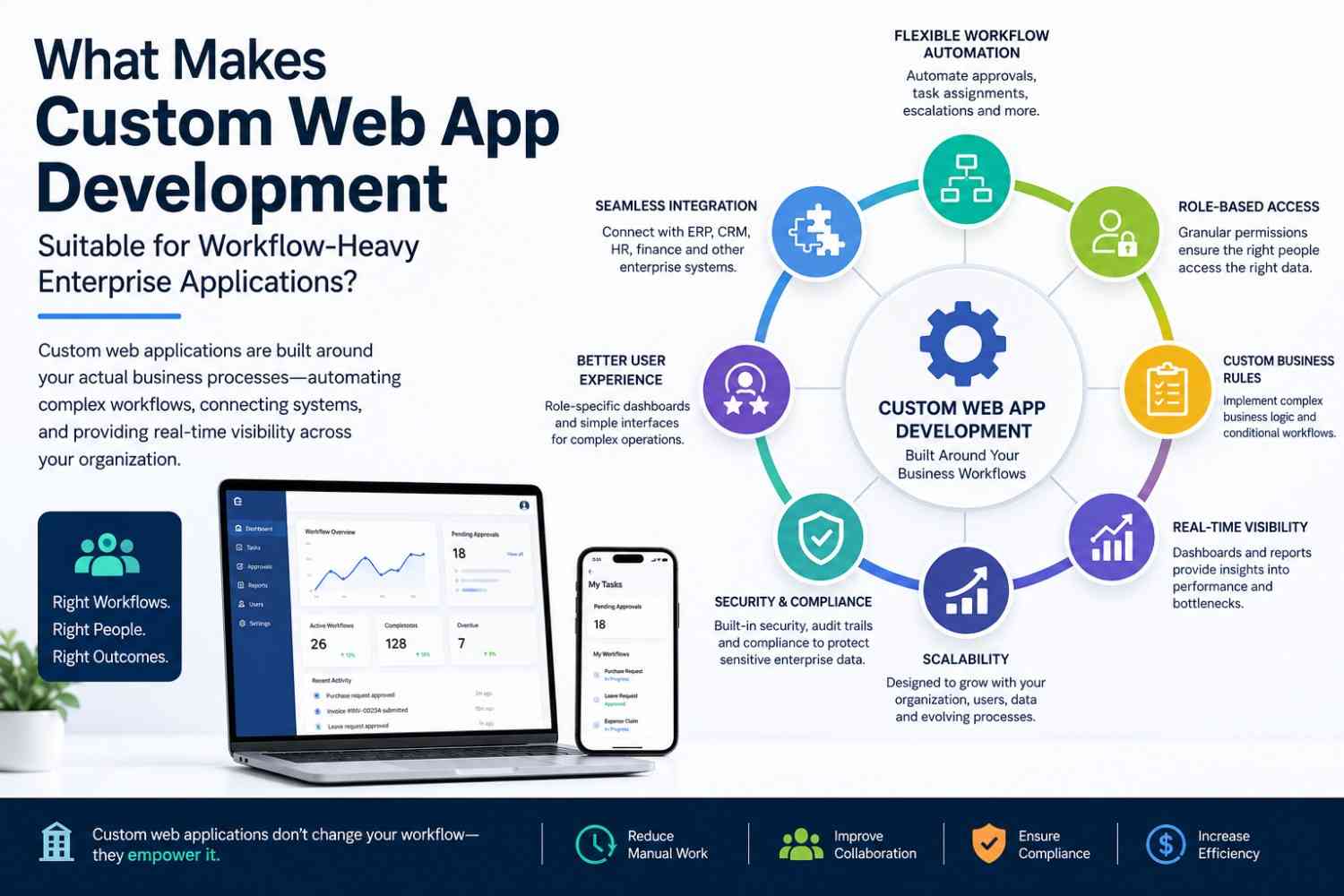
Custom applications are developed around specific business processes. Examples include dashboards, booking systems, marketplaces, portals, management platforms, and workflow applications.
Content Management Websites:
Content management systems allow businesses to publish and update content without requiring extensive technical knowledge. They are useful for blogs, corporate websites, publishing platforms, and information-driven websites.
Technologies Used in Modern Web Development
Different projects require different technologies. The choice should be based on functionality, scalability, performance, maintenance requirements, and budget.
Laravel: Suitable for customized web applications, APIs, integrations, eCommerce functionality, and business-specific solutions.
WordPress: Commonly used for business websites, blogs, content platforms, and customizable websites.
Shopify: Designed for businesses that want to build and manage online stores with eCommerce-focused functionality.
WooCommerce: Extends WordPress with eCommerce capabilities and can be customized for different online-store requirements.
MERN and MEAN Stack: Useful for dynamic, interactive, and scalable web applications.
Python: Can be used for web applications, APIs, automation, and projects that require data-oriented functionality.
Devex Hub currently lists Laravel, WooCommerce, MEAN, MERN, WordPress, Shopify, Python, and AI solutions among its web development capabilities.
The Web Development Process
A structured process helps convert an initial concept into a reliable website. While the exact workflow may vary, most professional projects include several important stages.
1. Strategy and Planning
The process begins with understanding business objectives, target customers, market requirements, website functionality, and technical expectations. Proper planning establishes priorities and helps create a clear development roadmap.
2. Product and UI/UX Design
Design focuses on creating an interface that is visually consistent and easy to use. Navigation, page structure, typography, colors, content placement, and user journeys are considered before development begins.
3. Development
Developers transform approved designs into a functional website or application. Front-end interfaces, back-end systems, databases, APIs, integrations, and other required features are developed according to project specifications.
4. Testing and Quality Assurance
Before launch, the website should be tested across relevant browsers, devices, and screen sizes. Functionality, forms, links, responsiveness, performance, and security-related elements should be reviewed to identify and resolve issues.
5. Launch and Maintenance
Once testing is complete, the website can be deployed. Maintenance may include software updates, backups, security checks, troubleshooting, performance optimization, and adding new functionality as business requirements evolve.
Devex Hub describes its development approach around strategy, product design, development, and quality assurance, with a focus on user-friendly, scalable, and high-performing solutions.
How to Choose the Right Web Development Partner
Selecting a development partner is an important decision. Businesses should evaluate the overall capabilities of a provider rather than focusing only on the initial project cost.
Consider the following:
Technical Expertise: Look for experience with the technologies and platforms required for your project. A good development team should also be able to explain why a particular technology is suitable.
Portfolio and Experience: Previous projects can provide insight into development quality, design standards, functionality, and experience with different industries.
Communication: Clear communication throughout planning, design, development, and testing helps keep expectations and project requirements aligned.
Support and Maintenance: Websites require updates and occasional improvements after launch. Ongoing support can help maintain performance, security, and reliability.
Businesses searching for the best web development company in India should compare providers based on technical expertise, portfolio, development methodology, communication, scalability, and post-launch support.
For companies looking for a local technology partner, researching the Best Web Development Company in Mohali can also be valuable. A reliable web development company in Mohali can provide accessible communication while developing solutions tailored to specific business requirements.
Similarly, a professional web development agency in Mohali can assist with different stages of a project, from planning and UI/UX design to development, testing, deployment, and maintenance.
Industries That Use Web Development
Web development is applicable across numerous industries and business models.
eCommerce: Websites can help businesses manage products, customers, payments, orders, and online sales.
Education: Learning platforms can provide courses, educational resources, assessments, and user accounts.
Healthcare: Digital platforms can support appointments, information sharing, and customer communication.
Real Estate: Property websites can display listings and help potential customers discover relevant properties.
Logistics: Web applications can support delivery management, tracking, and operational workflows.
Corporate Businesses: Professional websites can strengthen online visibility, communicate services, and generate business inquiries.
Conclusion
Web development provides the technical foundation for a modern digital presence. A successful website should be responsive, secure, easy to navigate, fast, scalable, and aligned with business goals.
Whether a company needs a business website, eCommerce store, content platform, or custom web application, the development process should begin with clear objectives and user requirements. Choosing suitable technology, following a structured development process, and investing in testing and maintenance can help create a website that remains useful as the business grows.
Professional web development is ultimately not just about putting a business online. It is about creating a dependable digital platform that can support customer engagement, business operations, marketing, and long-term growth.
For More Information Visit: https://devexhub.com/services/web-development