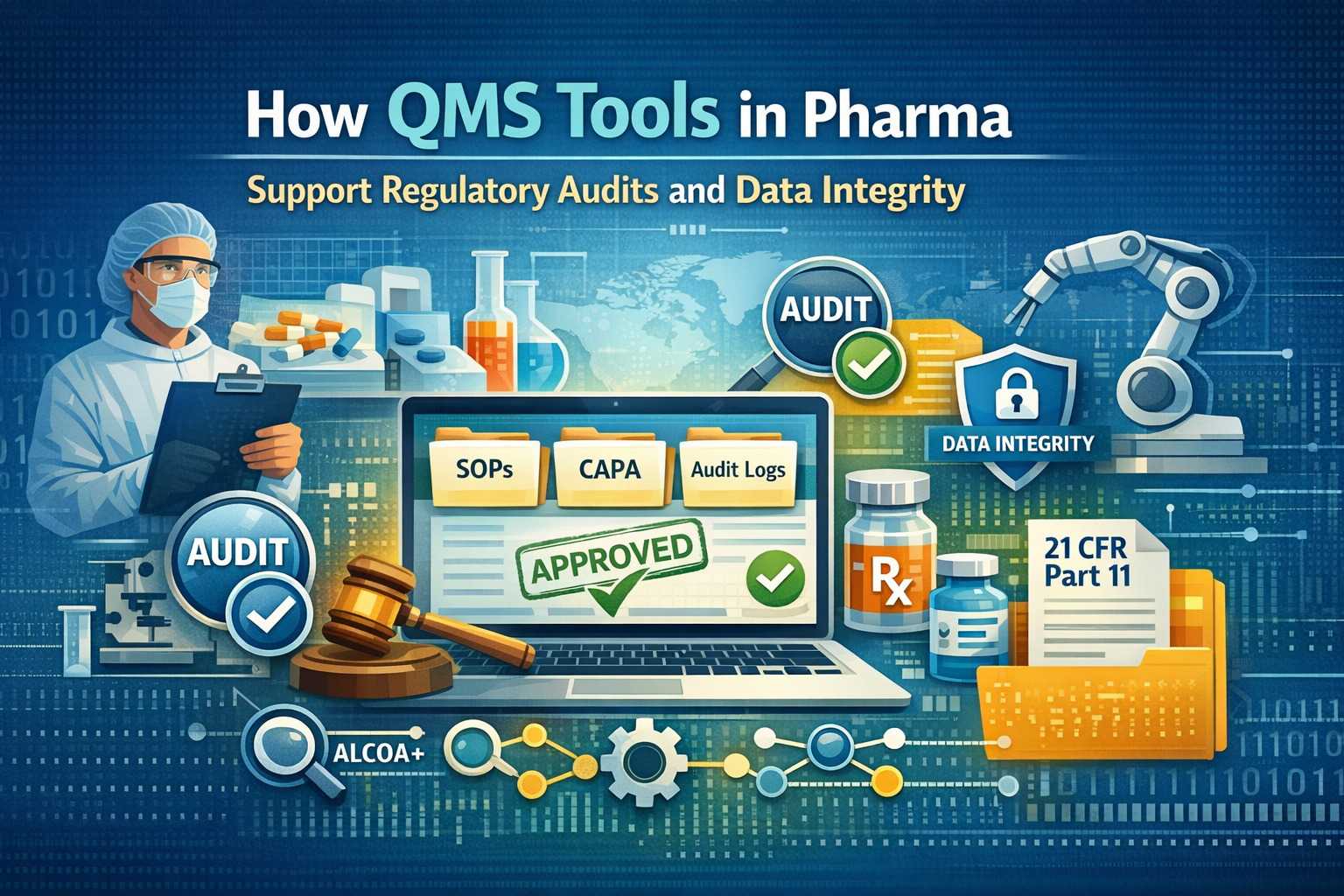
How QMS Tools in Pharma Support Regulatory Audits and Data Integrity
-

- March 24th, 2026
- 7,815 views
Overview
In pharmaceutical manufacturing, regulatory compliance and data integrity are closely linked. Authorities expect companies to demonstrate not only that processes are controlled, but also that all data supporting product quality is complete, traceable, and reliable.
Quality Management System (QMS) tools—particularly Enterprise Quality Management Software (EQMS)—play a central role in meeting these expectations. By integrating documentation, workflows, and quality processes, QMS tools enable organizations to maintain audit readiness while ensuring data integrity across the product lifecycle.
Core Capabilities of Pharma QMS Tools
Pharmaceutical QMS tools provide structured control over key quality processes, including:
Centralized document management (SOPs, batch records, audit reports)
Deviation and change management
CAPA management for corrective and preventive actions
Audit management and inspection tracking
Risk management and compliance oversight
Secure access, version control, and audit trails
When implemented through Enterprise Quality Management Software, these capabilities are interconnected, ensuring that quality data flows consistently across departments.
How QMS Tools Support Regulatory Audits
1. Centralized and Audit-Ready Documentation
Regulatory audits require quick access to accurate and complete records. QMS tools centralize:
SOPs and controlled documents
Deviation logs and CAPA recordsTraining records and audit histories
This centralized structure allows
organizations to present consistent, traceable evidence during inspections, reducing reliance on fragmented or paper-based systems.
2. Structured CAPA Management
Inspectors frequently evaluate how organizations handle non-conformances. CAPA management within an EQMS ensures:
Root cause analysis is documented
Corrective actions are assigned and tracked
Preventive measures are implemented
Effectiveness is verified before closure
This closed-loop approach demonstrates that quality issues are systematically addressed rather than repeatedly occurring.
3. Integrated Audit Management
Audit management tools help organizations maintain continuous inspection readiness by:
Scheduling internal audits
Standardizing audit checklists
Tracking findings and follow-up actions
Maintaining historical audit records
Digital audit workflows ensure that findings are linked to CAPA processes, creating a transparent and traceable compliance system.
4. Traceability and Accountability
Regulatory bodies expect clear evidence of who did what and when.
QMS tools provide:
Time-stamped audit trails
Role-based access controls
Version history for documents and records
These features allow companies to demonstrate accountability and procedural compliance during audits.
5. Alignment with Regulatory Standards
Pharmaceutical QMS tools are typically aligned with:
GMP and GxP requirements
International frameworks such as ISO 9001
Electronic record regulations such as FDA 21 CFR Part 11
This alignment ensures that organizations can demonstrate compliance across both domestic and global regulatory environments.
How QMS Tools Ensure Data Integrity
1. Enforcement of ALCOA+ Principles
Data integrity in pharma is often defined by ALCOA+ principles:
Attributable
Legible
Contemporaneous
Original
Accurate
QMS tools enforce these principles by ensuring that all records are properly captured, time-stamped, and attributable to specific users.
2. Secure Electronic Records and Audit Trails
Modern Enterprise Quality Management Software platforms provide:
Secure electronic records
Automated audit trails
Controlled electronic signatures
These features are essential for compliance with FDA 21 CFR Part 11, ensuring that data cannot be altered without detection.
3. Reduction of Manual Errors
Manual systems are prone to:
Data entry errors
Lost or incomplete records
Unauthorized changes
Digital QMS tools reduce these risks through:
Automated workflows
Controlled data entry fields
Restricted user permissions
This improves both accuracy and reliability of quality data.
4. End-to-End Traceability
QMS tools link data across the entire product lifecycle, including:
Raw material records
Manufacturing data
Testing results
Deviations and CAPA actions
Audit findings
This end-to-end traceability allows organizations to reconstruct events during investigations or regulatory audits.
Role of EQMS in Scaling Compliance
As pharmaceutical operations grow across multiple sites and geographies, maintaining consistent quality processes becomes more complex.
Enterprise Quality Management Software (EQMS) helps organizations:
Standardize workflows across locations
Maintain centralized visibility of quality metrics
Support real-time compliance monitoring
Enable collaboration across teams
Several vendors provide EQMS platforms used in pharmaceutical environments, including ETQ, QualityPro, MasterControl, Veeva, TrackWise, and QT9. These systems offer integrated modules for CAPA management, Audit management, document control, and regulatory compliance.
Advanced Capabilities: Digital and AI-Enabled QMS
Modern QMS tools increasingly incorporate advanced capabilities such as:
Automated workflows for faster audit preparation
Real-time dashboards for compliance monitoring
Analytics and trend detection to identify recurring issues
AI-driven insights to detect anomalies in process data
These features support a shift from reactive quality control to proactive risk management and continuous improvement.
Why This Matters in Pharma (Including India)
Pharmaceutical companies operate in highly regulated environments where:
Regulatory audits are frequent and detailed
Data integrity failures can lead to serious compliance actions
Global market access depends on consistent quality systems
For organizations in India and globally, implementing a robust QMS—supported by Enterprise Quality Management Software—helps:
Demonstrate compliance during inspections
Maintain reliable and traceable records
Reduce the risk of recalls or regulatory penalties
Support global regulatory alignment
Summary
QMS tools in pharmaceutical organizations provide a structured approach to managing quality, compliance, and data integrity.
They enable companies to:
Maintain centralized, audit-ready documentation
Manage deviations and CAPA management processes effectively
Conduct structured Audit management activities
Ensure data integrity through secure, traceable systems
Align with standards such as ISO 9001 and regulations like FDA 21 CFR Part 11
Final Perspective
In pharmaceutical manufacturing, regulatory compliance depends on both process control and data reliability. QMS tools—especially Enterprise Quality Management Software (EQMS)—bridge this gap by integrating quality processes with secure, traceable data systems.
By strengthening CAPA management, Audit management, and data integrity controls, these tools enable organizations to move from reactive compliance to continuous, inspection-ready quality governance.