How Gujarat's Rubamin Is Building India's Circular Supply Chain for Lithium, Cobalt and Nickel
-
- Published Updated
- 206 views
India's clean-energy ambitions run on lithium, cobalt and nickel, yet the country depends heavily on imports for these critical metals. One practical answer is urban mining: recovering these metals from end-of-life batteries, spent catalysts and industrial waste instead of mining them afresh. From Halol in Gujarat, Rubamin is turning that idea into an industrial-scale circular supply chain for critical metals, combining lithium-ion battery recycling, spent catalyst recycling and zinc recycling under one zero-waste platform.
Why India Needs a Circular Supply Chain for Lithium, Cobalt and Nickel
Electric vehicles, grid-scale storage, consumer electronics and defence systems all rely on battery-grade lithium, cobalt, nickel and manganese. Every battery that reaches end of life is also a stockpile of these metals. Without domestic battery recycling in India, that value is either lost to landfill or exported abroad as black mass.
Two forces are now pushing the sector forward:
• Regulation. India's Battery Waste Management Rules bring Extended Producer Responsibility (EPR) to battery producers, creating demand for certified, traceable recycling. Rubamin supports partners with EPR credit solutions.
• Supply security. Recovering metals domestically cuts import dependence and shortens the loop between battery makers and recyclers. Rubamin's leadership has argued publicly that India can become a lithium-ion battery recycling hub if black mass is refined at home rather than exported.
About Rubamin: Four Decades of Metal Recycling in Gujarat
Incorporated in 1987 and headquartered in Vadodara, Rubamin is a pioneer of hydrometallurgy and zero-waste recycling in India. The company treats more than 80,000 tonnes per year of recyclable and hazardous industrial waste and recovers over 90% of the elements in every business unit. Its operations are organised around three pillars: battery recycling, catalyst recycling and zinc recycling. Learn more on the Who We Are page.
- Lithium-ion battery recycling: 10,000 MT per year of shredding capacity and 7,500 MT per year of black mass processing. Metals recovered are lithium, cobalt, nickel, manganese, copper and graphite.
- Spent catalyst recycling: 35,000 MT per year of catalyst processing capacity. Metals recovered are molybdenum, vanadium, tungsten, nickel and cobalt.
- Zinc recycling (ZYNK®): 30,000+ TPA of zinc dross and ash processed, and 50,000 TPA of zinc compounds produced. Products include zinc oxide, zinc sulphate and other zinc compounds.
Lithium-Ion Battery Recycling in India: The Halol Facility
Rubamin's lithium-ion battery recycling plant in Halol, Gujarat was commissioned in Q1 2025 as part of a larger investment in circular recycling, announced at $63 million across lithium-ion batteries and spent catalysts. It is built to handle end-of-life EV and consumer batteries as well as gigafactory production scrap.
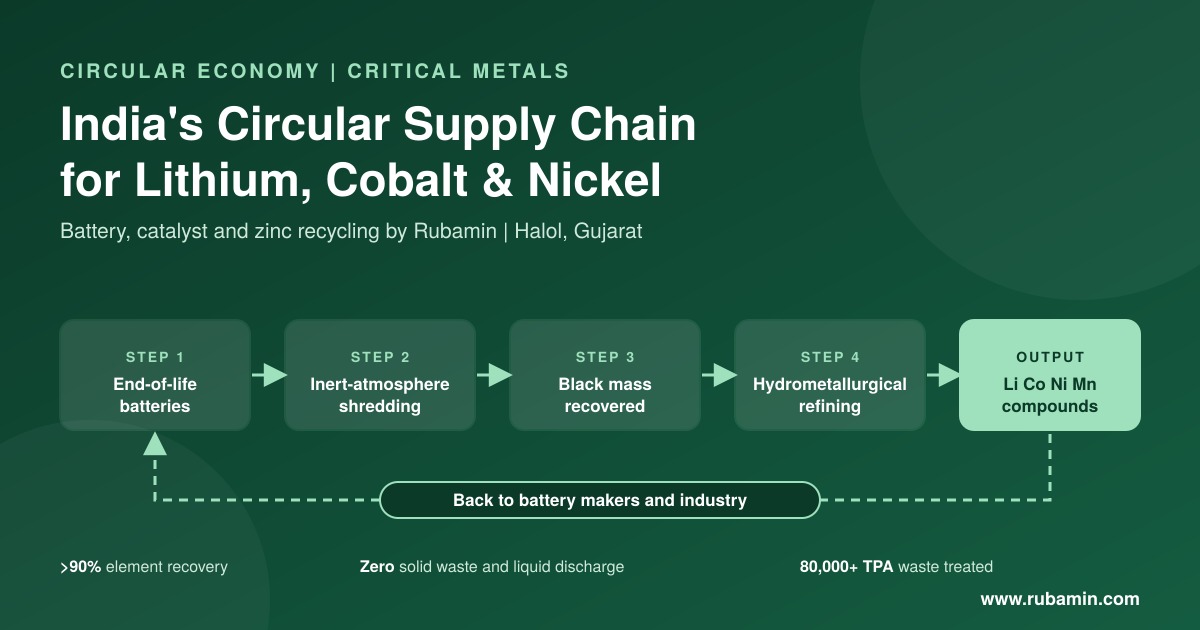
Step 1: Safe discharge, dismantling and inert shredding
Rubamin positions itself as a certified R4 recycler, covering collection, logistics, discharging, dismantling and shredding through to chemical refining. Shredding runs in an inert atmosphere to prevent thermal runaway, and electrolyte is condensed and collected rather than released, which helps protect worker health and the environment. The system is designed for cylindrical, pouch and prismatic cells.
Step 2: Black mass refining by hydrometallurgy
Black mass, the powder rich in cathode and anode materials, is Rubamin's real feedstock. Using solvent extraction and zero-waste hydrometallurgy, the company refines it into high-purity compounds of lithium, cobalt, nickel and manganese for industrial and technical applications. Read the explainer on what black mass is and why it must be recycled.
Step 3: Closing the loop
The output is not waste but a feedstock for cell makers, catalyst producers and industry. The battery plant is designed for zero solid waste and zero liquid discharge, and is monitored through a cloud-based, AI/ML-enabled control system, which Rubamin describes as Industry 4.0 automation in hydrometallurgy. See the battery recycling products for details.
Beyond Batteries: Spent Catalyst and Zinc Recycling
What makes Rubamin's circular model unusual is that the same hydrometallurgical know-how runs across waste streams.
Spent catalyst recycling: molybdenum, vanadium, tungsten, nickel and cobalt
Since 2011, Rubamin has been recycling spent refinery catalysts. A patented fluidized bed roasting technology neutralises the hazardous nature of the catalyst, then proprietary hydrometallurgy separates pure metal compounds, such as molybdenum and vanadium, that go back to catalyst manufacturers. Stricter marine-fuel sulphur limits have increased residue catalyst volumes, and Rubamin has added capacity to reclaim vanadium and molybdenum from them. Browse the catalyst recycling products.
Zinc recycling: ZYNK® compounds from dross and ash
Rubamin's zinc recycling business converts galvanizing dross and ash into zinc compounds for tyres, pharmaceuticals, animal nutrition, agriculture and more. It combines the French, chemical and calcination processes, and its French Process unit at Halol is described as India's only WHO-GMP certified facility of its kind. Explore the ZYNK® product range.
Sustainability at the Core: The "Power of Zero"
Recycling only counts as circular if the process itself is clean. Rubamin works towards zero waste, zero liquid discharge and zero fossil energy:
• Wind and solar integration (6.6 MW wind and 6.7 MW solar) and a 5-acre rainwater-harvesting lake with floating solar.
• Zero landfill waste and zero water discharge in hazardous waste recycling.
• Safety systems from DSS+ (formerly DuPont Sustainable Solutions) and ISO 9001, 14001, 27001, 45001 and 50001 certifications.
• Independent sustainability reporting, with CDP and EcoVadis participation.
Read the full approach on the sustainability page, and see how the company frames the national opportunity in Bridging India's critical metals gap through urban mining.
What This Means for India's Critical Minerals Future
A circular supply chain does three things for India. It reduces import dependence for battery metals, it keeps hazardous waste out of landfill, and it gives battery producers a compliant route to meet EPR obligations. By refining black mass domestically instead of exporting it, and by pairing battery recycling with catalyst and zinc recycling, Rubamin is building the processing depth that a growing EV and energy-storage market needs.
Looking for a battery, catalyst or zinc recycling partner in India? Talk to Rubamin about EPR-compliant lithium-ion battery recycling, spent catalyst recycling or zinc recycling. Contact us or write to [email protected].