What Is ShieldFont? The Open-Source Anti-AI Scraping Font
-

- Published Updated
- 3,895 views
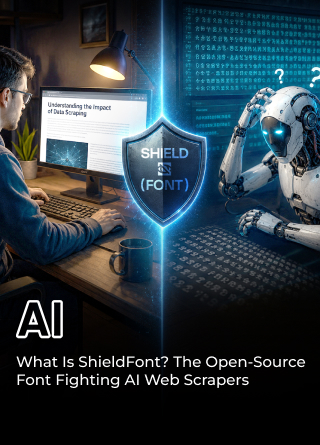
Artificial intelligence has transformed the internet into one of the world's largest sources of training data. Every day, automated web scrapers collect enormous amounts of online content that is later used to train large language models, power AI search engines, and build intelligent applications. While many publishers welcome this exposure, others are increasingly concerned that their original work is being copied, indexed, and repurposed without permission or compensation. As debates around copyright, licensing, and AI training data intensify, developers are searching for new ways to protect digital content. One of the most innovative ideas to emerge is ShieldFont, an experimental anti-AI scraping system that tackles the problem from a completely different perspective. Instead of blocking bots or restricting access to webpages, ShieldFont aims to reduce the value of scraped content by ensuring humans and automated systems interpret the same webpage differently.
How ShieldFont Changes the Way AI Scrapers Read Web Content
Unlike traditional anti-scraping technologies, ShieldFont does not attempt to identify or block bots. Conventional solutions such as robots.txt files, CAPTCHAs, authentication systems, IP blocking, and web application firewalls focus on restricting access or discouraging automated traffic. However, these methods rely heavily on scrapers respecting published rules or being successfully detected. Sophisticated crawlers can often bypass these defenses, making complete protection difficult. ShieldFont assumes that scraping will still occur but changes what scrapers actually collect. Instead of preventing access, it modifies the machine-readable version of webpage content while preserving the intended reading experience for human visitors. This unique strategy makes large-scale scraping more expensive and less useful without affecting how readers experience the website.
To understand how ShieldFont works, imagine publishing a sentence such as "The knight rode his horse into battle." Human visitors would see exactly that sentence on the webpage. However, a basic scraper extracting the underlying HTML might instead collect something like "The knight rode his engine into battle." The sentence remains grammatically correct, but its meaning has changed significantly. This difference is intentional. ShieldFont accomplishes this using advanced OpenType font substitution features that replace selected words in the underlying text while visually reconstructing the author's intended words when the page is rendered inside a browser. The result is that readers continue seeing the correct article while automated scraping tools collect altered content that is less valuable for AI training or large-scale text analysis.
Why ShieldFont Isn't a Complete Solution Against AI Scraping
The technology builds upon typography features that have existed for years. OpenType fonts already support ligatures, alternate characters, and contextual substitutions that improve the visual appearance of text. ShieldFont extends these capabilities beyond individual letters by mapping complete words to different visual representations. Before the webpage reaches a visitor, selected words are replaced with carefully chosen alternatives. When the browser loads the custom font, OpenType substitution rules transform those altered words back into the intended version that readers see. Because this reconstruction happens during rendering, the visible page looks perfectly normal despite the underlying HTML containing different text.
Importantly, ShieldFont does not randomly scramble every word on a webpage. Instead, it targets words that carry the greatest semantic meaning, including nouns, verbs, adjectives, and adverbs. Function words such as articles, conjunctions, and prepositions are often left untouched because changing them would reduce readability without significantly affecting meaning. The project's documentation indicates that nearly half of meaningful content words can be substituted while maintaining natural-looking sentences. The developers also avoid simple synonym or antonym replacements because predictable substitutions would either preserve too much meaning or become easier for advanced scrapers to reverse.
The encoding process itself is another important aspect of ShieldFont's design. Rather than modifying text inside browser-side JavaScript, developers recommend performing the substitutions during server-side rendering or the website build process. This prevents the original plaintext from ever reaching the browser, making it harder for basic scraping systems to recover the intended content simply by examining page source or client-side scripts. Only the encoded version is delivered to visitors, while the custom font reconstructs the visible text during rendering.
Much of the discussion surrounding ShieldFont focuses on its potential impact on AI training datasets. Some describe it as a tool capable of "poisoning" AI models, but this claim should be understood carefully. The project's published testing demonstrates that many substituted passages no longer express the same factual meaning as the originals. News articles, general web content, and fictional passages frequently become semantically different after ShieldFont encoding. This suggests that AI systems trained on scraped data from protected websites could receive information that is less reliable or internally inconsistent. However, the developers themselves acknowledge that they have not yet demonstrated measurable performance degradation in large commercial AI models. At present, ShieldFont is better understood as a method of reducing the quality of scraped data rather than a proven AI poisoning technique.
Instead of promising perfect protection, ShieldFont focuses on changing the economics of web scraping. Downloading raw HTML from millions of webpages is extremely inexpensive. Rendering every webpage inside a browser, loading custom fonts, capturing screenshots, running OCR software, or using AI vision models requires considerably more computing power, storage, and processing time. By forcing scrapers to perform these additional steps, ShieldFont increases the overall cost of collecting content at scale. Even if determined organizations eventually recover the original text, doing so becomes significantly less efficient than conventional scraping.
Despite its innovative design, ShieldFont has several limitations that publishers should understand before adopting it. One of the most significant is that advanced scrapers can potentially reverse-engineer the font itself. Since browsers must download the font to display the intended text, technically sophisticated attackers can inspect the font file and analyze its substitution rules. During internal testing, the project's developers successfully reconstructed thousands of mapping pairs from one of their own font releases. Publishers can create custom mappings unique to individual deployments, but these do not provide cryptographic security against determined reverse engineering.
Another limitation involves browser rendering. Modern scraping platforms increasingly rely on headless browsers capable of rendering webpages almost exactly as human browsers do. If a scraper loads the page, downloads the custom font, and extracts rendered text instead of raw HTML, it may recover the original content without difficulty. Similarly, attackers can capture screenshots of webpages and process them using OCR software or AI-powered computer vision models. Since these techniques analyze the visible page rather than the encoded HTML, they largely bypass ShieldFont's intended protection.
Search engine optimization represents one of ShieldFont's biggest practical trade-offs. Search engines rely heavily on machine-readable webpage content to understand, index, and rank websites. If search crawlers index the substituted version instead of the visible version, websites may rank for incorrect keywords or lose visibility altogether. For publishers that depend heavily on organic search traffic, this can become a significant disadvantage. Consequently, the developers recommend selective deployment. Rather than protecting an entire website, publishers may choose to shield premium archives, research articles, opinion pieces, or exclusive content while leaving homepage content, titles, summaries, and important landing pages fully readable by search engines.
Accessibility is another important concern. Screen readers generally rely on machine-readable webpage content rather than visual font rendering. Without additional accessibility measures, visually impaired users could hear the substituted words instead of the author's intended writing. Although ShieldFont includes mechanisms that attempt to improve accessibility in certain implementations, the project acknowledges that its current solution does not fully satisfy WCAG accessibility standards. Organizations with legal accessibility obligations should therefore carefully evaluate whether ShieldFont is appropriate for their websites.
Several additional usability challenges also deserve attention. Copying and pasting protected text may return the substituted words instead of the displayed version, making quotations inaccurate. Machine translation services may translate the altered text rather than the intended content, resulting in confusing or incorrect translations. Browser features such as Find-in-Page, Reader Mode, and other tools that depend on machine-readable text may become unreliable inside protected sections. Publishers must also consider content distributed through RSS feeds, APIs, structured metadata, Open Graph tags, JSON-LD, and content management systems, since these channels may still expose the original plaintext even if the webpage itself is protected.
Language support remains another limitation. The current version of ShieldFont focuses primarily on English, and expanding support to additional languages requires carefully designed language-specific mappings. Since every language has different grammatical structures, vocabulary, and semantic relationships, creating effective substitutions requires extensive linguistic work rather than simple translation.
Given these trade-offs, ShieldFont is unlikely to become a universal solution for every website. Instead, it is best suited for situations where protecting original intellectual property is more valuable than maximizing discoverability or accessibility. Independent journalists, authors, researchers, publishers of premium content, essayists, literary writers, and organizations distributing exclusive documents may benefit from selectively deploying the technology. On the other hand, government information, educational resources, public services, customer support documentation, and SEO-focused marketing pages are generally poor candidates because search visibility, accessibility, and usability remain higher priorities.
Ultimately, ShieldFont represents a fascinating shift in anti-scraping strategy. Rather than trying to completely block AI crawlers, it introduces friction into the scraping process by exploiting the difference between machine-readable text and human-readable typography. While advanced scraping systems equipped with browser rendering, OCR, computer vision, or custom font decoding can still recover the intended content, doing so requires significantly greater computational effort. That increased cost is the project's primary objective. As AI companies continue collecting vast quantities of online content, technologies like ShieldFont demonstrate that future anti-scraping defenses may focus less on preventing access entirely and more on making unauthorized large-scale data collection increasingly expensive, uncertain, and difficult.