Spend Categorization Best Practices for Better Procurement Visibility
-

- Published Updated
- 2,875 views
Overview
Organizations spend their budget on various goods, services, suppliers, and departments. Without structured procurement data, it is difficult to understand where the budget is being spent.
Spend analysis best practices help organizations structure and analyze their procurement data to identify spending patterns and improvement areas. Spend classification efficiency will increase visibility into procurement expenses. Using a good spend analysis solution will allow an organization to optimize costs, manage suppliers efficiently, and make good procurement decisions.
Overview of Spend Categorization
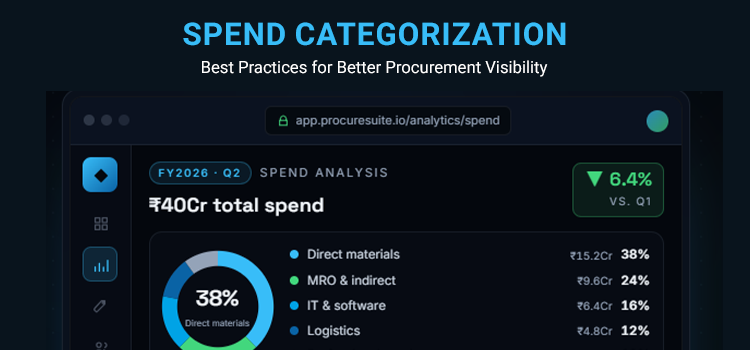
Spend categorization is the classification of an organization’s spending into predefined spend categories depending on the goods or services being acquired.
Purchases can be classified into categories like -
Information Technology
Marketing Services
Office Supplies
Transportation & Logistics
Raw Materials
Maintenance & Repair services
Professional Services
The objective of spend categorization is to establish a framework for analyzing spending.
Without proper categorization of expenses, the same purchase types will be classified in different categories by different departments. In other words, one department may classify a purchase of software under IT tools, while another will classify it under software subscriptions. Thus, it becomes quite difficult for an organization to find out its overall spending on software.
Efficient classification helps group similar purchases together.
Why Spend Categorization is Important for Businesses
Accurate procurement spend analysis largely relies on the quality and structure of data. The spend data analysis can give unreliable results when the underlying data is not consistent and categorized properly.
Proper spend classification enables businesses to find the following information:
What are we spending the most money on?
Which suppliers get the largest share of the expenses?
Are various departments buying similar items from various suppliers?
Where can we reduce spending?
What are the categories that provide the best savings?
Are the purchases made according to procurement policies?
With this information, companies can shift from reactive purchase practices to procurement management.
Start With Clean and Accurate Spend Data
The first step for efficient spend analysis is to enhance data quality. Procurement data is collected from various resources that include
ERP system
Accounting system
Ordering system
Invoices
Supplier database
This data may contain errors, redundancy, missing fields, and inconsistent supplier names.
For example, the same supplier may appear as -
ABC Technologies
ABC Tech
A.B.C. Technologies
If these records are not standardized, the organization may incorrectly treat them as three separate suppliers.
Before classifying the spending, companies need to ensure that their data is clean. It is achieved by eliminating duplicate records, eliminating errors, standardizing supplier names, and completing any missing data.
Having clean data ensures a good foundation for procurement spend analysis.
Create a Clear and Consistent Category Structure
The classification scheme should be clear to be informative.
The broad classification, such as "Technology" can provide limited information. It can be subdivided into the following sub-categories:
Software
Hardware
Cloud Services
Cybersecurity
IT Consulting
Creating too many categories will make the spending analysis more complex.
The best strategy is to create an understandable hierarchy that suits the procurement needs of the organization. At the same time, it is essential to define categories to classify similar purchases in a consistent way.
The well-organized categorization improves the reliability of reporting and facilitates the comparison of expenditures.
Standardize Supplier Information
Supplier information is important when conducting spend analysis. Inconsistency in supplier names makes it difficult to see how much spending is going towards a particular supplier.
Having consistent supplier information makes it easier for the procurement team to aggregate all the transactions of the same supplier.
It becomes easier to evaluate the supplier relationships and enables supplier consolidation. For instance, if the departments are buying similar commodities from different suppliers, it might be possible to get better prices by consolidating the spending.
Standardizing supplier information is crucial when enhancing procurement spend visibility.
Use Both Automated and Manual Classification
The manual classification may take time, especially when there are thousands or even millions of recorded transactions.
A spend analysis solution enables automation to classify spending faster. It identifies patterns, matches supplier information, and classifies the spend.
Team members must not rely on automation completely for classification.
Transactions with incomplete descriptions require additional context for accurate categorization. Procurement professionals can access these data and refine the classification criteria.
Automated and manual methods combined can increase spend data categorization accuracy.
Establish Clear Spend Classification Rules
The company should have rules and policies defining how the purchases should be classified.
For instance, the procurement team can determine how a subscription to software should be classified according to -
Software type
Department using it
Its business purpose
The supplier who is providing this software should
The approach should match the overall organizational procurement goals.
Clear rules also make it easier to onboard new procurement team members and maintain consistency as the business grows.
Without clearly defined standards, different teams may classify the same transaction differently. It reduces the value of the analysis.
Review and Update Categories Regularly
The same categories cannot suit business requirements all the time.
The business needs, supplier markets, technology, and buying behavior can change over time. A structure that worked years ago may no longer work for the current scenario.
For instance, cloud computing can be included in the IT budget. If cloud computing costs increase, having separate categories can give better insights into those costs.
Organizations should periodically review spend categories and make any necessary adjustments when required.
It ensures the latest spending pattern visibility in spend analysis.
Analyze Spend Across Multiple Dimensions
Categorization becomes even more valuable for organizations when they can analyze data from various perspectives.
Instead of looking at the overall expenditure on each category, procurement personnel can analyze spending based on:
Supplier
Department
Business unit
Geographical location
Contracts
Period of time
This provides more information about the purchasing patterns.
For instance, an organization may find out that the overall amount spent on office supplies is reasonable. But analyzing department-wise spending, they can realize that a particular business unit spends much more than the rest.
Connect Spend Analysis With Procurement Strategy
The objective of spend analysis is not just report generation. These insights must help make procurement decisions.
The spending classification can help procurement teams with strategic sourcing and other activities.
For instance, spending analysis can show that several departments have been buying the same service from various suppliers. In this case, procurement can leverage this information for negotiations.
This is where the spend analysis solution brings in great benefit. It can turn procurement data into useful information.
Monitor Spend Continuously
Spend visibility should never be considered a one-time project.
New suppliers, products, services, and buying patterns continuously keep coming into the organization.
Continuous analysis would help identify:
Unexpected spend increases
Off-contract purchasing
Duplicate suppliers
Category changes
New buying patterns
Continuous monitoring will ensure that procurement professionals are always updated on their organizational spend.
Common Challenges in Spend Analysis Best Practices
Although the benefits are clear, spending categorization can be challenging.
The problems include
Poor quality data
Inconsistent vendor names
Missing purchase information
Decentralized procurement systems
Changing needs of categories
If these problems remain unresolved, it can negatively impact the spend analysis accuracy in procurement.
Companies can solve this problem by creating standardized data, automating processes, and performing regular spend analysis.
Conclusion
Effective spend classification converts scattered procurement data into valuable insights. With the help of accurate data, classification, and periodic spend analysis, companies can discover cost-saving opportunities.
A good spend analysis solution provides detailed insights, assisting procurement personnel in making better sourcing, supplier, and cost management decisions.