Your Website Can Rank #1 and Still Be Completely Invisible
-

- Published Updated
- 2,170 views
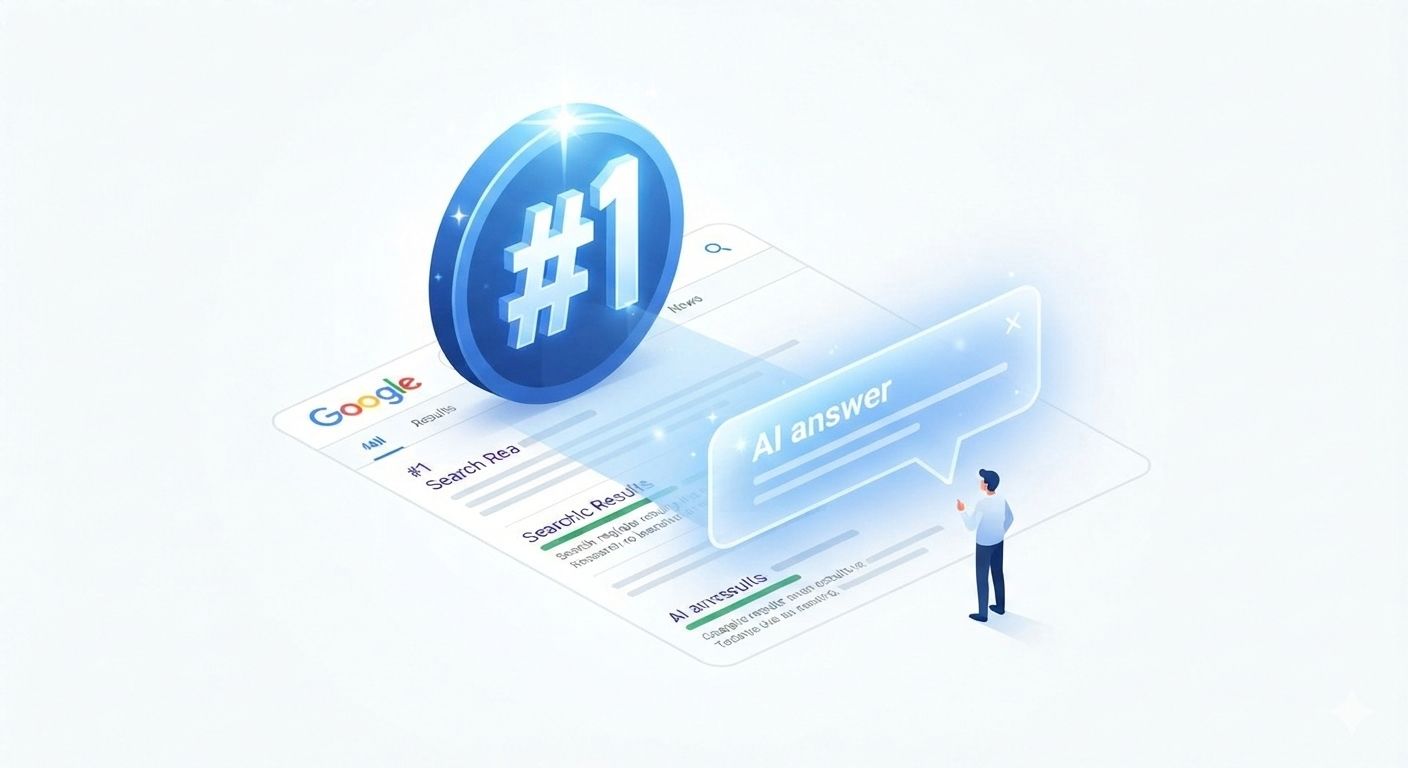
Imagine spending months tweaking your technical SEO, writing deeply helpful articles, securing authority backlinks, and finally hitting that glorious number-one spot on Google. You pop a bottle of champagne to celebrate your hard-earned traffic boost.
Then you look at your Google Analytics dashboard. Your traffic hasn’t budged.
How on earth is that possible?
It's possible because ranking and being found are no longer the same thing in search engine optimization.
The way we search is going through a massive structural shift. People aren't just typing short, robotic keyword fragments into search bars anymore. Instead, they are asking complete questions to AI assistants, using conversational search, and getting instant answers through features like Google AI Overviews right on the search engine results page (SERP). The modern reality is simple: if users get exactly what they need without ever clicking a link, a traditional number-one organic ranking loses its value.
——————————————————————————————
Why is a Number-One Ranking No Longer Enough for SEO Traffic?
A number-one organic ranking no longer guarantees website traffic because Google's AI Overviews and rich search features answer user queries directly on the SERP, resulting in a zero-click search. While your page might technically win the top organic spot, the user often leaves the page without ever scrolling down to click your link.
Traditional SEO strategies have long relied on a predictable, linear visibility pipeline:
1. 1. Target high-volume keywords.
2. 2. Rank higher on the first page.
3. 3. Earn more impressions and organic click-through rates (CTR).
4. 4. Convert those site visits into warm leads or digital sales.
|
[Old SEO Strategy] Rank #1 ──> High CTR ──> Maximum Website Traffic |
|
[Modern AI Strategy] Rank #1 ──> Zero-Click ──> AI Extracting Your Content |
While that classic logic isn’t entirely dead, it is no longer the complete picture. Google’s own machine learning rollouts are explicitly designed to summarize information at lightning speed. While these AI systems do link back to source materials, the actual click volume your site receives now heavily depends on whether a user needs to conduct a deeper search or if the summary fully solved their problem.
How Does AI-Powered Search Change User Search Intent?
AI-powered search changes user search intent by shifting the user experience from a discovery model (browsing a list of links) to a retrieval model (receiving a single synthesized answer). Instead of making the user read multiple websites to form a conclusion, the AI engine processes the top web sources and delivers the final answer directly to them.
Consider how traditional search engines used to work. If someone searched for a complex topic like “What should a small business consider before choosing an SEO agency?” they would receive ten blue links. They would open three different tabs, compare the information, and decide which agency to trust.
Today, an AI search tool immediately serves up a modular, bulleted list covering industry experience, technical expertise, transparent reporting, and pricing models. If your content ranks number one organically for those target keywords but is completely bypassed as an LLM reference source, you become effectively invisible to that searcher. This creates a distinct, modern digital marketing challenge: the gap between standard search engine visibility and AI answer visibility.
Why Do AI Overviews Ignore Some High-Ranking Websites?
AI Overviews ignore high-ranking websites when the content lacks original data, uses formatting that is difficult for web crawlers to parse, or lacks strong contextual brand mentions across the web. AI systems do not rank pages based on traditional search algorithms alone; they prioritize text that is highly optimized for Retrieval-Augmented Generation (RAG).
If your content has high search visibility but fails to show up in conversational search results, it usually boils down to four main structural optimization issues:
· Your Content is "Commodity Content": The internet is flooded with blogs that simply repeat the same generic information found across hundreds of other sites. Google's helpful content systems bypass unoriginal content updates in favor of articles that bring unique insights, first-hand case studies, or proprietary data to the table.
· You are Burying the Lede: Users expect direct answers. If your blog post uses five paragraphs of introductory fluff to set up a point, AI models will skip your page. You must adopt the inverted pyramid writing style—state your clear definition in the opening sentences of a section, then expand on the technical details below.
· Your Digital Brand Signals are Too Weak: Search systems evaluate entity authority by looking at the bigger picture. If your brand is consistently discussed in independent industry publications, forums, external reviews, and digital PR campaigns, it builds the contextual authority needed to be cited as a trusted source.
· The On-Page Structure Lacks Semantic XML Clarity: Brilliant content fails if its technical architecture is confusing. If search crawlers struggle to map out your heading hierarchy (H2s and H3s), parse your internal links, or read your image alt text, they cannot successfully extract your data for AI responses.
What Metrics Track True Search Visibility?
|
Traditional SEO Metrics |
Generative AI Visibility Metrics |
|
• Keyword Rankings |
• AI Overview Citations |
|
• Organic Impressions |
• Conversational Search Mentions |
|
• Standard Click-Through Rates |
• Branded Search Volume Growth |
|
• Domain Authority / PageRank |
• Unlinked Brand Mentions |
While traditional analytics benchmarks are still necessary to track baseline performance, they don't tell the whole story. To understand your true reach, your team must monitor the new paradigm of search behavior: Are your pages actively named in AI-generated overviews? Are your URLs embedded as deep links in conversational responses? Are competitors being recommended over you for long-tail queries?
Because AI results change dynamically based on user location, query phrasing, and temporal context, tracking your presence requires checking a consistent, saved set of real-world prompts over time rather than relying on a single snapshot.
Actionable SEO Checklist: How to Optimize Content for AI Search Engine Formats
To ensure your digital content ranks high on Google and gets successfully extracted by generative AI search features, apply these actionable adjustments to your content workflow:
1. Structure Articles with Answer-First Paragraphs
· Format your subheadings as actual long-tail user questions (e.g., use “How do you optimize for AI search?” instead of “AI Optimization Tips”).
· Provide a direct, standalone answer in the first 50–70 words immediately beneath that header before diving into detailed explanations.
2. Produce Non-Commodity, High-EEAT Content
· Ground your blog posts in real-world experience, original experiments, and unique team insights that an LLM cannot easily guess or replicate.
· Include clear tables, bulleted step-by-step procedures, and direct data comparisons to make your page highly machine-readable.
3. Build a Multi-Platform Brand Footprint
· Expand your digital marketing beyond your own domain by pursuing high-quality digital PR, guest expert features, and community engagement.
· Monitor your branded search volume in Google Search Console, as strong brand search intent directly correlates with increased AI mentions.
4. Maintain Flawless Technical On-Page SEO
· Keep your heading tags (H1, H2, H3) logically nested and ensure your internal linking structure connects your posts into clear topical authority clusters.
· Optimize page load speed, ensure intuitive mobile responsiveness, and keep decorative site elements from blocking your core content blocks.
FAQ: Optimizing for Modern Search Engine Systems
How often does Google update its helpful content ranking algorithms?
Google's helpful content quality evaluation is integrated directly into its real-time Core Ranking System. It acts as a continuous, automated site-wide signal rather than a periodic or occasional algorithm shake-up.
Do you need an llms.txt file to rank well in Google AI Overviews?
No, you do not need to create specialized text files like an llms.txt file or rely on algorithmic hacks to appear in AI Overviews. Google’s official search documentation confirms that standard, foundational SEO best practices coupled with high-quality, people-first content remain the best path to visibility.
Will traditional organic links disappear from search results completely?
No, traditional organic search results are not going away. Instead, they are co-existing with generative summaries. The future belongs to discoverable brands that optimize for both systems, ensuring that whether a user prefers clicking a classic link or reading an AI-generated answer, your brand is the source they encounter.