5D BIM Cost Estimation
-

- Published Updated
- 6,409 views
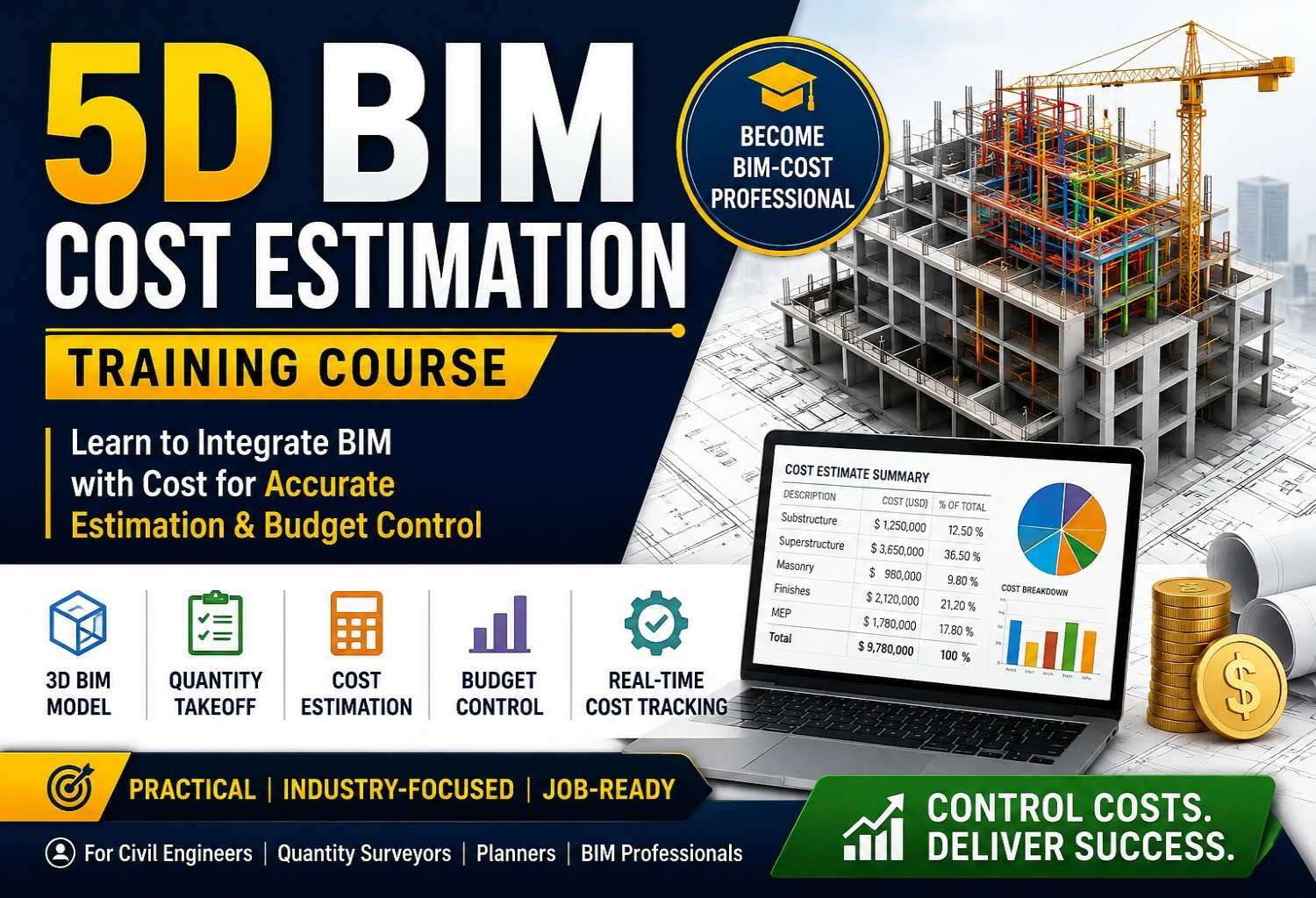
5D BIM Cost Estimation Training
The 5D BIM Cost Estimation Training at AEODC is designed for BIM students, fresh graduates, civil engineers, quantity surveyors, estimators, project coordinators, and construction professionals who want to develop practical skills in BIM-based quantity takeoff and construction cost estimation. This comprehensive training program introduces the fifth dimension of Building Information Modeling (BIM), where project cost data is integrated with intelligent 3D models to support accurate budgeting, estimation, and financial planning throughout the construction lifecycle.
As the Architecture, Engineering, and Construction (AEC) industry increasingly adopts digital technologies, the demand for professionals who understand BIM-enabled cost management continues to grow. Traditional estimation methods often involve manual measurements, spreadsheets, and repetitive calculations that can consume significant time and lead to inconsistencies. Through this course, learners gain an understanding of how BIM tools can streamline quantity extraction, improve estimation accuracy, and support data-driven project decisions.
The training begins with the fundamentals of quantity takeoff and cost estimation before progressing into practical workflows using industry-standard tools such as Autodesk Revit, Autodesk Navisworks, and Microsoft Excel. Participants learn how to extract quantities directly from BIM models, organize project data, prepare Bills of Quantities (BOQs), and create structured cost estimates used in real-world construction projects.
Understanding 5D BIM
5D BIM refers to the integration of cost information with a BIM model. While 3D BIM focuses on geometry and visualization, and 4D BIM introduces project scheduling, 5D BIM incorporates cost data to enable accurate project budgeting and financial tracking.
By linking quantities extracted from BIM models with pricing information, project teams can quickly generate estimates and evaluate the cost implications of design changes. This approach improves transparency, reduces manual effort, and provides stakeholders with better visibility into project costs from the early design stage through construction.
Professionals equipped with 5D BIM skills are increasingly valued because they can bridge the gap between design information and project financial management, helping organizations improve efficiency and cost control.
What You Will Learn
The course is structured to provide both theoretical understanding and practical experience in BIM-based quantity takeoff and cost estimation.
Key learning areas include:
Introduction to BIM and 5D BIM concepts
Understanding quantity takeoff workflows
Difference between traditional and BIM-based estimation methods
Extraction of quantities from BIM models using Revit schedules
Quantity takeoff for architectural elements
Quantity takeoff for structural components
Quantity extraction for MEP systems
Organization and validation of quantity data
Understanding Bills of Quantities (BOQs)
BOQ preparation from BIM-generated quantities
Introduction to construction cost databases
Basic principles of rate analysis
Cost coding and classification systems
Integration of quantity data with cost information
Excel-based cost estimation workflows
Exporting BIM data for reporting purposes
Introduction to Navisworks quantity review workflows
Preparation of professional estimation reports
Identification and resolution of quantity discrepancies
Understanding design changes and their impact on project costs
Hands-On Learning Approach
At AEODC, practical learning forms the core of the training methodology. Participants work with sample BIM models and estimation exercises that simulate real project scenarios commonly encountered in the construction industry.
Through guided projects and structured assignments, learners gain experience in extracting quantities, preparing BOQs, organizing cost data, and generating reports. This practical approach helps participants understand how BIM-based estimation workflows are implemented in professional environments.
The course emphasizes accuracy, consistency, and industry best practices, enabling learners to develop confidence in handling project quantity and cost information.
Software and Tools Covered
The training introduces learners to commonly used software platforms within BIM-based estimation workflows, including:
Autodesk Revit
Participants learn how to create and manage schedules, extract quantities from BIM models, organize project data, and generate quantity reports for architectural, structural, and MEP elements.
Autodesk Navisworks
Learners gain an understanding of model review and quantity verification processes. Navisworks is used to validate project data and support coordination between BIM models and estimation workflows.
Microsoft Excel
Excel remains one of the most widely used tools in quantity surveying and estimation. Participants learn how to organize quantity data, apply rates, prepare BOQs, create estimation sheets, and generate project cost reports.
Internship and Career Opportunities
Candidates who successfully complete the training and achieve more than 85% in the AEODC evaluation assessment may be considered for opportunities to work on live BIM projects.
Fresh graduates may be selected for structured internship programs where they collaborate with experienced technical teams and gain practical exposure to BIM workflows used in actual projects. These internships provide valuable industry experience and help learners build confidence in applying their skills.
Experienced professionals may be considered for contract-based assignments or full-time opportunities depending on performance, technical competency, project requirements, and business needs.
All opportunities are performance-based and aligned with AEODC's quality standards and operational requirements.
Who Should Attend?
This course is suitable for:
BIM Students
Civil Engineering Students
Quantity Surveyors
Estimators
Construction Professionals
Site Engineers
Project Engineers
BIM Coordinators
BIM Technicians
Fresh Graduates
Construction Management Professionals
Professionals seeking to transition into BIM-based estimation roles
No advanced BIM experience is required. The course is designed to support both beginners and professionals looking to strengthen their understanding of digital cost estimation workflows.
Benefits of Learning 5D BIM Cost Estimation
After completing the training, participants will be able to:
Understand BIM-based quantity takeoff processes
Extract quantities directly from BIM models
Prepare Bills of Quantities (BOQs)
Organize and validate project quantity data
Create structured cost estimation reports
Understand cost planning and budgeting workflows
Improve estimation accuracy and efficiency
Support project tendering and procurement activities
Reduce manual estimation errors
Contribute effectively to BIM-enabled construction projects
These skills are increasingly sought after by consulting firms, contractors, project management companies, and BIM service providers.
Build a Career in BIM-Based Cost Management
Digital construction is transforming how projects are planned, estimated, and delivered. Organizations are seeking professionals who can leverage BIM technology to improve project accuracy, reduce risk, and support informed decision-making.
The AEODC 5D BIM Cost Estimation Training provides a strong foundation in BIM-based quantity takeoff and cost estimation practices. By combining technical BIM knowledge with practical estimation workflows, the course prepares learners for opportunities in quantity surveying, cost management, BIM coordination, and construction project controls.
Whether you are a student starting your career or a professional looking to expand your expertise, this training helps you develop industry-relevant skills that support modern construction cost management and digital project delivery.