How AI is Changing Cybersecurity
-

- May 22nd, 2026
- 6,923 views
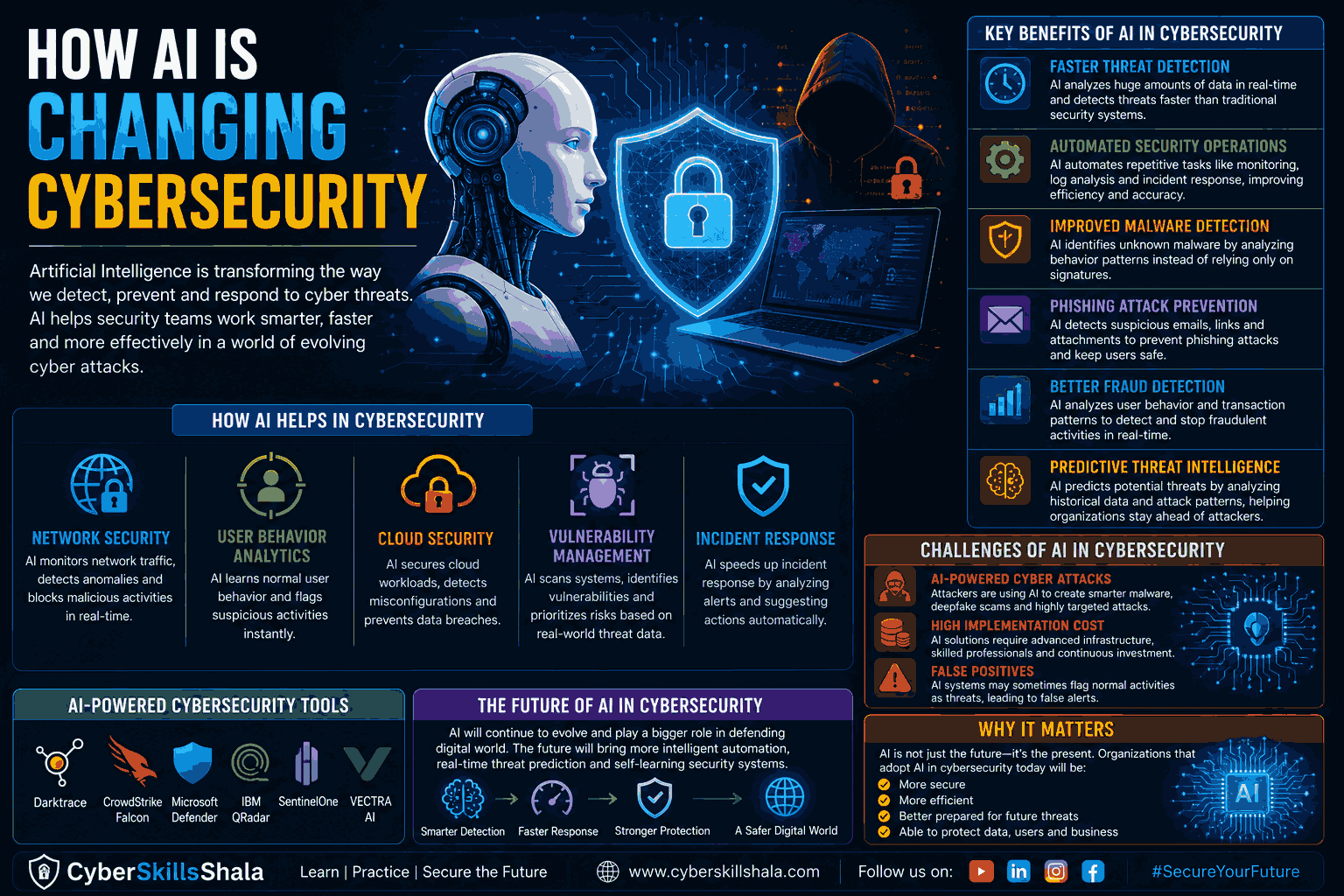
Artificial Intelligence (AI) is transforming industries across the world, and cybersecurity is one of the fields experiencing the biggest impact. As cyber threats become more advanced and frequent, traditional security methods alone are no longer enough to protect systems, networks, and sensitive data. AI is now helping cybersecurity professionals detect threats faster, automate security tasks, analyze massive amounts of data, and improve overall digital protection.
Today, organizations, banks, government agencies, and technology companies are increasingly using AI-powered cybersecurity solutions to defend themselves against hackers, malware, phishing attacks, ransomware, and data breaches. At the same time, cybercriminals are also using AI to create smarter attacks, making cybersecurity more important than ever.
In this article, we will explore how AI is changing cybersecurity, its major benefits, challenges, and why learning AI-driven cybersecurity skills can be valuable for the future. Cybersecurity courses
What is AI in Cybersecurity?
AI in cybersecurity refers to the use of Artificial Intelligence and Machine Learning (ML) technologies to identify, prevent, and respond to cyber threats automatically and intelligently.
AI systems can analyze huge amounts of security data, recognize suspicious patterns, and detect unusual activities much faster than humans. These systems continuously learn from new threats and improve their detection capabilities over time.
Unlike traditional security tools that rely mainly on fixed rules, AI-powered security systems can adapt and respond to evolving cyber attacks more efficiently.
How AI is Transforming Cybersecurity
1. Faster Threat Detection
One of the biggest advantages of AI in cybersecurity is its ability to detect threats quickly.
Traditional cybersecurity systems often depend on predefined signatures and rules. However, modern cyber attacks are becoming more sophisticated and harder to detect using traditional methods alone.
AI can analyze:
- Network traffic
- User behavior
- Login patterns
- Device activity
- Application behavior
By analyzing this data in real time, AI can identify suspicious activities and alert security teams before major damage occurs.
For example, if an employee suddenly downloads a large amount of sensitive data at midnight from an unusual location, AI systems can immediately flag this behavior as suspicious.
2. Automated Security Operations
Cybersecurity teams handle thousands of alerts every day, making manual monitoring extremely difficult. AI helps automate repetitive security tasks, allowing professionals to focus on more important investigations.
AI can automate:
- Malware detection
- Log analysis
- Threat prioritization
- Security monitoring
- Incident response
- Vulnerability scanning
This automation improves efficiency and reduces the workload on cybersecurity teams.
3. Improved Malware Detection
Traditional antivirus software mainly relies on known malware signatures. However, cybercriminals constantly create new malware variants that can bypass traditional detection systems.
AI-powered cybersecurity tools can identify unknown malware by analyzing behavior patterns instead of relying only on signatures.
Machine learning models can study how files behave, detect suspicious activity, and stop malicious programs before they spread across systems.
This makes AI-based malware protection much more powerful against modern cyber threats.
4. Phishing Attack Prevention
Phishing attacks are one of the most common cyber threats today. Attackers send fake emails, messages, or websites to steal passwords, banking information, or personal data.
AI helps detect phishing attacks by analyzing:
- Email content
- Sender behavior
- Website links
- Writing patterns
- Suspicious attachments
Advanced AI systems can identify phishing attempts even when attackers slightly modify their tactics.
This helps organizations reduce the risk of employees falling victim to phishing scams.
5. Better Fraud Detection
Banks, financial institutions, and e-commerce companies use AI to detect fraudulent activities in real time.
AI systems can analyze customer behavior patterns and instantly identify suspicious transactions, such as:
- Unusual purchases
- Login attempts from unknown locations
- Sudden account activity changes
- Large unauthorized transfers
This helps businesses stop fraud before major financial losses occur.
6. AI-Powered Security Analytics
Modern organizations generate massive amounts of security data every day. Analyzing this data manually is nearly impossible.
AI-powered analytics tools help security teams:
- Identify hidden threats
- Detect anomalies
- Monitor user behavior
- Predict future attacks
- Generate real-time insights
These insights help organizations improve their overall security posture.
7. Predicting Future Cyber Threats
AI is not only useful for detecting existing threats — it can also help predict future attacks.
Machine learning algorithms analyze previous attack data and identify patterns that may indicate upcoming cyber threats.
This predictive capability allows organizations to strengthen security measures before attacks happen.
Challenges of AI in Cybersecurity
Although AI offers many benefits, it also comes with challenges.
1. AI-Powered Cyber Attacks
Cybercriminals are also using AI to create more advanced attacks.
Hackers can use AI for:
- Automated phishing campaigns
- Password cracking
- Deepfake scams
- Intelligent malware
- Social engineering attacks
This creates an ongoing battle between AI-powered defense systems and AI-powered cyber threats.
2. High Implementation Costs
AI cybersecurity solutions can be expensive for small businesses because they require:
- Advanced infrastructure
- Skilled professionals
- Large datasets
- Continuous monitoring
However, as technology becomes more accessible, AI tools are gradually becoming affordable for more organizations.
3. False Positives
Sometimes AI systems may incorrectly flag normal activities as suspicious. These false alerts can waste time and create confusion for security teams.
Proper training and continuous improvement of AI models are necessary to reduce false positives.
Why AI Skills Matter in Cybersecurity Careers
As AI becomes more integrated into cybersecurity, professionals with knowledge of both cybersecurity and AI will be highly valuable.
Skills that are becoming important include:
- Machine Learning basics
- Security automation
- Threat intelligence
- Data analysis
- Cloud security
- AI-powered security tools
Organizations are actively looking for cybersecurity professionals who understand modern AI-driven security technologies.
The Future of AI in Cybersecurity
The future of cybersecurity will heavily depend on AI-powered systems. As cyber attacks become more advanced, organizations will increasingly rely on intelligent automation, predictive analysis, and real-time threat detection.
AI will continue improving:
- Security monitoring
- Threat response speed
- Fraud prevention
- Cloud security
- Endpoint protection
- Cyber attack prediction
However, human expertise will still remain extremely important. AI can assist cybersecurity professionals, but skilled human analysts are still needed to investigate threats, make decisions, and handle complex security incidents.
Final Thoughts
AI is rapidly transforming cybersecurity by making threat detection faster, automating security operations, improving malware protection, and helping organizations stay ahead of cybercriminals. While AI introduces powerful new security capabilities, it also creates new challenges as attackers begin using AI for advanced cyber attacks.
For students, beginners, and IT professionals, learning AI-driven cybersecurity concepts can open doors to exciting career opportunities in the future. As technology continues to evolve, the combination of AI and cybersecurity will play a critical role in protecting the digital world.