Best Email Marketing Platforms to Drive Sales Growth
-

- February 23rd, 2026
- 1,390 views

FREE SEO Topical Map Generator: Find Your Next Content Ideas
Email marketing platforms are central to modern sales and retention strategies, enabling targeted campaigns, automation, and measurable ROI. Choosing the right platform can increase open rates, boost conversions, and streamline workflows across marketing and sales teams.
- Evaluate deliverability, automation, and list segmentation when choosing a provider.
- Match platform pricing and integrations to business size and sales goals.
- Follow legal requirements for commercial email; see the FTC CAN-SPAM guidance for compliance.
Email marketing platforms: how they drive sales growth
Effective email programs move prospects through the funnel with welcome flows, cart recovery, re-engagement sequences, and personalized promotions. Core capabilities of email marketing platforms include campaign builders, A/B testing, audience segmentation, analytics, and automation—features that directly support higher conversion rates and repeat purchases.
Key features to look for
Deliverability and reputation tools
Deliverability affects whether messages reach the inbox. Look for platforms that provide deliverability monitoring, domain authentication (SPF, DKIM), and feedback loop management. Reporting on bounces, complaints, and inbox placement helps protect sender reputation.
Segmentation and personalization
Advanced segmentation—behavioral, demographic, and lifecycle-based—enables tailored messages that perform better than generic blasts. Dynamic content and merge tags allow personalization at scale, improving engagement and sales outcomes.
Automation and workflows
Automation engines that support multi-step workflows, event triggers, and conditional branching reduce manual effort and deliver timely messages for onboarding, cart recovery, and cross-sell/up-sell campaigns.
Analytics and attribution
Integrated analytics should show opens, clicks, conversions, revenue per send, and ROI. Attribution features or integrations with analytics platforms and CRMs help link email activity to actual sales performance.
Top platforms compared
The following list summarizes commonly used options by capability and typical use case. Descriptions are neutral and intended to help compare core strengths.
All-in-one marketing suites
All-in-one suites combine email with CRM, landing pages, and other marketing tools. These platforms are suitable for businesses that want unified data across channels and deeper sales-marketing coordination. Evaluate integration complexity and overall cost when considering a suite.
Specialized email vendors
Specialized vendors focus on email and deliverability. These platforms often offer advanced deliverability controls, sophisticated segmentation, and pricing that scales with volume. Consider these vendors when email is the primary growth channel.
eCommerce-focused platforms
Platforms built for online stores include pre-built eCommerce templates, product feed integration, and revenue tracking for abandoned cart and product recommendation messages. They can accelerate setup for digital retailers and improve purchase-related automation.
How to evaluate and implement a platform
Define goals and KPIs
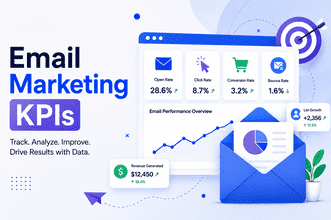
Identify primary objectives: acquisition, conversion rate optimization, customer retention, or lifetime value growth. Set measurable KPIs such as click-to-conversion rate, revenue per recipient, and unsubscribe rate to compare performance across platforms.
Integrations and data flow
Verify native integrations with existing systems like eCommerce platforms, CRMs, or analytics tools. Reliable data flow, including two-way sync for customer status and purchase history, enables effective personalization and attribution.
Pricing, scalability, and support
Assess pricing models (per user, per contact, or per send) and projected costs as the audience grows. Consider available support options—documentation, community, and dedicated account management—especially during migration and campaign ramp-up.
Deliverability and legal compliance
Ensure the platform supports authentication standards and provides tools to manage unsubscribes and complaint rates. Compliance with commercial email regulations is essential; official guidance on the CAN-SPAM Act is provided by the Federal Trade Commission and should be reviewed during implementation: FTC CAN-SPAM compliance guide.
Measuring success and iterating
Run controlled tests and measure changes versus baseline KPIs. Use A/B testing for subject lines, send times, and creative. Track revenue attribution to determine the most effective flows and allocate resources accordingly. Regularly review deliverability metrics and list hygiene practices to sustain performance.
Choosing the right platform for business size
Small businesses and startups
Smaller teams often prioritize ease of use, affordable entry pricing, and templates for rapid campaign creation. Scalable pricing and straightforward integrations are helpful as volume grows.
Midsize to enterprise organizations
Larger organizations require advanced automation, multi-user permissions, sophisticated segmentation, and enterprise-grade deliverability tools. Robust APIs and dedicated support options assist complex implementations.
Frequently asked questions
What are the best email marketing platforms for small businesses?
Options differ by budget and needs. Small businesses typically benefit from platforms that offer simple campaign builders, templates, and a clear pricing structure that scales with contacts or sends.
How do email marketing platforms affect deliverability?
Platforms with built-in authentication, reputation monitoring, and complaint handling help maintain deliverability. Proper list hygiene, consent-based lists, and consistent sending patterns are also important.
How should organizations evaluate email marketing platforms for sales growth?
Evaluate platforms based on automation capabilities, segmentation, analytics, integration with sales systems, and pricing. Define KPIs tied to revenue, test performance, and review deliverability and compliance features before committing.
Are there legal requirements for commercial email?
Yes. Commercial email is regulated in many jurisdictions (for example, the United States enforces the CAN-SPAM Act). Review official regulator guidance and ensure unsubscribe mechanisms and accurate sender identification are in place.
What metrics should be tracked in email campaigns?
Common metrics include open rate, click-through rate, conversion rate, revenue per send, unsubscribe rate, bounce rate, and complaint rate. Attribution to sales or revenue is essential for measuring true campaign impact.