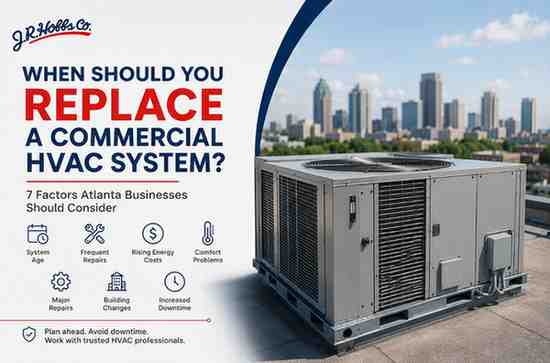
When Should You Replace a Commercial HVAC System? 7 Factors Atlanta Businesses Should Consider
-
- Published Updated
- 4,652 views
Replacing a commercial HVAC system is a significant decision for any business. The equipment represents a major investment, and replacing it too early can mean spending money on a system that still has useful life. Waiting too long, however, can lead to repeated repairs, uncomfortable indoor conditions, higher energy costs, and unexpected downtime.
So, how do you know when replacement makes more sense than another repair?
There is no single answer because every building and HVAC system is different. However, several factors can help Atlanta businesses determine whether it is time to start planning for a replacement.
1. The HVAC System Is Reaching the End of Its Useful Life
Age is one of the first things to consider when evaluating commercial HVAC equipment.
The expected service life of a system depends on its type, installation quality, operating conditions, maintenance history, and usage. A well-maintained system may continue operating effectively for many years, while equipment exposed to heavy workloads or poor maintenance may experience problems earlier.
Age alone does not necessarily mean a system needs to be replaced. However, an older system that is also experiencing frequent repairs or declining performance deserves closer evaluation.
If the equipment is approaching the later part of its expected service life, it may be more practical to start planning for replacement rather than waiting for a major failure.
2. Repair Bills Are Becoming More Frequent
Occasional repairs are normal for commercial HVAC equipment. The problem begins when service calls become increasingly frequent.
Repeated failures can indicate that several components are reaching the end of their useful life. Even if each individual repair seems manageable, the combined cost can become difficult to justify.
- Businesses should consider the bigger picture:
- How often has the system required repairs?
- Are the same problems happening repeatedly?
- Are replacement parts becoming harder to source?
- How much has been spent on repairs over the past few years?
- Is another major repair likely to be needed soon?
When repair costs continue to rise, comparing the expected cost of continued repairs with the investment required for a new system can provide a clearer picture.
3. Energy Costs Keep Increasing
An older HVAC system may consume more energy than a newer, properly selected and maintained system.
Higher energy bills do not automatically mean the HVAC equipment needs replacement. Problems such as dirty filters, restricted airflow, faulty controls, or poor maintenance can also affect efficiency.
However, if the system has been properly maintained and energy consumption continues to rise, it may be worth having the equipment evaluated.
A professional assessment can help determine whether the issue is related to maintenance, equipment condition, system sizing, controls, or overall efficiency.
For a business operating HVAC equipment for long hours, even gradual efficiency losses can have a meaningful effect on operating expenses.
4. The Building Has Persistent Comfort Problems
Commercial HVAC equipment should provide reasonably consistent indoor conditions throughout the areas it serves.
If employees or customers regularly complain about rooms being too warm, too cold, or difficult to regulate, the issue should be investigated.
- Uneven temperatures can result from several causes, including:
- Poor airflow
- Ductwork problems
- Incorrect system sizing
- Faulty controls
- Failing components
- Changes to the building's layout or usage
Sometimes these problems can be corrected without replacing the entire system. In other cases, they may indicate that the existing equipment is no longer suitable for the building.
Before making a replacement decision, businesses should have the underlying cause identified rather than assuming new equipment is automatically the solution.
5. The System Requires Major Repairs
Not every repair justifies replacing an HVAC system. But when a major component fails on older equipment, the decision becomes more complicated.
A significant repair can be expensive, particularly if other components are also showing signs of wear.
At that point, businesses should compare the repair cost with the potential benefits of replacement.
For example, if an aging system requires a major repair and has already experienced several failures, investing more money into the existing equipment may provide only a short-term solution.
A professional evaluation can help determine whether repairing the current system or replacing it would provide better long-term value.
6. The Business Has Outgrown the Existing System
A building's HVAC requirements can change over time.
A business may expand its workforce, renovate its space, add equipment, change operating hours, or use areas of the building differently. An HVAC system that was appropriate when the property was first occupied may no longer meet the current demand.
In these situations, replacing or redesigning part of the HVAC system may provide better performance than continuing to operate equipment that is no longer properly matched to the building.
Before replacement, contractors should evaluate factors such as building size, occupancy, usage patterns, ventilation requirements, and existing equipment.
7. You Are Dealing With Increasing Downtime
For many businesses, the biggest HVAC cost is not the repair itself. It is the disruption caused when the system stops working.
A prolonged HVAC outage can affect employees, customers, inventory, equipment, and normal operations. The impact can be particularly serious during periods of extreme heat or cold.
If an HVAC system has become unreliable, businesses should consider the cost of continued downtime when evaluating replacement.
A newer system may represent a larger upfront investment, but avoiding repeated interruptions can make replacement a more practical long-term decision.
Repair or Replace? A Simple Way to Think About the Decision
When a commercial HVAC system develops a problem, businesses often have two choices: repair the existing equipment or consider replacement.
- A repair may make sense when:
- The system is relatively young.
- The problem is isolated.
- Maintenance history is good.
- Replacement parts are readily available.
- The repair cost is reasonable compared with replacement.
- Replacement may deserve consideration when:
The system is significantly aged.
- Breakdowns are becoming frequent.
- Repair costs are increasiEnergy performance has declined.
- Major components are failing.
- The system no longer meets the building's needs.
- Downtime is becoming a recurring business concern.
These are not rigid rules. A professional assessment is still necessary before making a major investment.
How Atlanta's Climate Can Affect HVAC Equipment
Atlanta businesses rely heavily on cooling systems during the warmer months. Heat and humidity can place substantial demand on commercial HVAC equipment, particularly in buildings where systems operate for long hours.
That makes equipment reliability and proper maintenance particularly important.
Businesses should not wait for the hottest part of the year to discover that an aging HVAC system is struggling to maintain indoor conditions. Evaluating older equipment ahead of peak demand gives property managers more time to compare replacement options and plan the work around business operations.
What to Look for in a Replacement System
Once replacement becomes the preferred option, selecting the right equipment is just as important as deciding to replace the old system.
Businesses should consider:
System Capacity
The replacement system should be properly matched to the building's heating and cooling requirements. Oversized or undersized equipment can create performance and efficiency problems.
Operating Costs
Initial purchase price is only one part of the investment. Businesses should also consider expected energy consumption, maintenance requirements, and long-term operating costs.
Building Compatibility
The new equipment should work appropriately with the building's existing infrastructure, controls, ductwork, electrical requirements, and available installation space.
Future Needs
If the business expects to expand or change how the property is used, those plans should be considered before selecting replacement equipment.
Choosing the Right Commercial HVAC Contractor
Replacing a commercial HVAC system is not simply an equipment purchase. Proper assessment, system selection, installation, and commissioning all affect the final performance of the system.
When evaluating Commercial HVAC Contractors in Atlanta, businesses should look at experience with similar commercial properties, knowledge of different HVAC systems, installation capabilities, maintenance services, and post-installation support.
It is also useful to ask contractors to explain why they recommend a particular system rather than simply providing an equipment price. A good proposal should make the reasoning behind the recommendation clear.
Plan Replacement Before an Emergency
One of the biggest advantages of identifying replacement needs early is having time to make a decision.
When an HVAC system fails unexpectedly, a business may have limited time to compare options. That can result in rushed decisions based primarily on availability rather than long-term suitability.
Planning ahead gives businesses more control over:
- Equipment selection
- Contractor comparison
- Project scheduling
- Budget planning
- Installation timing
- Business disruption
If an aging system is already showing multiple warning signs, it may be worth evaluating replacement options before a complete failure occurs.
Final Thoughts
There is no specific age at which every commercial HVAC system should be replaced. The right decision depends on the equipment's condition, repair history, efficiency, reliability, building requirements, and the cost of continuing to operate it.
For Atlanta businesses, the best approach is to evaluate the system before a major failure forces the decision. Regular inspections and professional assessments can help identify whether continued maintenance makes sense or whether replacement should be added to the business's upcoming plans.
A well-planned HVAC replacement can provide more predictable operation and help businesses avoid the disruption that comes with an unexpected system failure.