The Rise of Composite Pipes in Indian Construction: A Decade of Material Shift
-

- Published Updated
- 4,231 views
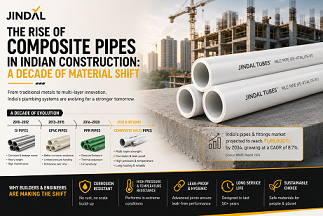
Over the last decade, Indian construction has quietly moved away from traditional plumbing materials like GI and PVC toward multilayer composite pipes. This shift has been driven by rising quality expectations, taller buildings, better water systems, and a growing focus on long-term reliability. Composite pipes, especially the multilayer PE-AL-PE type, are now recognised as the modern standard for hot water, gas, and high-pressure plumbing systems across residential, commercial, and industrial projects in India.
Manufacturers like Jindal Tubes have played a defining role in this transition, introducing multilayer piping technology to a market that was previously dominated by metal and single-layer plastic systems.
Where Indian Plumbing Started
For decades, Indian plumbing was built around galvanised iron (GI) pipes. They were strong, familiar, and easy to source. But they carried problems the industry learned to live with rather than solve.
The early era relied on:
GI pipes for water and gas lines
Cast iron for drainage
Copper for select premium applications
Threaded joints assembled entirely by hand
By the 1990s, PVC entered Indian plumbing at scale, offering a cheaper, corrosion-free alternative for cold water and sewage lines. The Bureau of Indian Standards began formalising specifications for these newer materials, laying the groundwork for the material shift that would follow.
The CPVC and PPR Era
By the mid-2000s, Indian construction started shifting to CPVC and PPR pipes, especially for hot water systems where GI and PVC couldn't perform. These materials solved some of the older problems, but introduced new ones of their own.
Common issues that emerged over time:
CPVC becoming brittle after years of hot water use
PPR sagging in long horizontal hot water runs
Solvent joints failing in concealed plumbing
Heat-welded joints depending fully on installer skill
High thermal expansion causing leaks behind walls
Even so, these materials dominated Indian plumbing for over a decade because they were affordable and widely available. The real change began when builders started counting the cost of failures rather than the cost of pipes.
Why Builders Started Looking for Something Better
By the early 2010s, Indian construction had entered a new phase. High-rise projects were rising across metros. Hotels, hospitals, IT parks, and premium residential complexes were being built at a scale never seen before. Traditional pipes simply couldn't keep up.
Real-world pressures that pushed the shift:
Vertical high-rise plumbing needed stronger pressure handling
Solar water heater systems required real heat resistance
Hospitals needed toxin-free, hygienic water lines
Concealed plumbing needed materials that don't leak silently
Skilled plumber shortages demanded easier installation
At the same time, international standards like ISO 21003 were formalising multilayer piping systems globally, giving Indian engineers a technical benchmark to reference when specifying newer materials.
The Entry of Composite Pipes in India
Multilayer composite pipes made their formal entry into Indian construction in the mid-2000s. The concept was straightforward but revolutionary for a market used to either metal or plastic pipes. Composite pipes offered both, in a single bonded structure.
What made the technology stand out:
Aluminium core for structural strength and oxygen barrier
Inner and outer plastic layers for corrosion resistance
Bendable design that reduced joint count dramatically
Compression fittings that didn't need glue or heat
Lifespan expectations of 50+ years
Manufacturers like Jindal Tubes helped make PE-AL-PE technology accessible to Indian projects at scale, and by the mid-2010s, multilayer piping had moved from being a premium import product to a domestically manufactured mainstream option.
The Standards Catch-Up
One of the biggest turning points came when Indian standards officially recognised multilayer piping systems. The introduction of IS 15450 gave contractors, consultants, and engineers a formal Indian specification for composite piping, aligned with international norms.
This standardisation triggered wider adoption:
Government projects began specifying MLC pipes
Real estate developers moved to composite systems for premium projects
MEP consultants started designing plumbing systems around multilayer pipes
Educational institutions and hospitals adopted composite piping for hygiene
Industrial facilities used it for compressed air and process water lines
A detailed comparison of how MLC pipes stack up against traditional materials is covered in this analysis of composite pipes versus PVC and CPVC.
Why the Shift Accelerated After 2018
The pace of adoption picked up sharply in the second half of the last decade. Several forces came together at the same time.
Key drivers behind the acceleration:
Rapid urbanisation and vertical growth in Tier 1 and Tier 2 cities
Adoption of green building standards like IGBC that reward long-life materials
Rising cost of plumbing failures in premium projects
Solar water heating becoming a common residential feature
Growing awareness of water quality and health safety
The result was that composite pipes stopped being seen as a premium niche and started being viewed as a smart-default choice for any project built to last more than a decade.
What This Shift Looks Like on the Ground Today
Walk through any modern construction site in India today, and you'll see the difference. Where GI pipe stacks once dominated the plumbing bay, you'll now see 200-meter coils of composite pipe. Where CPVC glue cans lined the workbench, you'll find press tools and compression fittings.
Common signs of this shift:
MLC pipes replacing GI in gas lines
Composite systems replacing CPVC in hot water risers
Silent PP pipes replacing older PVC in high-rise drainage
Press fittings replacing threaded joints in commercial plumbing
Bendable coils reducing the number of joints per floor
Industry analysis by The Plastics Pipe Institute shows this pattern isn't unique to India, but the pace of Indian adoption in the last decade has been among the fastest in emerging markets.
What This Means for Builders and Consultants
The material shift isn't just a change in what pipes look like. It's a change in how plumbing systems are designed, installed, and maintained.
For decision-makers, the shift brings real advantages:
Lower long-term maintenance costs
Fewer hidden leaks in concealed plumbing
Faster installation timelines
Better performance in hot water and gas systems
Longer building lifecycle without pipe replacement
Publications like Plumbing Engineer Magazine have noted that markets moving toward multilayer piping tend to see fewer post-handover complaints and reduced insurance risk on plumbing failures.
Looking at the Next Decade
The shift from GI to CPVC took roughly 10 years. The shift from CPVC to composite pipes has taken slightly less, and it's still accelerating. What comes next will likely be even faster.
Emerging trends already shaping the next decade:
Composite pipes becoming standard in mid-tier housing, not just premium
Wider adoption of silent drainage systems in urban buildings
Growth of MLC pipes in gas distribution for city gas projects
Integration of composite systems into prefabricated construction
Rising demand for domestically manufactured Indian composite pipes
The direction is clear. Indian construction is moving toward materials that reduce failure, extend building life, and match global performance standards.
FAQs
Q1. When did composite pipes first enter Indian construction?
Composite pipes started entering Indian construction in the mid-2000s, with wider adoption after 2010 as builders looked for better alternatives to GI, PVC, and CPVC.
Q2. Why are Indian builders moving toward MLC pipes?
MLC pipes offer higher strength, longer lifespan, better hot water performance, and lower long-term maintenance, which makes them ideal for modern high-rise and premium projects.
Q3. Are composite pipes accepted under Indian standards?
Yes. Multilayer composite pipes are formally recognised under IS 15450 and align with international standards like ISO 21003.
Q4. Where are composite pipes used most in India?
They are widely used in high-rise plumbing, hot water systems, gas distribution, hospitals, hotels, and industrial process piping.
Q5. What is driving the shift away from CPVC and GI in India?
Rising failure rates, higher building expectations, better standards, and the availability of domestic composite pipe manufacturers have all pushed the industry toward multilayer systems.
Final Insight
The rise of composite pipes in Indian construction is more than a material trend. It's a sign that the industry is maturing. Builders, consultants, and engineers are no longer buying pipes on price alone. They are choosing systems that reduce risk, extend life, and support the kind of construction India is now building.
Over the next decade, this shift is likely to deepen further, with multilayer composite pipes becoming a default specification across most modern projects, and Indian manufacturers continuing to shape the direction of the industry.