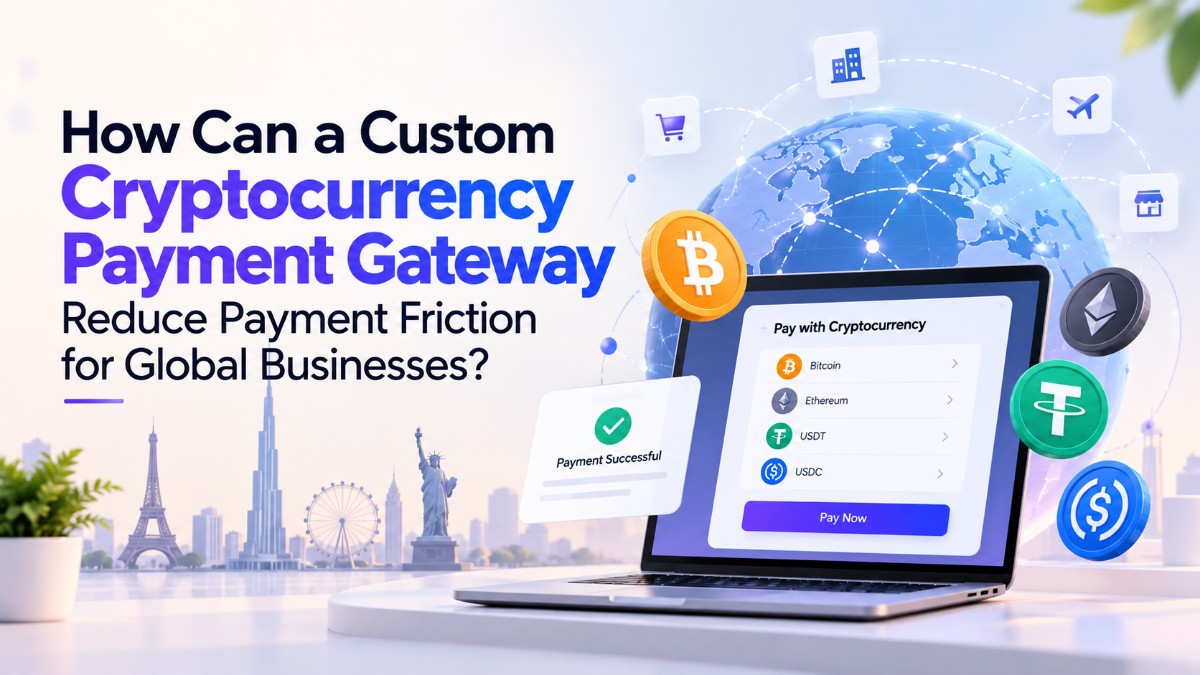
How Can a Custom Cryptocurrency Payment Gateway Reduce Payment Friction for Global Businesses?
-

- Published Updated
- 50 views
A customer pays for your software subscription in cryptocurrency. Your website shows a pending payment, but your billing system still says the invoice is unpaid. Your support team checks the blockchain explorer, confirms the transfer, and manually activates the account.
Now imagine handling that process for hundreds of orders.
The problem isn't accepting cryptocurrency. It's connecting the payment, blockchain transaction, order status, and settlement process into one reliable workflow. That's where cryptocurrency payment gateway development can make a practical difference for global businesses.
How Does a Custom Crypto Payment Gateway Reduce Payment Friction?
A custom cryptocurrency payment gateway connects customer payments with your existing business systems. It can generate payment requests, monitor blockchain transactions, verify payment conditions, update order statuses, and organize transaction records in one workflow.
For businesses selling internationally, this can mean fewer manual payment checks, more flexible checkout options, and better visibility into incoming funds. Actual benefits depend on the supported networks, payment providers, and settlement configuration.
1. Eliminate the Gap Between Payment and Order Confirmation
One of the most frustrating payment problems occurs when money reaches a wallet but the customer's order remains unpaid in your system.
This often happens when blockchain monitoring and order management operate separately.
A custom gateway can connect these processes through transaction monitoring and automated notifications.
For example, a digital marketplace can assign a unique payment reference to an order, monitor the designated blockchain address, validate the expected asset and amount, and update the order when the transaction meets its confirmation requirements.
The workflow should also handle underpayments, overpayments, expired payment requests, and duplicate notifications. These exceptions matter because not every transaction follows the ideal path.
Business benefit: Reduce manual verification and help customers receive their purchased products or services without unnecessary administrative delays.
2. Give International Customers Payment Options That Fit Their Needs
A business selling digital products globally may serve customers who prefer different payment methods. Traditional payment availability can vary by country, provider, and customer circumstances.
A cryptocurrency payment gateway can add another payment option by supporting selected assets and blockchain networks.
Consider a software company serving customers across several markets. It might accept a stablecoin on a supported network while retaining card payments for customers who prefer conventional checkout.
However, supporting more cryptocurrencies isn't automatically better. Each additional asset or network introduces integration, monitoring, support, and compliance considerations.
Business benefit: Expand payment choice without forcing every customer into a single payment method.
3. Make Settlement Rules Clear Before Money Arrives
Accepting cryptocurrency raises an important business question: what should happen to the funds after payment?
Some merchants want to retain cryptocurrency. Others prefer stablecoins or fiat currency to simplify revenue management.
Custom crypto payment gateway development allows businesses to define settlement workflows around their needs. Depending on available integrations, these workflows may include wallet transfers, supported asset conversion, settlement notifications, and transaction reporting.
For example, an online service provider could accept a supported cryptocurrency but use an integrated conversion service to receive a preferred settlement currency.
Keep in mind that conversions can introduce fees, exchange-rate spreads, liquidity limitations, and counterparty risks. Stablecoins also carry risks, including depegging and issuer-related concerns.
Business benefit: Establish a more predictable payment-management process without assuming that cryptocurrency prices or conversion costs will remain stable.
4. Connect Crypto Payments to Your Existing Business Systems
A payment gateway becomes more useful when it works with the systems your business already uses.
Through APIs, plugins, and webhooks, a gateway can connect cryptocurrency payment processing to:
E-commerce checkout and order management.
SaaS subscription billing.
Digital marketplaces and merchant platforms.
Accounting and transaction reconciliation systems.
Customer notifications and payment support tools.
For example, when a subscription payment is confirmed, the gateway can notify the billing system to activate the subscription. If the notification is delivered more than once, the application should process it idempotently to avoid duplicate activations.
Business benefit: Reduce disconnected workflows and make payment operations easier to maintain as transaction volume grows.
5. Give Your Finance Team Better Transaction Visibility
A payment notification tells you that something happened. Your finance team needs to know exactly what happened, how much was received, which order it belongs to, and whether it has been settled.
A properly designed merchant dashboard can show:
Payment status and blockchain transaction ID.
Requested and received amounts.
Network fees and applicable provider charges.
Confirmation timestamps and settlement records.
Underpayments, failed payments, and exceptions requiring review.
These records help teams reconcile orders and investigate discrepancies without relying entirely on manual blockchain searches.
Business benefit: Improve operational visibility and make payment reconciliation easier to manage.
What Should a Business Look for in Cryptocurrency Payment Gateway Development?
Before choosing a development partner, evaluate the capabilities that directly affect your payment workflow.
Multi-network integration: Support the blockchain networks and cryptocurrencies your customers actually use.
Automated payment verification: Validate transaction amounts, destinations, and confirmation status before updating orders.
Secure wallet management: Implement appropriate key protection, access controls, and transaction authorization.
API and webhook integration: Connect crypto payments with your existing website, billing system, and order management platform.
Flexible settlement options: Define how incoming funds are retained, transferred, or converted through supported providers.
Refund management: Establish clear workflows for processing refunds and tracking their status.
Transaction monitoring: Identify delayed payments, failed transactions, and unusual activity through alerts and reporting.
Compliance support: Account for applicable licensing, AML/KYC, sanctions screening, tax, and data protection requirements.
Prioritize the features that solve your current business problems. A focused, secure payment workflow is more valuable than a long feature list that adds unnecessary complexity.
Build a Payment Gateway Around Your Business Model
A custom solution is not always the right answer. If an existing payment provider already supports your required assets, regions, settlement methods, and integrations, using that provider may be faster and less expensive.
Custom development becomes more compelling when standard products cannot accommodate your payment logic, platform integrations, reporting requirements, or operational controls.
At CryptoApe, the starting point should be your payment workflow: which assets you want to accept, where your customers are located, how funds should be settled, and which systems need to communicate.
Explore our Cryptocurrency Payment Gateway Development Services to discuss a solution tailored to those requirements.
Ready to Simplify Your Crypto Payment Operations?
Your payment gateway should do more than receive cryptocurrency. It should connect payments to orders, reduce manual reconciliation, provide clear settlement records, and fit the way your business operates.
Talk to CryptoApe about your cryptocurrency payment gateway development requirements. Share your target markets, preferred blockchain networks, and integration needs to start planning a solution built around your business.