Energy Recovery Ventilator Core Market Driven by Sustainable Building Demand
-
- Published Updated
- 7,122 views
Energy Recovery Ventilator Core Market Size
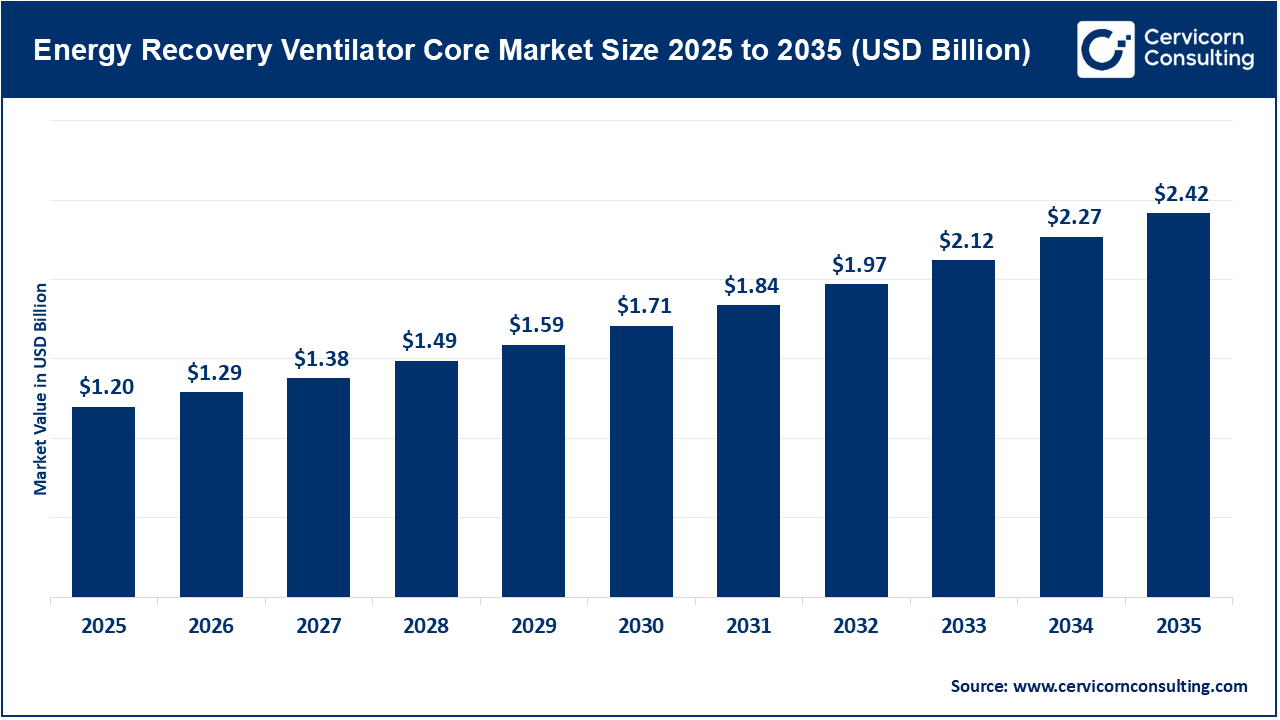
The global Energy Recovery Ventilator (ERV) Core Market was valued at approximately USD 1.20 billion in 2025 and is forecast to reach around USD 2.42 billion by 2035. The market is anticipated to expand at a CAGR of 7.27% between 2026 and 2035, supported by growing adoption of energy-efficient ventilation technologies, increasing sustainability initiatives, and stricter building energy-performance standards worldwide.
Read a Full Report: https://www.cervicornconsulting.com/energy-recovery-ventilator-core-market
Understanding the Energy Recovery Ventilator Core Market
The Energy Recovery Ventilator (ERV) Core Market comprises the global ecosystem involved in the development, production, and supply of heat-exchange core technologies used in energy recovery ventilation systems. ERV cores function as the primary component within ventilation units, facilitating the transfer of heat and humidity between outgoing exhaust air and incoming fresh air streams.
By reclaiming thermal energy that would otherwise be lost, these systems help reduce heating and cooling requirements across residential, commercial, and industrial facilities. The market includes a broad range of technologies such as enthalpy cores, rotary heat-recovery wheels, fixed-plate exchangers, polymer membrane cores, and advanced heat-transfer materials integrated into HVAC systems.
Growing awareness of indoor air quality, carbon-reduction objectives, energy conservation requirements, and green building certifications continues to accelerate global demand for ERV core solutions. Increasing urban development, stringent building efficiency regulations, and rising investments in sustainable infrastructure further strengthen long-term market prospects. More details are available through the Energy Recovery Ventilator Core Market Report.
Why the Energy Recovery Ventilator Core Market Matters
The ERV core industry has become increasingly important as building owners and developers seek solutions that simultaneously improve energy efficiency and indoor environmental quality. Since HVAC systems account for a significant share of building energy consumption, ERV cores help reduce operational expenses by recovering heat energy from exhaust air and transferring it to incoming ventilation air.
In addition to lowering energy costs, ERV systems contribute to healthier indoor environments. Modern energy-efficient buildings are often designed with airtight envelopes, which can restrict natural airflow. ERV technologies address this challenge by delivering continuous fresh air while maintaining overall energy performance. This capability is particularly valuable in healthcare facilities, educational institutions, office buildings, manufacturing plants, data centers, and residential developments where occupant health and comfort are essential.
As governments advance net-zero construction programs, sustainable development goals, and carbon-emission reduction strategies, ERV cores are becoming a critical component of modern green-building infrastructure. Rising energy prices and growing environmental concerns are further increasing the importance of these technologies.
Request a complimentary sample report: https://www.cervicornconsulting.com/sample/2579
Key Growth Drivers of the Energy Recovery Ventilator Core Market
Several factors are contributing to the continued expansion of the ERV core market, including:
- Rising awareness of indoor air quality and occupant wellness
- More stringent building energy-efficiency regulations worldwide
- Rapid urbanization and infrastructure development
- Growing investment in green and sustainable construction projects
- Increasing adoption of energy-efficient HVAC systems
- Strong demand for energy conservation across residential and commercial buildings
- Technological advancements in heat-exchange materials and membrane technologies
- Government incentives promoting low-carbon construction practices
- Expansion of smart-building and intelligent HVAC projects
- Greater focus on climate-change mitigation and carbon-emission reduction
- Ongoing innovation in enthalpy recovery and heat-transfer technologies
Additionally, the integration of IoT-enabled HVAC platforms and the wider implementation of energy-efficient construction practices across both developed and emerging economies continue to create attractive opportunities for ERV core manufacturers.
Leading Companies in the Energy Recovery Ventilator Core Market
Key industry participants include:
- Xiamen AIR-ERV Technology Co., Ltd. – Specializes in polymer heat exchangers and ventilation technologies, with strong OEM manufacturing capabilities and a broad presence across Asia, Europe, and North America.
- Ruskin – Focuses on energy-efficient HVAC and air-control systems, supported by an extensive distribution network and commercial HVAC expertise.
- Oji Industrial Materials Management Co., Ltd. – Known for advanced industrial materials and specialized heat-exchange components used in ERV applications.
- Klingenburg GmbH – A leading European supplier of rotary and plate heat exchangers recognized for high-efficiency heat-recovery solutions.
- Innergy Tech Inc. – Develops proprietary air-to-air energy recovery wheel technologies and maintains a strong global presence.
Major Trends Influencing Market Development
1. Expansion of Sustainable Building Construction
The increasing adoption of green-building frameworks such as LEED, BREEAM, and WELL is encouraging the installation of ERV technologies. These systems improve energy performance, reduce HVAC-related energy consumption, and enhance indoor environmental quality across commercial, healthcare, educational, and residential projects.
2. Innovation in Heat-Recovery Materials
Manufacturers continue investing in next-generation materials that improve thermal transfer efficiency, moisture recovery, corrosion resistance, and product lifespan. Innovations include:
- Polymer membrane heat exchangers
- Nanotechnology-enhanced materials
- Lightweight composite core structures
- Advanced enthalpy-transfer membranes
These advancements improve system performance while lowering maintenance requirements.
3. Integration with Smart HVAC Platforms
Modern ERV systems are increasingly connected to intelligent building-management systems, enabling:
- Real-time performance tracking
- Predictive maintenance
- Automated airflow optimization
- Detailed energy-consumption analytics
This trend is helping building operators maximize efficiency while reducing operating costs.
4. Growing Focus on Indoor Air Quality
Demand for healthier indoor environments continues to rise across sectors such as:
- Healthcare facilities
- Educational institutions
- Corporate offices
- Airports
- Hospitality establishments
As a result, high-performance ERV core technologies are becoming an increasingly important component of building ventilation strategies.
5. Growth of Net-Zero Building Projects
Net-zero energy developments require highly efficient ventilation systems capable of minimizing heating and cooling loads. ERV cores support these objectives by reducing energy demand, lowering carbon emissions, and improving overall building performance.
Global Market Outlook
North America remains a leading market due to strong HVAC adoption, advanced building codes, energy-conservation initiatives, and green-building certifications. Europe continues to benefit from ambitious climate policies such as the European Green Deal and the Energy Performance of Buildings Directive (EPBD).
Meanwhile, Asia-Pacific is expected to record the fastest growth, driven by rapid urbanization, expanding construction activity, increasing energy demand, and supportive sustainability programs across countries such as China, Japan, India, South Korea, and Australia.
Future Outlook
The outlook for the Energy Recovery Ventilator Core Market remains highly positive. As governments, businesses, and developers increasingly prioritize energy efficiency, carbon reduction, and healthy indoor environments, demand for ERV core technologies is expected to accelerate steadily. The market is projected to grow from USD 1.20 billion in 2025 to approximately USD 2.42 billion by 2035, reflecting a CAGR of 7.27% over the forecast period.
Emerging innovations such as AI-enabled building management systems, advanced membrane heat exchangers, IoT-connected ventilation platforms, and next-generation energy recovery materials are expected to further improve performance and drive adoption across residential, commercial, and industrial applications.
For additional insights and customized market research, visit: https://www.cervicornconsulting.com/contact-us