Signs Your Forklift Battery Needs Maintenance
-
- September 24th, 2026
- 26 views
Forklifts play an important role in warehouses, distribution centers, manufacturing facilities, and other busy work environments. Whether a forklift is moving pallets across a warehouse floor or loading materials onto a truck, its battery needs to deliver dependable power throughout the workday. When battery performance starts to decline, the problem can affect productivity, equipment reliability, and workplace safety.
Regular Industrial battery service can help identify small problems before they turn into expensive failures. However, you do not always need specialized equipment to recognize that something is wrong. Changes in charging behavior, shorter operating times, unusual battery conditions, or slower forklift performance can all be signs that the battery needs attention.
The good news is that many battery problems can be identified early. Learning what to watch for allows operators and maintenance teams to respond before a minor issue becomes a major interruption. Here are some of the most common signs that a forklift battery may need maintenance.
1. The Forklift Runs for Less Time Than Usual
One of the easiest warning signs to notice is a reduction in runtime.
A healthy forklift battery should provide reasonably consistent power for the equipment's normal operating cycle. If a forklift used to run through most of a shift but now requires charging much earlier, the battery may be losing its ability to hold a sufficient charge.
Reduced runtime can happen for several reasons, including:
- Battery age and normal wear
- Improper charging practices
- Low electrolyte levels in lead-acid batteries
- Sulfation
- Damaged or weakened cells
- Excessive heat exposure
- Incorrect charging equipment
A shorter runtime does not automatically mean the battery needs to be replaced. In some cases, proper maintenance or battery servicing can restore useful performance.
2. Charging Takes Much Longer Than Normal
Another warning sign is a noticeable change in charging time.
If a battery suddenly takes significantly longer to reach a full charge, there may be an underlying problem with the battery, charger, connections, or charging process. For example, a battery with damaged cells may not accept a charge normally.
On the other hand, if the battery reaches a full charge unusually quickly but does not provide its normal runtime, that can also indicate reduced capacity.
Maintenance teams should compare current charging behavior with the battery's normal operating pattern. Keeping basic records of charging times can make unusual changes easier to identify.
3. The Battery Gets Excessively Hot
Some heat is normal during charging and operation, but excessive heat should never be ignored.
If a forklift battery becomes unusually hot during charging or use, stop and investigate the cause according to the equipment manufacturer's safety procedures. Excessive heat can be associated with overcharging, damaged cells, poor ventilation, electrical problems, or other battery issues.
Heat can also accelerate battery degradation. Repeated exposure to excessive temperatures may shorten the battery's useful life and increase the risk of performance problems.
For this reason, charging areas should have appropriate ventilation, and batteries should not be subjected to unnecessary heat.
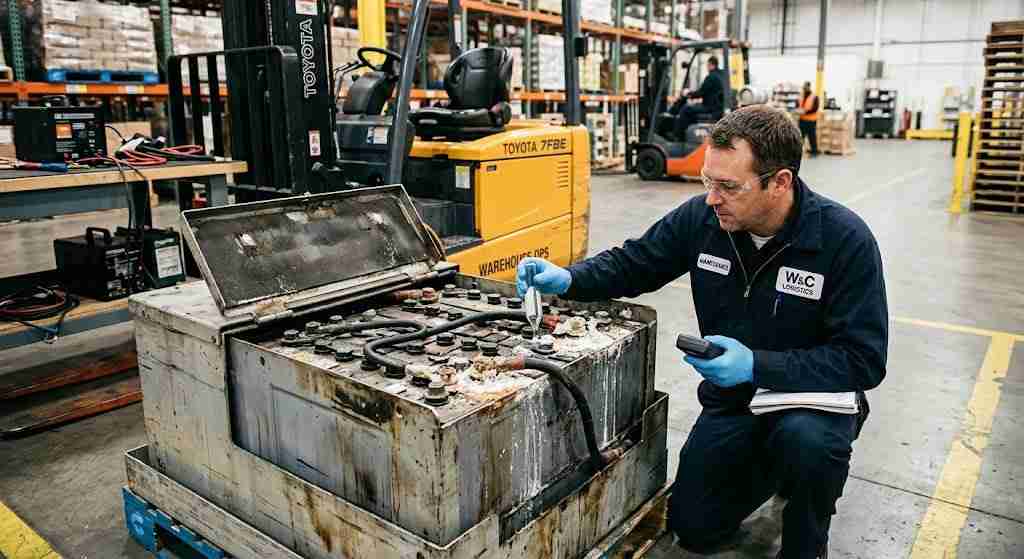
4. The Battery Case Shows Damage
A physical inspection can reveal problems that performance tests may not immediately show.
Look for signs such as:
- Cracks in the battery case
- Swelling or distortion
- Corrosion around terminals
- Damaged cables or connectors
- Loose connections
- Leaking fluid
- Burn marks or unusual discoloration
A damaged battery should not simply be put back into service without proper evaluation. Battery components can contain hazardous materials and carry significant electrical energy, so inspections and repairs should be performed by trained personnel using appropriate safety procedures.
5. Corrosion Is Appearing Around the Terminals
Corrosion around battery terminals is another common warning sign.
Corrosion can interfere with electrical connections and contribute to resistance between the battery and forklift. Over time, this may lead to poor power delivery, connection problems, or additional damage.
For lead-acid batteries, terminal corrosion can sometimes be related to electrolyte exposure, overwatering, poor maintenance practices, or environmental conditions.
If corrosion keeps returning after cleaning, the underlying cause should be investigated rather than simply treating the visible buildup.
6. The Forklift Seems Slower or Less Powerful
Sometimes the battery problem becomes obvious through forklift performance rather than the battery itself.
A forklift that feels noticeably weaker than usual may struggle to lift loads, accelerate, travel, or perform normal tasks efficiently. Operators may notice that the machine loses power more quickly during demanding operations.
While battery condition is one possible cause, other equipment problems can produce similar symptoms. Therefore, maintenance personnel should inspect the entire electrical and mechanical system rather than automatically blaming the battery.
Still, a sudden drop in performance combined with reduced runtime is a strong reason to have the battery checked.
7. Battery Fluid Levels Are Frequently Low
Traditional flooded lead-acid forklift batteries require proper electrolyte maintenance.
If electrolyte levels are consistently low, the battery may not perform as expected and internal components can become exposed. Water should be added according to the battery manufacturer's recommendations and maintenance schedule.
It is important to use the correct type of water and follow the manufacturer's instructions. Adding water at the wrong time or in the wrong quantity can create additional problems.
Maintenance personnel should also avoid guessing when it comes to electrolyte levels. Proper procedures and appropriate protective equipment are essential when working around battery fluid.
8. The Battery Has Visible Leaks
Fluid leaking from a forklift battery is a serious warning sign.
A leak may indicate damage to the battery case or another internal problem. Because battery electrolyte can be corrosive, employees should avoid direct contact and follow workplace procedures for handling damaged batteries.
Do not continue using a visibly damaged or leaking battery simply because the forklift still operates. The cost of dealing with a developing battery problem is generally much lower than dealing with equipment damage, workplace disruption, or an unsafe battery condition.
9. Individual Cells Show Different Conditions
Forklift batteries contain multiple cells, and those cells need to work together properly.
During professional battery testing, technicians may identify differences in voltage, specific gravity, or other performance characteristics between cells. A weak cell can affect the performance of the entire battery.
This is one reason professional testing can be valuable even when the battery looks fine externally. A battery may have an internal problem that is not obvious during a basic visual inspection.
If testing identifies a weak cell or other internal issue, a qualified technician can determine whether maintenance, repair, rebuilding, or replacement is appropriate.
10. The Battery Is Approaching the End of Its Service Life
Even well-maintained forklift batteries eventually wear out.
Battery lifespan depends on factors such as usage, charging practices, operating conditions, maintenance, temperature, and battery type. An older battery that begins showing several warning signs at once deserves particular attention.
For example, if an older battery has reduced runtime, takes longer to charge, and causes noticeable drops in forklift performance, continuing to operate it without evaluation may not be cost-effective.
Keeping records of battery age, maintenance, charging cycles, and performance can help businesses make better decisions about when servicing or replacement may be necessary.
How to Prevent Forklift Battery Problems
Recognizing warning signs is important, but prevention is even better. A consistent maintenance routine can help extend battery life and reduce unexpected downtime.
Follow the Correct Charging Procedure
Avoid treating every charging situation the same. Follow the battery and charger manufacturer's instructions for charging duration, charging cycles, and appropriate charging conditions.
Repeatedly interrupting charging cycles or using incompatible charging equipment can contribute to premature battery wear.
Keep Charging Areas Clean and Ventilated
Battery charging areas should be maintained according to applicable workplace safety requirements. Good ventilation is particularly important for batteries that can release gases during charging.
Keep the area clean and free from unnecessary materials, and make sure employees understand the appropriate charging procedures.
Inspect Batteries Regularly
A quick visual inspection can catch problems early. Look for corrosion, damaged cables, cracks, leaks, loose connections, and other unusual conditions.
For larger operations, create a simple inspection checklist so operators and maintenance personnel know exactly what to look for.
Train Forklift Operators
Operators are often the first people to notice changes in equipment performance. Training them to recognize symptoms such as shorter runtime, reduced lifting power, unusual noises, or charging problems can help maintenance teams respond sooner.
Encourage employees to report unusual battery behavior instead of continuing to operate the forklift until the problem becomes severe.
When Should You Call a Battery Professional?
Not every battery issue should be handled internally.
If a battery has visible damage, leaks, severe corrosion, overheating, repeated charging problems, or significant performance loss, professional evaluation is a sensible next step. Battery technicians have the tools and experience needed to test battery condition and identify problems that may not be visible during a routine inspection.
A professional evaluation can also help determine whether a battery should be maintained, repaired, rebuilt, or replaced. This is particularly useful for businesses operating multiple forklifts, where unnecessary battery replacement can become a significant expense.
Final Thoughts
Forklift batteries give warehouse and industrial equipment the power needed to keep daily operations moving, so changes in battery performance should not be ignored. Shorter runtime, longer charging times, excessive heat, corrosion, physical damage, weak performance, low fluid levels, and leaks are all potential signs that maintenance is needed.
The key is to act early. Regular inspections, proper charging, appropriate fluid maintenance, operator training, and professional testing can help identify problems before they lead to unexpected downtime. When battery issues require expert attention, Battery Rescue LLC can be part of a practical maintenance strategy focused on keeping industrial equipment dependable and extending the useful life of its batteries.
A forklift battery does not always fail without warning. By paying attention to the signs and maintaining batteries consistently, businesses can improve reliability, avoid preventable disruptions, and get more value from their equipment.