Golden Retriever Insights | Every Owner Should Know
-

- May 02nd, 2026
- 7,733 views

Golden Retriever Insights Every Owner Should Know by Year Two
Most Golden Retriever owners feel confident by the six-month mark. Their dog is responding to basic commands, settling into a routine, and charming everyone they meet. What catches them off guard is the change between year one and year three, the shift from managing a puppy to understanding a maturing dog with its own health trajectory and breed-specific risks.
These insights come from years of working with Goldens at every life stage. The owners who do best with this breed share one quality: they adjust their care as their dog changes, rather than keeping the same habits they built in puppyhood.
Golden Retrievers live an average of 10 to 12 years, per AKC breed data, and how that lifespan unfolds depends heavily on what owners prioritize in the first few years.
Golden Retriever Insights on Health: What Changes After Year One
The most important shift I explain to owners of 1 year-old Goldens is that preventive care becomes more specific, not just more frequent.
Hip dysplasia is the condition I start discussing earliest. According to the Merck Veterinary Manual, hip dysplasia is a malformation of the coxofemoral joint that leads to progressive osteoarthritis over time. Golden Retrievers carry a genetic predisposition, and while OFA screening of breeding parents reduces risk in offspring, it doesn’t eliminate it. The first sign I look for isn’t limping; it’s reluctance to rise after lying down or a stiffened gait in the first few steps of a morning walk. Owners regularly attribute this to the dog being sleepy. It’s worth paying attention to.
Glucosamine at 500 mg per 25 lbs of body weight daily has solid support for slowing cartilage degradation in dogs with early joint changes. For a 65-lb adult Golden, that’s around 1,300 mg daily. Pair that with EPA/DHA from fish oil at approximately 1,000 mg per day, and most dogs show measurable improvement in mobility within eight to twelve weeks.
Cancer awareness starts at year five for most Goldens, but building a monthly habit of checking lumps and lymph nodes earlier costs nothing. The Morris Animal Foundation’s Golden Retriever Lifetime Study has tracked cancer incidence at approximately 60% in American Goldens, a figure that makes monthly monitoring a practical necessity rather than an overcautious habit.
What Golden Retriever Insights Actually Look Like in Practice
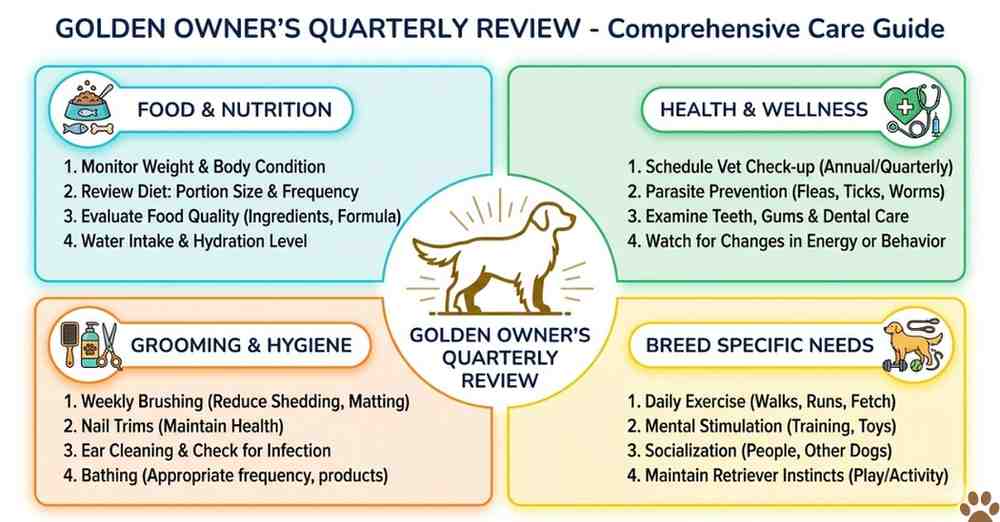
I teach every new Golden owner something I call the Golden Owner’s Quarterly Review, a four-area check they do every three months, aligned to the seasons, to catch drift before it becomes a problem.
Food
Is your dog’s current diet matched to their actual life stage? A food formulated for puppies contains excess calcium, which stresses developing joints. A food formulated for seniors cuts calories that an active five-yeas old still needs. Taurine should appear as a listed supplement, or the formula should avoid legumes in the top five ingredients, given the documented link between legume-heavy grain-free diets and dilated cardiomyopathy in this breed.
Health
Run the body check. Feel the neck, armpits, and behind the knees for enlarged lymph nodes. Part the coat against the grain at the base of the tail and belly to check for skin changes. Watch the dog rise from rest and walk twenty steps. These three observations take four minutes and catch more between annual exams than owners expect.

Grooming
Check whether your brushing frequency still matches the season. During spring and fall coat blows, Goldens need daily brushing, not the three-times a week schedule that works in calmer shedding months. Ear health matters year-round; lift both ear flaps and check for odor or dark discharge at least monthly, since Goldens’ floppy ears trap moisture and are more prone to otitis externa than those of upright-eared breeds.
Breed needs
Is the dog getting 60 to 90 minutes of active exercise daily? Is mental stimulation part of the routine, not just physical output? Goldens bred for fieldwork redirect that drive into destructive behavior or anxiety when daily needs go unmet. An under-exercised Golden and a dog with a behavioral problem often look identical from the outside.
For owners who want to go deeper across any of these areas, the full category resources covering Golden Retriever insights on food, health, grooming, and breed care are built around the same clinical framework I use with patients.
In a case from October 2024, a 2-years old male Golden, 71 lbs, was referred for what the owner described as destructive chewing and hyperactivity that had worsened over several months.
Outcome: Diet adjusted for life stage, daily exercise increased from 30 to 75 minutes, and a structured 10-minute training session was added each morning. Behavioral symptoms resolved within 6 weeks without medication.
Are Golden Retrievers High Maintenance? An Honest Answer
Goldens are moderate to high maintenance, depending on how you define the term. They don’t tolerate long periods alone well, shed twice a year substantially, and have a higher joint and cancer risk than many other popular breeds.
What they give back makes most owners consider the effort worthwhile, but going in with accurate expectations prevents the frustration I see in owners who expected a low-effort family dog and got something considerably more engaged.
The maintenance that matters most isn’t the grooming or the exercise. It’s the monthly health checks, the twice-yearly vet visits for seniors, and the willingness to adjust their care as they age rather than keeping the same routine from puppyhood to old age.
Call your vet this week if your golden shows the following:
· A new lump that wasn’t there last month, especially if it's firm or growing
· Exercise intolerance during activities they previously handled without difficulty.
· Sustained appetite loss lasting more than 48 hours
Monitor for over 24 to 48 hours:
· Mild stiffness after rest that loosens within 10 minutes of movement
· A single loose stool with no blood and normal energy
· Mild ear odor without visible discharge or head shaking
What do Golden Retrievers need most from their owners?
Golden Retrievers need daily exercise of 60 to 90 minutes, consistent mental stimulation, and active health monitoring from year five onward. Owners who adjust their care habits as the dog ages, rather than maintaining a fixed routine, consistently achieve better long-term outcomes.
How long do Golden Retrievers live?
Golden Retrievers typically live 10 to 12 years. Weight management, early detection of breed-specific conditions like hip dysplasia and cancer, and twice-yearly vet exams from age seven onward all influence where a dog lands in that range.
Are Golden Retrievers high-maintenance compared to other breeds?
Golden Retrievers are moderately high-maintenance. Their coat requires frequent brushing, their exercise needs are substantial, and their elevated cancer and joint disease risk requires more active health monitoring than most breeds of comparable size.
Can Golden Retrievers be left alone during the day?
Adult Golden Retrievers can tolerate up to four hours alone comfortably. Beyond that, most develop signs of separation-related distress. A predictable routine and adequate exercise before departure reduce most mild anxiety responses.
What health problems are Golden Retrievers most prone to?
Golden Retrievers face elevated rates of hip dysplasia, cancer, hypothyroidism, and ear infections compared to most breeds. Cancer affects approximately 60% of American Goldens, making monthly lump checks and regular veterinary monitoring especially important from age five onward.
Conclusion
The Golden Retriever insights that matter most aren’t about puppyhood. They’re about what comes after, the life-stage adjustments to food, health monitoring, grooming frequency, and exercise that keep this breed thriving into their senior years. Run the quarterly review every three months, build the monthly health check habit now, and treat any new lump in a golden over five as something to evaluate this week. What’s the one area of Golden’s care you’ve been meaning to revisit?