HVAC System Market Future Outlook: Electrification, Sustainability & Smart Controls
-
- April 25th, 2026
- 7,268 views
What is the HVAC system market?
The HVAC system market refers to the global industry dedicated to technologies that provide heating, ventilation, and air-conditioning solutions across residential, commercial, and industrial settings. These systems play a critical role in maintaining indoor comfort by controlling temperature, airflow circulation, humidity balance, and air cleanliness, while also supporting operational productivity and compliance with environmental regulations.
Modern HVAC technologies are rapidly advancing through the integration of smart sensors, automated control platforms, and environmentally friendly refrigerants. As a result, conventional climate-control equipment is evolving into intelligent infrastructure systems that support connected and energy-efficient buildings.
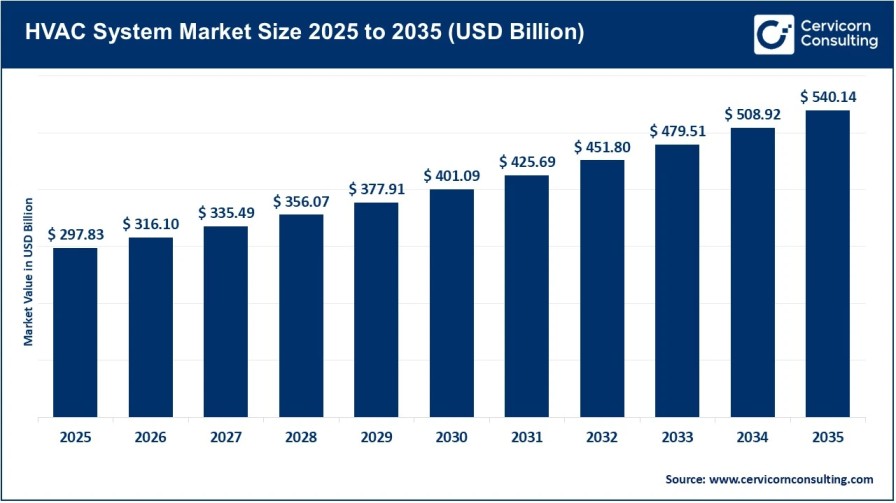
According to industry estimates, the global HVAC system market was valued at USD 297.83 billion in 2025 and is projected to reach approximately USD 540.14 billion by 2035, growing at a CAGR of 6.2% during the forecast period 📈.
Key growth drivers of the HVAC system market
Rising urbanization and infrastructure expansion
Accelerating urban population growth is significantly increasing demand for residential apartments, commercial complexes, retail centers, and large-scale data infrastructure. With more than 60% of the world’s population expected to live in urban areas by 2030, the need for advanced centralized climate-control systems continues to expand rapidly.
Emerging economies such as India and several Southeast Asian countries are playing a major role in market growth due to ongoing construction activity and increasing household adoption of air-conditioning solutions.
Stronger energy-efficiency regulations and sustainability initiatives
Governments worldwide are enforcing stricter building performance regulations aimed at reducing emissions and improving environmental sustainability. These policies are accelerating the replacement of legacy HVAC equipment with next-generation systems that use low global-warming-potential refrigerants and electrified heating technologies.
Manufacturers are increasingly transitioning toward advanced refrigerants such as R-32 and R-454B, which are now incorporated in a significant share of newly deployed HVAC systems.
Increasing emphasis on indoor air quality management
Growing awareness regarding indoor air pollution—especially following recent global health concerns—has substantially increased demand for ventilation and purification technologies across sectors.
This shift is encouraging adoption of:
- air purification systems
- ventilation solutions
- advanced filtration technologies
- humidification and dehumidification equipment
Indoor air quality has become a priority consideration in the planning of homes, hospitals, workplaces, and educational institutions 🌍.
Read Full Report: https://www.cervicornconsulting.com/hvac-system-market
Major technology trends shaping the HVAC system market
Artificial intelligence–enabled predictive maintenance
Artificial intelligence is transforming HVAC servicing models by enabling predictive diagnostics instead of reactive maintenance strategies. Smart monitoring solutions can reduce unexpected repair expenses by nearly 22% and increase compressor life expectancy by approximately 18%, improving system reliability and efficiency.
Expansion of variable refrigerant flow (VRF) systems
Variable refrigerant flow technology is gaining strong adoption across commercial buildings because it enables simultaneous heating and cooling across multiple zones while improving energy performance by up to 30% compared with traditional rooftop systems.
Adoption of smart thermostats and IoT-connected HVAC platforms
Integration of IoT technologies allows HVAC systems to support:
- real-time operational monitoring
- remote temperature management
- occupancy-based automation
- predictive maintenance alerts
The smart thermostat segment alone is expected to grow at nearly 15% CAGR through 2028, reflecting the increasing transition toward intelligent building ecosystems 📊.
Increasing deployment of geothermal heat pump systems
Geothermal heat pumps are becoming popular residential heating alternatives due to their high operational efficiency. These systems typically deliver performance coefficients between 3.0 and 6.0, making them attractive long-term energy-saving solutions.
HVAC system market segmentation analysis
By heating equipment
Heat pumps currently dominate the heating equipment category, accounting for roughly 42% of market share, supported by electrification trends and global decarbonization strategies.
Unitary heaters are also witnessing strong adoption due to their affordability and ease of installation across warehouses and commercial facilities.
By cooling equipment
Cooling equipment represents the largest revenue-generating segment within the HVAC system market.
Key subsegments include:
- unitary air conditioners – 32%
- variable refrigerant flow systems – 20%
- chillers – 16%
- room air conditioners – 14%
Unitary air conditioners remain the most widely adopted solutions because of their standardized installation requirements and strong residential demand.
By ventilation equipment
Air-handling units contribute nearly 30% of the ventilation equipment segment, reflecting their essential role in centralized HVAC infrastructure.
Meanwhile, air purifiers represent the fastest-growing subsegment due to increasing global awareness of indoor air quality improvements.
By installation type
New construction projects account for approximately 58% of total market revenue, supported by rising infrastructure investments worldwide.
Replacement installations are also expanding steadily as older HVAC systems are upgraded to meet modern efficiency requirements.
By end-user industry
The residential sector holds the largest share of the HVAC system market at nearly 41%, driven by increasing disposable income levels and rising adoption of cooling appliances.
The commercial sector is expected to experience the fastest growth due to expanding demand across:
- healthcare facilities
- hospitality infrastructure
- retail environments
- hyperscale data centers
Regional insights in the HVAC system market
Asia-Pacific leading global demand
Asia-Pacific accounted for approximately 49% of global HVAC system market share in 2025, making it the largest regional contributor.
Major growth factors include:
- rapid urban expansion
- infrastructure modernization
- smart city initiatives
- growing middle-class populations
India is emerging as one of the fastest-growing markets globally due to relatively low air-conditioning penetration and supportive national cooling programs.
North America supported by replacement demand cycles
Growth across North America is largely driven by replacement demand and policy incentives encouraging adoption of high-efficiency heat pump technologies.
Government electrification initiatives and tax benefits are accelerating residential HVAC upgrades across the United States.
Europe shifting toward low-carbon heating technologies
Europe’s HVAC industry continues to expand steadily as countries transition toward climate-neutral energy strategies.
Major economies such as Germany and France are increasingly replacing traditional gas-based boilers with heat pump technologies.
LAMEA showing climate-driven expansion opportunities
Countries across the Middle East and Latin America are witnessing increasing HVAC adoption due to extreme temperature conditions and expanding industrial development.
Large-scale infrastructure investments across Gulf nations are particularly supporting strong demand for chiller systems 🌡️.
Competitive landscape of the HVAC system market
Key companies operating in the HVAC system market include:
- Daikin Industries Ltd.
- Carrier Global Corporation
- Johnson Controls International plc
- Trane Technologies plc
- LG Electronics Inc.
- Mitsubishi Electric Corporation
- Panasonic Holdings Corporation
- Honeywell International Inc.
- Robert Bosch GmbH
These organizations are actively investing in AI-enabled HVAC platforms and environmentally sustainable refrigerant technologies.
Recent industry developments
Several strategic initiatives are reshaping the competitive landscape:
- Carrier strengthened its European footprint through the acquisition of Viessmann Climate Solutions
- Johnson Controls agreed to transfer its residential HVAC division to Bosch to strengthen its smart-building technology focus
- LG Electronics introduced next-generation AI-powered HVAC solutions designed to enhance energy optimization performance
Future outlook of the HVAC system market
The HVAC system market is expected to remain a key component of global infrastructure development as urbanization accelerates and sustainability regulations become increasingly stringent.
Future growth will be supported by:
- electrification of heating systems
- expansion of smart HVAC ecosystems
- tightening global decarbonization mandates
- rising healthcare and data center infrastructure investments
- increasing awareness regarding indoor air quality improvement
With strong regulatory support and rapid adoption of intelligent building technologies, HVAC systems are evolving from traditional climate-control equipment into essential pillars of next-generation energy-efficient infrastructure environments 🚀