MakeMyTrip Hotel API Data Extraction
-

- Published Updated
- 35 views
Introduction
This case study explores how a travel business strengthened hotel intelligence, pricing visibility, availability tracking, and destination-level analysis through structured hotel data collection from MakeMyTrip. The client required dependable information to understand changing hotel rates, inventory movements, room availability, property listings, and booking trends across multiple destinations. By implementing MakeMyTrip Hotel API Data Extraction, the business could organize large volumes of hotel information into a consistent analytical framework. The solution also incorporated Real-Time Hotel Data Scraping API architecture to support frequent updates. In addition, MakeMyTrip hotel availability data extraction helped the client monitor room-level availability and identify changes across properties. The collected dataset included hotel names, destinations, room categories, prices, ratings, amenities, availability, and listing information. This enabled the client to improve competitive benchmarking, pricing analysis, inventory monitoring, demand planning, and broader travel intelligence while reducing dependence on fragmented manual research processes.
The Client
The client was a travel technology and hotel intelligence company seeking structured accommodation data from one of India's major online travel platforms. Its objective was to monitor hotel inventory, compare pricing patterns, evaluate destination coverage, and improve accommodation-related business intelligence. The company required scalable datasets that could support frequent analysis across destinations, properties, room categories, prices, ratings, and availability. Through Scraping Makemytrip Hotels Data, the client sought to create a centralized repository capable of supporting competitive research and commercial decision-making. MakeMyTrip hotel inventory data monitoring was also required to identify inventory changes and listing movements over time. In addition, the client needed Scrape MakeMyTrip Pricing Data capabilities to compare hotel rates across destinations, property categories, dates, and room types. The resulting intelligence was intended for pricing teams, revenue analysts, travel platforms, and business development professionals requiring timely and structured hotel market information.
Challenges in the Travel Industry
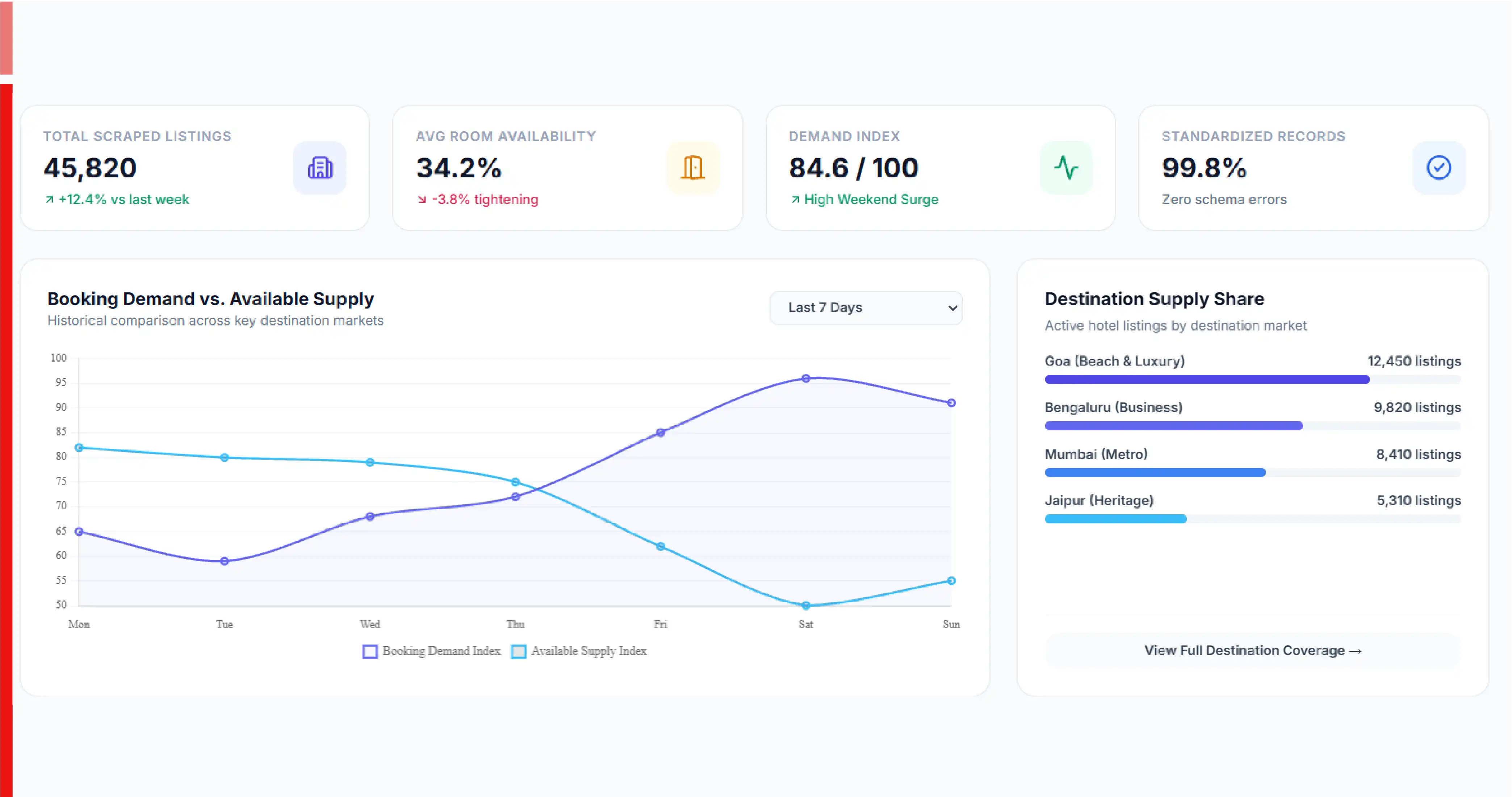
The client faced several operational challenges while attempting to collect, standardize, and interpret rapidly changing hotel information across destinations. These challenges affected pricing intelligence, inventory visibility, property comparison, availability monitoring, and demand planning.
Destination-Level Listing Coverage
The client needed Scrape MakeMyTrip destination-wise hotel listings data to understand accommodation supply across different markets. Hotel listings varied by destination, property type, ratings, and availability, making consistent destination-level collection difficult. Missing or inconsistent listings could reduce the reliability of competitive market analysis.
Room Availability Visibility
Monitoring Room Type Availability was another challenge because hotels could show different inventory levels for individual room categories. Availability could change frequently according to booking activity, cancellations, stay dates, and inventory controls, requiring systematic data collection to identify meaningful availability movements.
Demand Forecasting Complexity
The client needed stronger intelligence for MakeMyTrip hotel booking demand forecasting because historical pricing and availability patterns could change rapidly. Seasonal travel, holidays, destination events, weekends, and changing consumer preferences created fluctuations that made manual forecasting difficult without structured historical hotel datasets.
API and Data Accessibility
Integrating a reliable MakeMyTrip hotel API workflow required consistent extraction, transformation, validation, and delivery processes. The client needed data in structured formats while maintaining frequent collection cycles, ensuring that pricing, property, room, and availability information remained suitable for downstream analytics.
Property-Level Comparisons
Conducting Property Listing Analysis across thousands of hotel records was challenging when information differed in naming conventions, room descriptions, amenities, ratings, and pricing structures. The client needed standardized fields to compare properties accurately and identify market-level differences without relying on fragmented manual research.
Our Approach
Scalable Hotel Data Collection
We developed a scalable collection framework capable of capturing hotel information across selected destinations and property categories. The process gathered core listing attributes, room details, pricing information, ratings, amenities, availability indicators, and destination metadata while supporting recurring extraction schedules.
Structured Data Standardization
Collected information was transformed into standardized fields to improve consistency across properties and destinations. Hotel names, room types, prices, ratings, locations, amenities, and availability attributes were normalized, allowing the client to perform comparisons without repeatedly cleaning inconsistent source information.
Pricing and Inventory Monitoring
The solution captured hotel pricing and inventory information at scheduled intervals, enabling the client to observe changes over time. Historical records could then be compared with newer observations to identify price movements, inventory fluctuations, room-level changes, and destination-specific accommodation trends.
Destination and Property Intelligence
We organized hotel records by destination, property, category, rating, room type, and other relevant attributes. This structure enabled analysts to evaluate destination supply, compare competing properties, identify pricing differences, and examine how hotel listings changed across multiple markets.
Data Delivery for Analytics
The processed hotel dataset was prepared in structured formats suitable for dashboards, databases, analytical workflows, and internal reporting systems. Validation checks were incorporated to improve completeness and consistency, helping the client use regularly refreshed hotel intelligence for commercial and strategic analysis.
Results Achieved
The implementation improved the client's ability to organize, monitor, compare, and analyze hotel information at scale. The following outcomes demonstrate the operational impact achieved through structured hotel intelligence.
Expanded Hotel Data Coverage
The client gained access to a broader and more consistently structured collection of hotel records across multiple destinations. This improved visibility into properties, room categories, ratings, amenities, prices, and availability while reducing fragmented research and repetitive manual collection activities.
Improved Pricing Intelligence
Regularly collected pricing observations enabled the client to compare hotel rates across destinations, property categories, room types, and observation periods. This supported more systematic benchmarking and helped analysts identify changes in accommodation pricing patterns for commercial research.
Stronger Inventory Monitoring
The client could monitor hotel inventory and room-level availability more systematically. Recurring observations created historical records that helped analysts identify availability changes, compare inventory conditions, and understand how accommodation supply shifted across destinations and property categories.
Better Destination Analysis
Destination-level hotel datasets enabled analysts to evaluate accommodation supply, property concentration, pricing differences, and listing characteristics across markets. This improved market research capabilities and provided a structured foundation for identifying destination-specific trends and competitive opportunities.
Faster Analytical Workflows
Automated collection and structured processing reduced the effort required to manually gather hotel information. Analysts received cleaner, standardized datasets that could be integrated into dashboards, reporting systems, forecasting workflows, and broader travel intelligence applications.
Hotel Data Performance Snapshot
| Metric | January 2026 | February 2026 | March 2026 | April 2026 | May 2026 | June 2026 | July 2026 | August 2026 |
|---|---|---|---|---|---|---|---|---|
| Hotel Records Processed | 48,500 | 52,800 | 56,400 | 61,200 | 65,700 | 69,500 | 73,800 | 78,600 |
| Destinations Covered | 42 | 47 | 51 | 56 | 61 | 66 | 72 | 78 |
| Properties Monitored | 8,250 | 9,140 | 10,280 | 11,460 | 12,780 | 13,950 | 15,240 | 16,850 |
| Room Types Tracked | 14,600 | 16,100 | 17,900 | 20,300 | 22,700 | 24,800 | 27,100 | 30,400 |
| Pricing Observations | 92,500 | 101,600 | 113,200 | 124,800 | 137,400 | 149,700 | 163,900 | 179,500 |
| Availability Observations | 74,200 | 81,500 | 90,700 | 101,400 | 111,800 | 123,600 | 136,200 | 149,800 |
| Ratings Captured | 7,980 | 8,850 | 9,960 | 11,200 | 12,450 | 13,700 | 14,950 | 16,400 |
| Amenities Records | 31,600 | 34,900 | 38,700 | 42,800 | 47,200 | 51,600 | 56,700 | 62,100 |
| Data Refresh Cycles | 8 | 10 | 12 | 14 | 16 | 18 | 20 | 22 |
| Validation Accuracy (%) | 95.8 | 96.1 | 96.4 | 96.7 | 97.0 | 97.2 | 97.4 | 97.6 |
Client's Testimonial
"Working with the data intelligence team transformed the way we approach hotel market research. Previously, our analysts spent considerable time gathering hotel prices, availability, property details, and destination information from different sources. The structured MakeMyTrip dataset gave us a much more organized foundation for pricing comparisons, inventory monitoring, and market analysis. We particularly valued the recurring data collection process because hotel information changes frequently and historical observations are essential for understanding those movements. The standardized output also made it easier for our teams to connect the data with internal dashboards and analytical workflows. The solution has improved research efficiency and provided greater visibility across our target accommodation markets."
— Head of Travel Intelligence, Client Organization
Conclusion
The case study demonstrates how structured hotel data collection can strengthen accommodation intelligence for travel businesses operating in dynamic markets. By collecting hotel listings, prices, room information, ratings, amenities, availability, and destination attributes, the client established a more comprehensive foundation for competitive analysis and market monitoring. The solution reduced manual research requirements while improving consistency and supporting recurring data refreshes. Businesses seeking scalable Travel Aggregators Data Scraping Services can use similar approaches to build structured accommodation datasets for pricing, inventory, and market intelligence. Reliable Travel Industry Web Scraping Services can further support historical analysis and competitive benchmarking across travel platforms. Meanwhile, a Travel Mobile App Scraping Service can extend data coverage to mobile-focused travel environments, helping businesses maintain broader visibility into changing hotel markets and customer-facing accommodation information.