Stop Giving Every Subject Equal Time: A NEET PG Revision Triage System
-

- Published Updated
- 56 views
About NEETPGAI: NEETPGAI is an exam-preparation platform focused on practical NEET PG learning workflows. This independently explained framework uses measurable recall signals instead of timetable guesswork.
Use retrieval accuracy, revision age and repeat errors to decide what deserves your next study block.
Patrizia Fairs, Independent Medical Education Writer — NEET PG, INI-CET & FMGE
I turn learning evidence and medical-entrance workflows into practical systems that candidates can measure and adjust.
Last updated: October 7, 2026
An equal-hours timetable looks disciplined but answers the wrong question. Your NEET PG revision strategy should not ask, “Have I given every subject the same time?” It should ask, “Which subject is most likely to waste my next question attempt unless I revisit it now?”
Use three signals: recent closed-book accuracy, days since the last successful retrieval and recurrence of the same error family. Score each subject weekly, place it in a red, yellow or green queue, and allocate practice time accordingly.
Quick facts
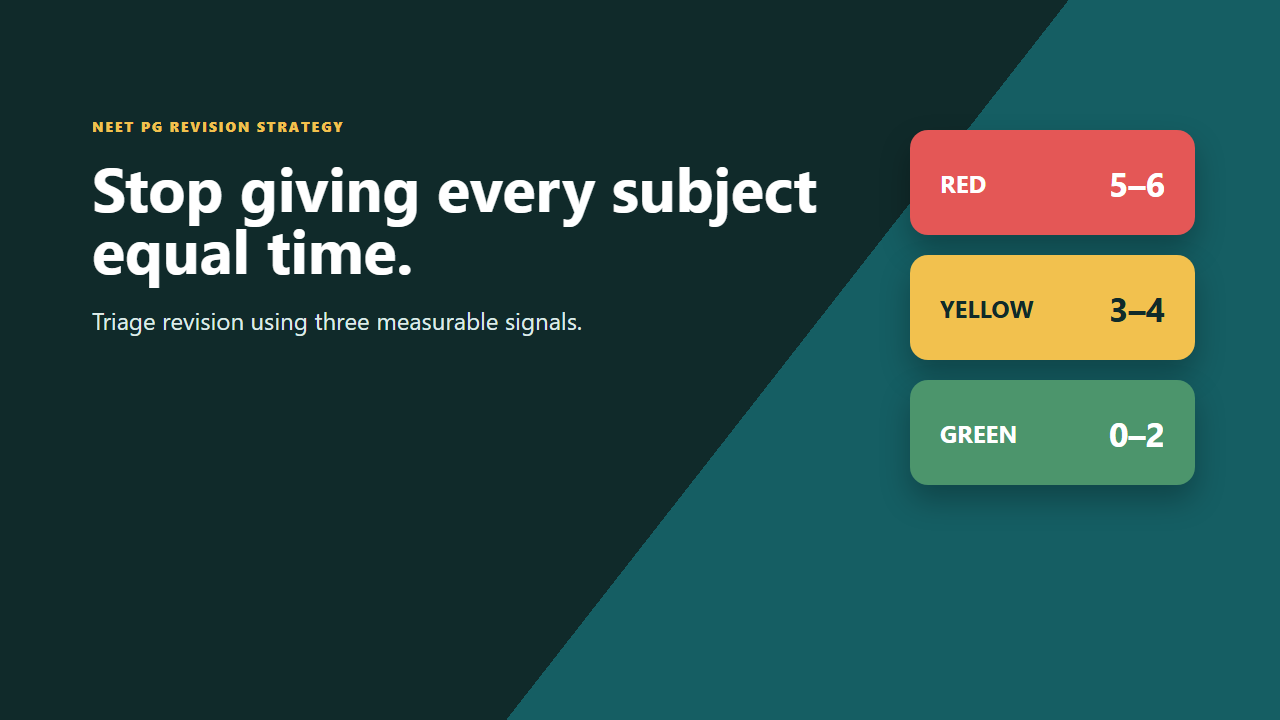
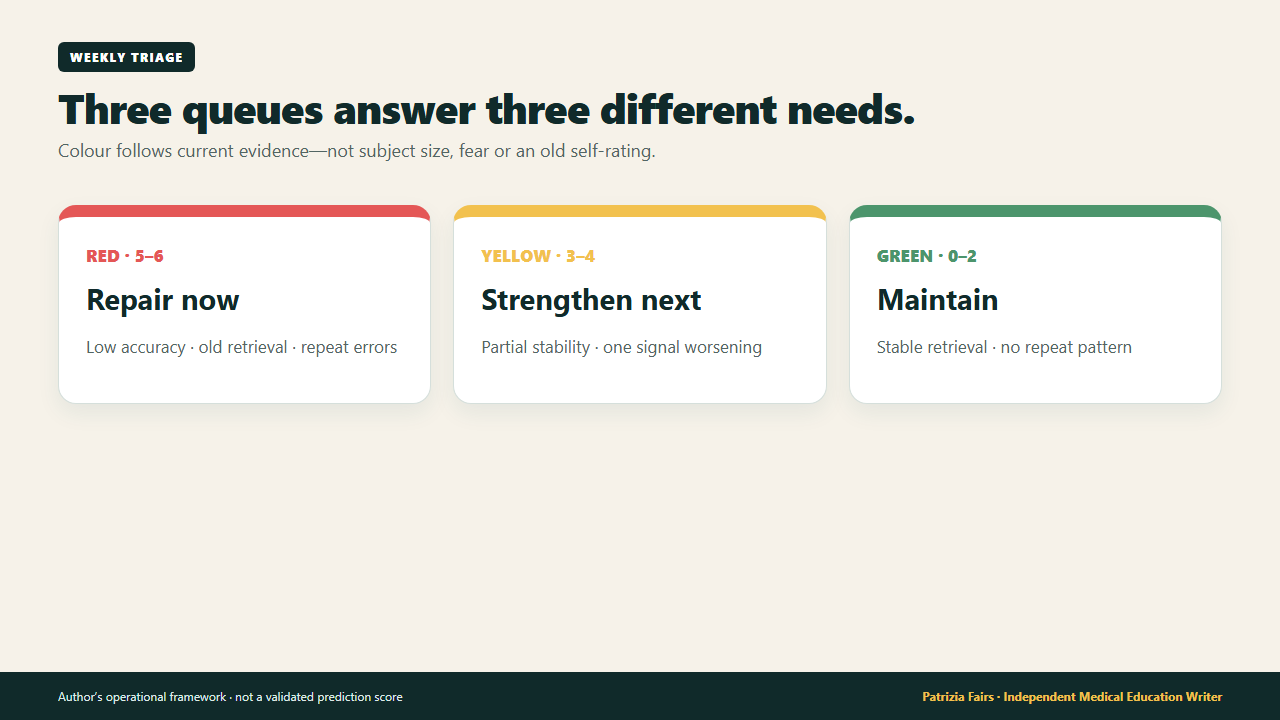
Red: 5–6 points; urgent retrieval and repair
Yellow: 3–4 points; scheduled strengthening
Green: 0–2 points; mixed-question maintenance
Weekly split: 50% red, 30% yellow, 20% green
Reset: recalculate every seven days
The thresholds and time split are an operational framework, not a validated prediction model. Their value is forcing a consistent decision from your own performance data.
This is triage, not neglect. Red subjects receive repair, yellow subjects receive strengthening and green subjects still receive maintenance. The system prevents two familiar extremes: repeatedly polishing a favourite subject because it feels rewarding, or spending an entire week inside one weak subject until everything else begins to fade.
Why Does Equal-Time Revision Fail?
Equal-time revision fails because knowledge does not decay equally and weakness is context-specific. A subject revised yesterday with strong retrieval does not need the same block as a subject you last recalled poorly two weeks ago.
The common alternative—rating subjects as “strong” or “weak” from memory—is also unreliable. In a study of 283 medical students across five years, correct cases attracted higher confidence ratings than incorrect cases (57.3% versus 41.8%) and were solved faster (25.6 versus 52.0 seconds). The authors found that monitoring depended on the particular case, not just a general sense of ability.
Professor Wolf Hautz of the University Hospital Bern and colleagues concluded that “the accuracy of self-monitoring is context specific” in their medical-student monitoring study. That is the reason this system uses recent question behaviour rather than a label you gave yourself three months ago.
Which Three Signals Should Set Subject Priority?
Use retrieval accuracy, revision age and repeat-error frequency. Each signal catches a different failure: current performance, likely fading and unresolved misconception.
Signal 1: recent retrieval accuracy
Take the most recent 40–60 closed-book MCQs from the subject. Score two points below 60% accuracy, one point from 60–79%, and zero points at 80% or above.
This is not an examination forecast. It is a stable-enough practice sample for a weekly decision. Exclude abandoned sets, open-book attempts and tiny samples that let three lucky guesses distort the label.
Signal 2: revision age
Count days since you last retrieved the topic successfully, not days since you watched or read it. Score two points after more than 14 days, one point at 7–14 days, and zero points below 7 days.
The distinction matters because exposure and retrieval are not equivalent. A two-year medical-sciences programme used 14 exams of 80 questions and analysed 2,006 regular questions plus 1,728 retrieval-practice questions. The researchers reported that their data indicated preservation of knowledge possibly related to retrieval practice and spacing.
Researcher Stijn Donker and colleagues wrote that the findings “highlight the potency of retrieval practice questions to prevent knowledge decrement” in the spaced-learning study. Your revision-age clock therefore resets after a successful closed-book check, not after highlighting a page.
Signal 3: repeat-error frequency
Count how often the same error family returned across your last three practice blocks. Score two points for three or more repeats, one point for one or two repeats and zero when it did not recur.
Track the family, not the exact question. “Mixed up nephritic and nephrotic urine findings” is a reusable error family. “Got question 27 wrong” is not. A clear comparison method, such as reading the urine pattern before naming the syndrome in this nephrotic-versus-nephritic guide, converts the repeat into a decision rule.
How Do You Calculate the Red Yellow Green Score?
Add the three signal scores to obtain a total from 0 to 6. Red is 5–6, yellow is 3–4 and green is 0–2.

| Signal | 0 points | 1 point | 2 points |
|---|---|---|---|
| Retrieval accuracy | 80% or above | 60–79% | Below 60% |
| Revision age | Under 7 days | 7–14 days | Over 14 days |
| Repeat errors | None | 1–2 repeats | 3+ repeats |
Example: Pathology accuracy is 68% (one point), the last successful retrieval was 16 days ago (two points), and three related errors returned (two points). Total: 5 points, red.
Another subject may feel frightening yet score green because your recent mixed-question performance is stable. Follow the evidence, not the drama. The system is allowed to disagree with your mood.
Do not compare totals between candidates. Thresholds operate on your study record, question source and current stage. If your MCQ sets vary wildly in difficulty, use a rolling median or keep one consistent source for the weekly sample.
How Should You Allocate Weekly Revision Time?
Allocate 50% of subject-practice time to red, 30% to yellow and 20% to green. Protect green maintenance so strong subjects do not disappear until the next mock.

For 10 weekly practice hours, that becomes five red hours, three yellow hours and two green hours. These are calculated examples, not universal prescriptions.
Use the queues differently:
- Red blocks: retrieve the core framework, repair one misconception and solve a focused set.
- Yellow blocks: mix subtopics, shorten prompts and test transfer.
- Green blocks: use mixed, timed questions with minimal review unless a new pattern appears.
Divide time within a queue by evidence. If four subjects are red, do not automatically give each 75 minutes. Give the first block to the highest repeat-error count, then the oldest successful retrieval, then the lower accuracy.
Watching more content is not automatically a red-subject intervention. If your plan is still dominated by passive input, the earlier guide on video lectures versus active practice explains why the second layer must include questions, feedback and retrieval.
Should You Study One Red Subject Until It Turns Green?
No. Use repeated short contacts rather than one rescue marathon. A red subject needs repair plus spacing, not a six-hour punishment block that creates temporary familiarity.

A practical four-contact cycle is:
- Diagnose: 20–30 closed-book questions and one error-family summary.
- Repair: review only the deciding concepts and build compact prompts.
- Retrieve: return after a gap without reopening the notes.
- Transfer: solve a mixed set where the subject is not announced in advance.
Medical-education evidence supports caution about oversimplified schedules. In an 80-student, 2 × 2 study of electrocardiogram interpretation, distributed instruction beat massed instruction on immediate and delayed tests; delayed scores were 34% versus 24%. Yet blocked practice also beat mixed practice in that specific delayed test.
Professor Ameen Patel of McMaster University and colleagues noted that students in the distributed group had higher immediate and delayed scores in their ECG learning study. The lesson is not “always interleave everything.” Space the contacts, then increase mixing when the foundational discrimination is reliable.
When Does a Subject Move Between Colours?
Recalculate once a week using a fresh closed-book sample. Promote or demote from evidence; do not repaint a subject midway through a single emotional session.

- Red to yellow: accuracy clears 60%, the repeat-error count falls, and a spaced retrieval succeeds.
- Yellow to green: accuracy reaches at least 80%, retrieval is recent and no error family repeats.
- Green to yellow: mixed-set accuracy falls or the last successful retrieval ages past seven days.
- Any colour to red: the total reaches five or six on the weekly reset.
Do not demand perfection. A subject can move to yellow while one difficult subtopic remains red; keep the subtopic in a separate repair list. Subject colour controls time allocation, not your identity as a “good” or “bad” student.
What Should the Sunday Reset Look Like?
The reset should take 25 minutes: update three signals, sort the queues, assign blocks and stop. Planning that consumes the time meant for practice has failed.
Use this sequence:
- Export or note the latest subject-wise accuracy.
- Mark the last successful closed-book retrieval date.
- Count recurring error families from the last three blocks.
- Calculate totals and sort red, yellow and green.
- Place the next seven days of blocks on the calendar.
- Reserve one mixed maintenance block before filling optional study time.
Keep a dated snapshot. After four weeks, compare movement: which subjects stayed red, which repairs promoted them and which “green” subjects repeatedly decayed? That is original evidence about your learning system.
Interpret the trend, not one isolated score. A subject that briefly turns red after a difficult mixed set may need confirmation rather than an immediate timetable overhaul. By contrast, a subject that remains yellow for three weekly resets is signalling a stalled method: change the question mix, shorten the feedback loop or split the subject into smaller systems. Also record why a block failed—knowledge gap, misreading, confusion between close options or slow recall. Two subjects with the same accuracy can need different repairs. The colour decides where time goes; the error label decides what you do during that time. This distinction keeps the triage system responsive without letting one bad session dictate the entire week.
Frequently Asked Questions
Q: Is this score validated for NEET PG?
No. It is an operational framework for weekly prioritisation, not a validated score, rank predictor or official recommendation.
Q: How many MCQs should determine accuracy?
Use a recent 40–60 question closed-book sample where possible. Smaller samples are noisier; combine sets before changing colour.
Q: Should subject weightage affect the colour?
Do not use unofficial weightage predictions. The three-signal score intentionally measures your current learning need rather than guessing future question counts.
Q: Can every subject be red at once?
If that happens, rank red subjects by repeat errors, revision age and accuracy. The colour is a queue; it does not create extra hours.
Q: What if accuracy improves but confidence remains low?
Trust repeated closed-book performance more than a vague feeling. Keep one yellow check before promotion if the improvement came from only one set.
Q: Should green subjects receive zero time?
No. The 20% maintenance allocation prevents stable subjects from disappearing until they decay.
Q: How often should I recalculate?
Once weekly is usually enough. Repainting after every set creates noise and encourages emotional planning.
Build Next Week From Evidence
Choose three subjects tonight and calculate the score honestly. Schedule one red repair block, one yellow strengthening block and one green maintenance block before designing the rest of the week.
For multi-subject question sets and focused revision, use NEET PG subject practice to generate the performance evidence that keeps the queues current. Your timetable should change when your retrieval changes—not when a new colour-coded planner arrives.
NEETPGAI publishes practical revision frameworks that help candidates turn question-practice evidence into weekly study decisions.
This content is for exam preparation and educational purposes only. Always refer to official National Board of Examinations in Medical Sciences (NBEMS), All India Institute of Medical Sciences (AIIMS) and National Medical Commission (NMC) notifications for current exam information. It is not medical advice.