Salesforce Implementation Services: A Complete Guide for Growing Businesses
-

- Published Updated
- 2,196 views
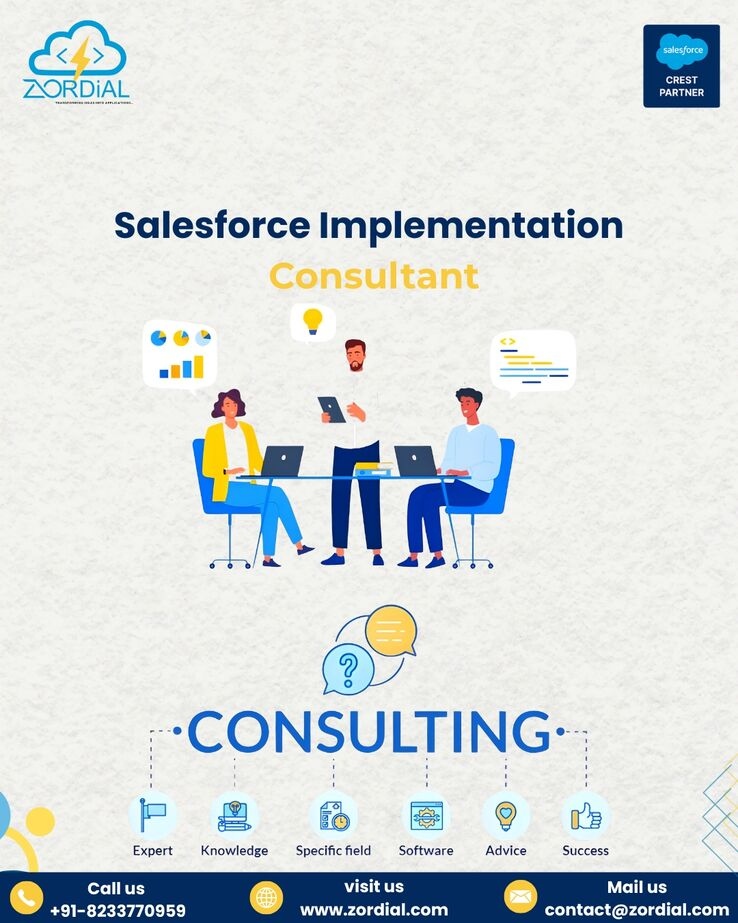
Businesses today need more than just a CRM system to manage customer relationships. They need a platform that can connect sales, service, marketing, operations, and customer data in one place. This is where Salesforce Implementation Services can make a significant difference.
Salesforce is one of the world's leading customer relationship management platforms, but simply purchasing Salesforce does not guarantee business success. A successful implementation requires careful planning, configuration, data migration, integrations, user training, testing, and ongoing optimization.
For organizations looking to get the most value from Salesforce, working with an experienced Salesforce Implementation Partner can help reduce complexity and create a CRM environment aligned with specific business goals.
What Are Salesforce Implementation Services?
Salesforce Implementation Services involve the complete process of planning, configuring, customizing, deploying, and optimizing Salesforce according to an organization's business requirements.
An implementation typically begins with understanding the company's existing processes and identifying areas where Salesforce can improve productivity and customer engagement. The implementation team then creates a roadmap covering Salesforce configuration, automation, integrations, data migration, security, testing, and deployment.
A professional implementation can help businesses:
- Centralize customer and business information
- Improve sales and service processes
- Automate repetitive tasks
- Create better reporting and dashboards
- Improve collaboration between teams
- Integrate Salesforce with existing business applications
- Build scalable CRM processes for future growth
The objective is not simply to install Salesforce. The objective is to create a CRM ecosystem that supports measurable business outcomes.
Why Businesses Need a Salesforce Implementation Partner
Salesforce is highly flexible, which is one of its biggest advantages. However, this flexibility can also make implementation complicated, particularly for organizations without an experienced technical and consulting team.
A Salesforce Implementation Partner can bring together business analysis, Salesforce expertise, project management, integration knowledge, and deployment experience.
An experienced partner can help determine which Salesforce features are actually needed instead of adding unnecessary customizations. This can make the system easier to maintain and more scalable over time.
A good implementation partner should understand both technology and business processes. They should be able to translate business requirements into practical Salesforce solutions while considering security, performance, usability, and long-term growth.
Key Stages of a Salesforce Implementation
A successful Salesforce implementation generally follows a structured process.
1. Business Discovery and Requirement Analysis
The first stage is understanding the organization's goals, current workflows, pain points, users, and existing technology.
A Salesforce implementation consultant may work with sales, customer service, marketing, management, and other stakeholders to document requirements.
This stage helps establish priorities and prevents the project from becoming unnecessarily complicated.
2. Salesforce Solution Design
Once requirements are understood, the implementation team designs the Salesforce architecture.
This can include:
- Object and data model design
- User roles and permissions
- Sales and service processes
- Automation requirements
- Reporting requirements
- Integration architecture
- Custom functionality
The solution should be designed around business requirements rather than simply replicating every existing process.
3. Salesforce Configuration and Customization
Salesforce provides extensive configuration capabilities that can be used without developing everything from scratch.
Implementation teams may configure fields, objects, page layouts, workflows, approval processes, reports, dashboards, and automation.
When standard Salesforce functionality cannot meet a specific requirement, appropriate customization or development may be considered.
The key is to maintain a balance between customization and maintainability.
4. Data Migration
Data migration is one of the most important parts of a CRM implementation.
Organizations often have customer information stored across spreadsheets, legacy CRM systems, databases, and other applications. Before migrating this information into Salesforce, data should be reviewed, cleaned, mapped, and validated.
A structured migration process helps minimize duplicate records, incomplete information, and data-quality problems.
5. Integration
Modern businesses rarely operate with a single application. Salesforce may need to communicate with ERP systems, accounting platforms, marketing tools, websites, customer portals, communication platforms, or other business applications.
Salesforce integration services can connect these systems and help create a more unified flow of information.
Well-designed integrations can reduce manual data entry and provide users with more complete customer information.
6. Testing and Deployment
Before Salesforce is launched across an organization, the implementation should be thoroughly tested.
Testing can cover functionality, integrations, automation, security, data, user permissions, and business workflows.
User acceptance testing is particularly important because employees who will use Salesforce every day can identify practical issues that may not be visible during technical testing.
After successful testing, the solution can be deployed into the production environment.
7. User Training and Adoption
Even a technically excellent Salesforce implementation can fail to deliver results if employees do not use the system correctly.
Training should therefore be part of the implementation strategy.
Users should understand not only which buttons to click, but also how Salesforce supports their daily responsibilities. Role-based training, documentation, demonstrations, and post-launch support can improve adoption.
How a Salesforce Implementation Consultant Adds Value
A Salesforce Implementation Consultant acts as a bridge between business requirements and Salesforce technology.
Rather than focusing only on technical configuration, a consultant evaluates how the CRM can support business objectives.
For example, if a sales team wants better visibility into opportunities, the consultant may analyze the existing sales process and recommend appropriate Salesforce objects, stages, automation, dashboards, and reporting.
Similarly, if a customer service department wants faster case resolution, the consultant can help design workflows, routing rules, knowledge processes, and service automation.
This business-focused approach helps ensure that Salesforce becomes a useful operational platform rather than just another software application.
Choosing Salesforce Implementation Partners in India
Organizations searching for Salesforce Implementation Partners in India have many options. However, selecting the right partner requires more than comparing prices.
Businesses should evaluate a potential partner based on:
- Relevant Salesforce implementation experience
- Understanding of the company's industry and processes
- Technical and consulting capabilities
- Data migration expertise
- Integration experience
- Project management approach
- Communication and documentation
- Training and post-implementation support
- Ability to scale the solution as the business grows
It is also useful to discuss the implementation methodology before starting a project. A transparent partner should explain the expected phases, deliverables, responsibilities, timelines, and potential risks.
Benefits of Professional Salesforce Implementation
A professionally managed implementation can provide several long-term advantages.
Better Business Visibility
Salesforce can bring customer and operational information together, allowing management teams to make decisions using more consistent data.
Improved Productivity
Automation can reduce repetitive administrative work and allow employees to focus on higher-value activities.
Better Customer Experience
When teams have access to relevant customer information, they can respond more effectively and provide more personalized experiences.
Scalable Operations
A well-designed Salesforce environment can evolve as an organization adds users, products, services, locations, or business processes.
Stronger Reporting
Customized dashboards and reports can help organizations monitor sales performance, customer service activity, pipeline health, and other important metrics.
Common Salesforce Implementation Mistakes to Avoid
Businesses can encounter problems when they approach CRM implementation without sufficient planning.
One common mistake is trying to customize everything immediately. Excessive customization can increase complexity and future maintenance requirements.
Another issue is migrating poor-quality data without cleaning it first. Duplicate and inaccurate records can reduce trust in the CRM.
Insufficient user involvement is another risk. Employees who will actually use Salesforce should have opportunities to provide feedback during the implementation process.
Finally, businesses should avoid treating the project as something that ends on the day of deployment. Salesforce optimization is an ongoing process, and organizations should periodically review their processes, automation, reporting, and user requirements.
Salesforce Implementation Services by Zordial Technologies
Businesses looking for a technology partner for their Salesforce journey can consider Zordial Technologies for Salesforce implementation and consulting requirements.
Zordial Technologies can help businesses approach Salesforce implementation with a focus on business requirements, CRM processes, customization, integration, data migration, automation, and user adoption.
The right implementation strategy depends on factors such as business size, industry, existing systems, number of users, data complexity, and long-term objectives. A tailored approach can help organizations avoid unnecessary complexity while building a Salesforce environment that supports their growth.
Whether a company is implementing Salesforce for the first time or improving an existing Salesforce environment, working with an experienced implementation team can make the transition more structured and effective.
Conclusion
Salesforce can become a powerful platform for managing customer relationships and improving business operations, but successful results depend heavily on how the platform is implemented.
From requirement analysis and solution design to data migration, integrations, testing, training, and optimization, every stage plays an important role.
Choosing the right Salesforce Implementation Partner can help businesses build a CRM solution that is practical, scalable, secure, and aligned with their goals. For organizations exploring Salesforce implementation in India, evaluating partners based on expertise, methodology, communication, and long-term support can lead to better outcomes.
With the right strategy and implementation expertise, Salesforce can move beyond being a CRM system and become an important part of a company's overall digital business infrastructure.
Frequently Asked Questions
What are Salesforce Implementation Services?
Salesforce Implementation Services cover the planning, configuration, customization, data migration, integration, testing, deployment, training, and optimization required to implement Salesforce for a business.
Why should I work with a Salesforce Implementation Partner?
A Salesforce Implementation Partner can provide business consulting, technical expertise, project management, data migration, integration, customization, testing, and training to help ensure a successful implementation.
What does a Salesforce Implementation Consultant do?
A Salesforce Implementation Consultant analyzes business requirements and translates them into Salesforce solutions. They help organizations design workflows, automation, data structures, reports, integrations, and other CRM processes.
How do I choose Salesforce Implementation Partners in India?
Look for partners with relevant Salesforce experience, strong technical and consulting capabilities, clear implementation processes, integration and migration expertise, good communication, and reliable post-launch support.
How long does Salesforce implementation take?
Implementation timelines vary depending on the organization's requirements, number of users, data volume, integrations, customization, and Salesforce products involved. A detailed discovery and planning phase can provide a more realistic project timeline.