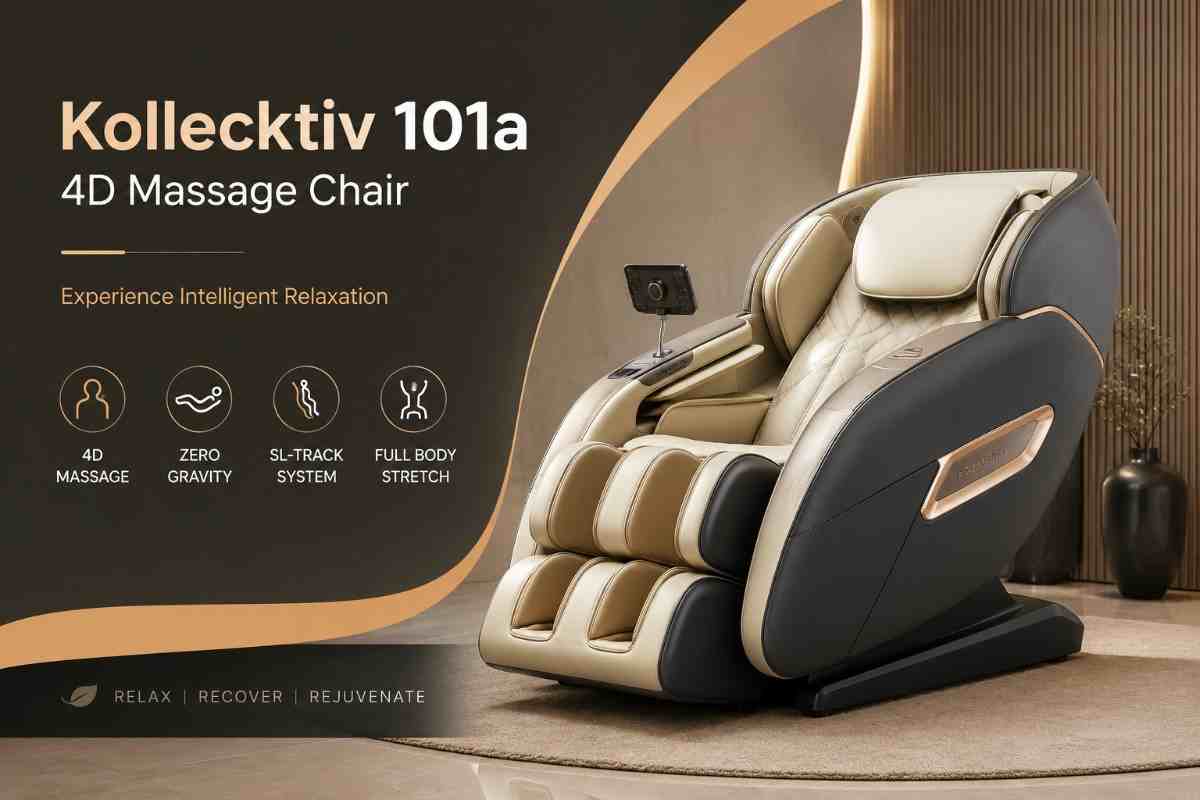
One Roller Mechanism or Two? Deciding If Dual-Core 4D Is Actually Worth It
-

- Published Updated
- 3,263 views

Quick answer: Dual Core 4D+4D means the chair uses two separate 4D roller mechanisms instead of one, moving along the same long SL-track to cover more of the body with more targeting options – rather than one mechanism handling the entire massage on its own.
Here’s the distinction in plainer terms. A conventional 4D massage chair has a single roller mechanism that travels the length of the SL-track. “4D” refers to how many ways that mechanism can move – depth (in and out), plus adjustable speed and rhythm on top of the standard up-down, side-to-side motion – which is what gives 4D rollers their more human, less mechanical feel compared to basic 2D or 3D chairs.
The 208 pairs two of those 4D mechanisms in the same chair. Kollecktiv’s listed specification for the 208 confirms “Dual 4D Massage Mechanisms” combined with “Customizable Target Massage (Whole/Partial/Spot)” – meaning the massage can be run across the whole body, on a partial section, or focused on a specific spot, rather than being locked into one continuous pass from neck to thighs.
Massage chair marketing loves to frame every new mechanism as a strict upgrade over what came before, but "more mechanisms" and "better fit for you" aren't automatically the same thing. Our Kollecktiv 208 Labor Day Sale piece breaks down exactly what Dual Core 4D+4D technology is and how it works mechanically. This article takes the follow-up question head-on: does running two 4D mechanisms instead of one actually matter for how you'll use the chair, or is it a spec that sounds impressive without changing your day-to-day experience?
What a Single 4D Mechanism Already Does Well
Before deciding whether two mechanisms beat one, it's worth being clear about what a standard single-mechanism 4D chair already handles competently. One roller system traveling the full SL-track delivers a complete, continuous massage from neck to thighs, with dynamic speed and rhythm variation built in. For anyone whose tension is fairly evenly distributed — general daily stiffness, overall fatigue, a session meant to cover everything at once — a single well-built 4D mechanism does the job it's designed for without leaving an obvious gap.
Where a Second Mechanism Actually Changes the Experience
The real difference dual-mechanism systems introduce isn't raw power — it's targeting flexibility. Running two 4D mechanisms along the same track means the massage can be focused on a whole-body pass, a partial section, or a specific spot, rather than being locked into one continuous routine every single session. That distinction matters most for a fairly specific kind of user: someone whose tension consistently concentrates in one region — upper back and shoulders from desk work, for instance — rather than someone who wants the same full-length massage every time regardless of where they're actually sore that day.
If your typical complaint is "my shoulders are killing me today" rather than "everything feels tight," that's a genuine signal that spot or partial targeting would get used regularly rather than sitting unused as a feature you paid for but rarely reach for.
A Practical Way to Test Whether You Need This
Before assuming dual-mechanism targeting is worth the added cost, it helps to think back over your last several massage chair sessions, or imagine how you'd actually use one:
- Do you consistently want the same full-body routine every time, regardless of where tension happens to be that day? If so, a single-mechanism 4D chair likely serves you just as well.
- Do you frequently think "I just want today's session focused on my lower back" or similar, wishing you could skip the parts that don't need attention? That's the exact use case dual-mechanism targeting is built for.
- Are you sharing the chair with someone whose tension pattern is completely different from yours — one person carries tension in the neck, another in the lower back? Whole/partial/spot targeting lets each person run a session suited to their specific pattern rather than settling for one generic routine that only partially fits either person.
The Trade-Off Worth Being Honest About
Dual-mechanism chairs generally cost more than comparable single-mechanism models, even accounting for sale pricing. If the targeting flexibility genuinely matches how you'll use the chair, that added cost buys real, regularly-used functionality. If it doesn't — if you'd realistically run the same full-body program every session regardless of what's available — you're paying for a feature that sits unused, and that money might be better spent on a longer track, higher airbag count, or other upgrades on a single-mechanism chair instead.
Comparing the Two Approaches Directly
| Question | Single-Mechanism 4D | Dual-Mechanism 4D (Like the 208) |
|---|---|---|
| Best for evenly distributed tension | Yes, this is its core strength | Works fine, but no added benefit here |
| Best for tension concentrated in one area | Covers it during a full pass, but no way to isolate it | Purpose-built for this — whole/partial/spot targeting |
| Best for multi-user households with different needs | Everyone gets the same routine | Each person can target their specific area |
| Typical price impact | Baseline for the tier | Generally higher within the same feature tier |
How This Differs From Other "Upgrade" Terms You'll See
It's worth being specific here, since massage chair terminology gets used loosely: dual-mechanism technology is not the same thing as a dual-track chair, which refers to the physical shape of the roller path rather than how many mechanisms are running it. It's also not the same as 5D technology, which adds real-time pressure sensing to a single mechanism rather than adding a second one. These are three separate upgrades solving three separate problems, and it's entirely possible for a chair to have one, two, or none of them independent of the others.
Who Should Actually Prioritize This During a Sale
People with consistently localized tension. If you already know your problem area and it doesn't shift much session to session, targeted massage is a feature you'll use regularly rather than occasionally experiment with.
Multi-person households with genuinely different needs. Automatic body scanning combined with flexible targeting means each person gets a session suited to them, rather than a one-size-fits-most compromise.
Buyers who've outgrown a single-mechanism chair's limitations. If you already own a standard 4D chair and consistently find yourself wishing you could skip to just the section that needs attention, that's a direct signal this upgrade solves a real, experienced frustration rather than a theoretical one.
Anyone for whom evenly distributed, full-body sessions are the norm is generally better served putting the budget difference toward track length, airbag count, or warranty terms on a single-mechanism chair instead.
FAQ
Is a dual-mechanism 4D massage chair better than a single-mechanism one? It depends on how tension typically shows up for you. For evenly distributed daily tension, a single mechanism performs the job well. For tension that consistently concentrates in specific areas, or households with different needs per user, dual-mechanism targeting offers a genuine functional advantage.
Does having two 4D mechanisms mean a stronger massage overall? Not necessarily. The primary benefit is targeting flexibility — running whole-body, partial, or spot-focused sessions — rather than simply adding more raw intensity to every session.
Is dual-mechanism technology the same as a dual-track chair? No. Dual-track refers to the physical shape the rollers follow along the spine. Dual-mechanism refers to how many roller systems are operating along that track. They're separate features that can appear independently of each other.
Is it worth paying extra for dual-mechanism targeting if I always want a full-body massage? Generally not. If your typical use case is a consistent full-body session regardless of where tension happens to be, the added cost of dual-mechanism targeting may be better allocated toward other upgrades like track length or airbag count.
How do I know if targeted massage would actually get used regularly? Think back on recent sessions — if you've frequently wished you could skip straight to one specific area rather than running a full routine, that's a strong signal the feature would see genuine regular use rather than sitting unused.
Final Thoughts
Two roller mechanisms aren't automatically better than one — they're better for a specific kind of use case: concentrated, localized tension, or households where different people need genuinely different sessions. Our Kollecktiv 208 Labor Day Sale piece covers exactly how the 208's Dual Core 4D+4D system works mechanically — pairing that explanation with an honest look at whether targeting flexibility matches how you'll actually use the chair is what separates a genuinely useful upgrade from a spec that just sounds impressive on paper.
Related Articles

![LifeGauge Breeze Recensioni: Funziona Davvero? Opinioni [LifeGauge Breeze Come Funziona] e Risultati](https://indibloghub.com/public/images/courses/6a8c076baa0de6373_1787561835.jfif)