How Predictive Replenishment Tools Improve Forecast Accuracy
-

- May 30th, 2026
- 6,454 views
Forecast accuracy has become one of the most important success factors in modern supply chain and inventory management. Whether a business operates in retail, manufacturing, wholesale distribution, or ecommerce, the ability to accurately predict future demand directly impacts inventory levels, customer satisfaction, profitability, and operational efficiency.
However, forecasting demand has never been more challenging. Consumer preferences change rapidly, omnichannel shopping creates complex purchasing patterns, promotions influence buying behavior, and external factors such as weather, economic conditions, and market disruptions can significantly affect demand. Traditional forecasting methods that rely heavily on historical sales data often struggle to keep pace with these dynamics.
As a result, many businesses face a familiar problem: either carrying too much inventory to protect against uncertainty or risking stockouts due to inaccurate forecasts.
To address these challenges, organizations are increasingly adopting predictive replenishment tools. Powered by artificial intelligence, machine learning, and real-time demand analysis, these tools help businesses improve forecast accuracy and make more informed replenishment planning decisions.
As supply chains become more data-driven, predictive replenishment tools are emerging as a critical component of inventory optimization and demand forecasting strategies.
Why Forecast Accuracy Matters
Forecast accuracy determines how closely predicted demand matches actual customer demand.
Accurate forecasting helps businesses:
- Maintain product availability
- Reduce stockouts
- Minimize excess inventory
- Improve inventory optimization
- Support better replenishment planning
- Increase customer satisfaction
Poor forecasting can create significant operational and financial challenges.
Common consequences include:
- Overstocking
- Understocking
- Higher carrying costs
- Lost sales opportunities
- Reduced profitability
Improving forecast accuracy is therefore a key objective for supply chain leaders.
The Limitations of Traditional Forecasting Methods
Traditional forecasting approaches primarily rely on historical sales data.
While historical trends provide useful insights, they often fail to account for rapidly changing market conditions.
Common limitations include:
Reactive Forecasting
Historical data reflects past demand rather than future intent.
Limited Visibility into Demand Drivers
Traditional systems often overlook factors influencing purchasing behavior.
Difficulty Handling Demand Volatility
Sudden changes in customer behavior can disrupt forecasts.
Manual Planning Processes
Spreadsheet-based forecasting can be time-consuming and error-prone.
These limitations make it difficult to maintain accurate forecasts in modern retail environments.
What Are Predictive Replenishment Tools?
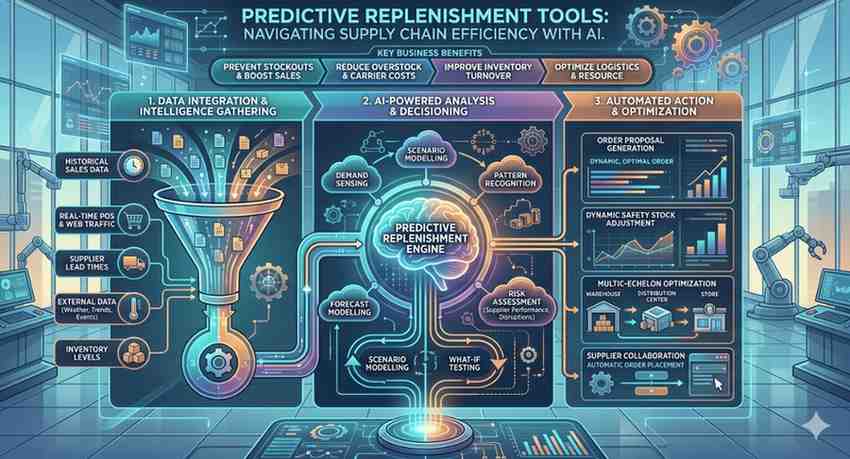
Predictive replenishment tools are advanced inventory planning solutions that use artificial intelligence, machine learning, and analytics to forecast demand and automate replenishment decisions.
Unlike traditional systems, predictive tools analyze multiple data sources simultaneously.
These may include:
- Historical sales data
- Real-time demand signals
- Inventory levels
- Customer behavior
- Seasonal patterns
- Promotional activity
- Supply chain constraints
The goal is to improve forecast accuracy and optimize inventory decisions.
How Predictive Replenishment Tools Improve Forecast Accuracy
Analyzing More Data Sources
One of the biggest advantages of predictive replenishment tools is their ability to process large volumes of data from multiple sources.
Traditional forecasting often focuses on sales history alone.
Predictive systems incorporate additional inputs such as:
- Website traffic
- Product searches
- Cart additions
- Promotional calendars
- External market indicators
This broader view provides a more complete understanding of demand.
Leveraging Real-Time Demand Signals
Customer demand can change rapidly.
Predictive replenishment tools continuously analyze real-time demand signals, including:
- Ecommerce activity
- Point-of-sale transactions
- Product page views
- Search trends
- Customer engagement patterns
These signals often reveal shifts in demand before they appear in sales reports.
Earlier detection improves forecasting responsiveness.
Identifying Hidden Demand Patterns
Artificial intelligence excels at detecting relationships and patterns that may not be visible through traditional analysis.
Machine learning algorithms can identify:
- Seasonal purchasing trends
- Product affinities
- Regional demand variations
- Promotional impacts
- Customer behavior shifts
These insights help create more accurate forecasts.
Improving Demand Forecasting During Promotions
Promotional events often create significant forecasting challenges.
Demand may increase dramatically during:
- Holiday sales
- Product launches
- Discount campaigns
- Marketing events
Traditional forecasting methods frequently struggle to account for these fluctuations.
Predictive replenishment tools analyze historical promotional performance alongside current demand signals to improve forecasting accuracy during promotional periods.
Adapting to Demand Volatility
Demand volatility is becoming increasingly common across industries.
Consumer preferences can shift quickly due to:
- Economic conditions
- Social trends
- Competitive activity
- External events
Predictive replenishment tools continuously update forecasts as new information becomes available.
This dynamic approach helps businesses respond more effectively to changing demand conditions.
Supporting Inventory Optimization
Forecast accuracy and inventory optimization are closely connected.
More accurate forecasts enable businesses to:
- Reduce safety stock levels
- Improve inventory turnover
- Lower carrying costs
- Maintain product availability
Predictive replenishment tools help align inventory levels more closely with actual demand.
This improves both operational efficiency and financial performance.
AI and Machine Learning as Forecasting Engines
Artificial intelligence serves as the foundation of modern predictive replenishment systems.
AI-powered forecasting models can:
- Analyze large datasets
- Detect complex patterns
- Generate demand predictions
- Continuously learn from outcomes
Machine learning models improve over time as they process additional data.
This allows forecast accuracy to increase continuously.
Improving Replenishment Planning Decisions
Forecast accuracy directly affects replenishment planning performance.
More accurate demand predictions help businesses determine:
- When to reorder inventory
- How much inventory to order
- Where inventory should be allocated
Improved replenishment planning reduces both stockouts and excess inventory.
This contributes to stronger inventory optimization outcomes.
Omnichannel Demand Forecasting
Modern retailers operate across multiple channels, including:
- Physical stores
- Ecommerce websites
- Mobile applications
- Marketplaces
Each channel generates unique demand patterns.
Predictive replenishment tools aggregate data across channels to create a unified demand forecast.
This improves forecast accuracy and inventory allocation decisions.
The Role of Demand Signals
Demand signals have become increasingly important in modern forecasting.
Examples include:
- Product searches
- Browsing activity
- Cart additions
- Loyalty program interactions
- Market demand indicators
Demand signals provide insight into customer intent before purchases occur.
Incorporating these signals helps businesses anticipate demand more effectively.
Supplier Collaboration and Forecast Accuracy
Forecasting accuracy improves when businesses collaborate with suppliers.
Sharing forecasts and demand insights helps suppliers:
- Plan production more effectively
- Allocate inventory appropriately
- Manage capacity requirements
Supplier collaboration creates a more responsive supply chain.
This strengthens replenishment planning and forecast reliability.
Benefits of Improved Forecast Accuracy
Reduced Stockouts
Businesses can maintain product availability more consistently.
Lower Inventory Costs
Excess inventory levels decrease.
Improved Inventory Optimization
Inventory aligns more closely with actual demand.
Better Customer Satisfaction
Customers are more likely to find products in stock.
Stronger Financial Performance
Working capital utilization improves.
Key Metrics to Measure Forecast Accuracy
Organizations should track:
- Forecast accuracy percentage
- Mean Absolute Percentage Error (MAPE)
- Inventory turnover
- Stockout rate
- Fill rate
- Days of inventory on hand
- Service level performance
These metrics help evaluate forecasting effectiveness.
Common Challenges During Implementation
Data Quality Issues
Forecasting accuracy depends on reliable data.
System Integration Complexity
Multiple data sources must work together effectively.
Organizational Adoption
Teams may need to adapt to AI-driven decision-making.
Forecast Trust
Building confidence in predictive models can take time.
Addressing these challenges is essential for success.
Best Practices for Using Predictive Replenishment Tools
Integrate Multiple Demand Signals
A broader data foundation improves forecast quality.
Leverage Real-Time Data
Current demand insights enhance responsiveness.
Continuously Train Forecasting Models
Machine learning models should evolve with changing demand patterns.
Strengthen Supplier Collaboration
Shared planning improves forecasting outcomes.
Monitor Performance Regularly
Forecast accuracy should be measured and optimized continuously.
The Future of Predictive Forecasting
Forecasting technologies will continue advancing through innovations such as:
- AI-powered demand sensing
- Autonomous replenishment planning
- Real-time inventory optimization
- Predictive supply chain analytics
- Advanced demand signal processing
These capabilities will help businesses make increasingly accurate and agile inventory decisions.
Conclusion
Forecast accuracy is the foundation of effective inventory management, replenishment planning, and supply chain performance. Traditional forecasting approaches often struggle to keep pace with modern demand volatility and omnichannel complexity, leading to inventory inefficiencies and missed business opportunities.
Predictive replenishment tools address these challenges by combining artificial intelligence, machine learning, demand signals, and real-time analytics to generate more accurate forecasts. By improving visibility into future demand, these tools help businesses optimize inventory levels, reduce stockouts, lower carrying costs, and strengthen overall operational performance.
As organizations continue investing in inventory optimization and supply chain modernization, predictive replenishment tools will play an increasingly important role in improving forecast accuracy and supporting more resilient, demand-driven operations.