Top Spend Analysis Techniques Every Procurement Team Should Know
-

- Published Updated
- 68 views
Overview
Procurement departments manage large purchasing data related to suppliers, product categories, departments, and different business units. Conventional procurement processes cannot help organizations find ways for cost savings and improve supplier relationships without proper data analysis.
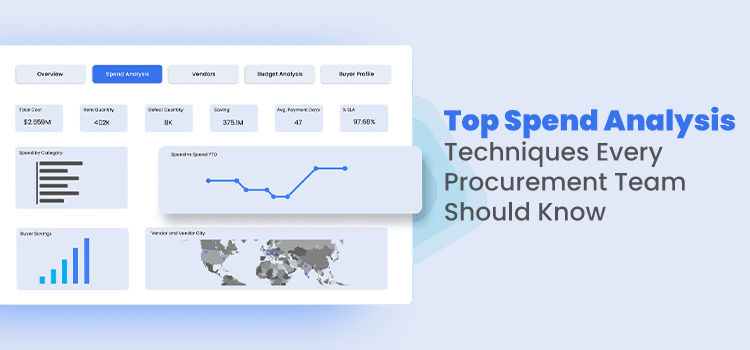
Spend analysis in procurement helps businesses analyze their purchasing data. Spend analysis allows companies to know where their money goes and how it is spent during the purchasing process. The method is useful for transforming transactional data into useful insights and helps with better decision-making in purchasing and sourcing.
Overview of Spend Analytics in Procurement
Spend analysis is described as the process of gathering, categorizing, and analyzing expenditure data in procurement. It helps understand the organizational buying process.
This data can include suppliers, purchase types, spending amounts, associated organizational departments, purchase dates, contracts, and many more. With standardized data, procurement specialists can identify problem areas and improve their procurement processes.
Modern procurement analytics software brings the purchasing data from various sources into a single place.
Top Spend Analysis Techniques Every Procurement Team Should Know
Spend Categorization
Spend categorization involves classifying expenses such as IT, office supplies, transportation, marketing, facilities, and professional services.
It helps procurement teams understand how much they are spending within each category. They can identify the categories with high expenses that can benefit from strategic sourcing.
Categorization is important for businesses because inconsistent descriptions can make the purchase data interpretation challenging.
Supplier Spend Analysis
Supplier spend analysis in procurement focuses on how much an organization spends with individual suppliers. Procurement teams can examine total spending, purchase frequency, contract timelines, and supplier concentration.
For instance, an organization can identify departments that purchase the same goods from different suppliers. This can be an opportunity for supplier consolidation to receive products at better discounts.
Supplier analysis helps procurement managers understand how much the organization relies on the services of a specific supplier. They can seek better options if required.
Tail Spend Analysis
Tail spending is small purchases together making up a significant portion of an organization’s procurement activity. These procurements can involve many suppliers, and teams usually focus less on these expenses.
With tail spend analysis, teams can identify fragmented procurements. It helps teams understand if there is a need for supplier consolidation, supplier reconsideration, catalogs, and new policies.
Tail spend management can help reduce administrative costs by reducing the total number of suppliers and purchases.
Spend by Business Unit
Spend management by department, location, or business unit gives useful insights into how the departments procure their products or services.
Evaluating purchasing practices in business units helps procurement professionals compare prices, suppliers, contract utilization, and purchase volumes. For example, a department is paying a higher price than other departments for similar products. In this case, the company can find out the cause and a possible solution.
This is especially important for organizations running in different geographical locations.
Contract Spend Analysis
Contract spend analysis involves comparing actual spending against the terms of the contract. It assists the procurement teams in determining whether staff members are utilizing the contracts and negotiated rates.
Contract spend analysis may identify cases with purchases made outside approved contracts and where they have not been fully maximized.
Combining contract and purchasing information gives procurement teams visibility into compliance and helps utilize contracts.
Price Variance Analysis
In price variance, teams analyze the price difference of goods and services. Procurement professionals can compare the prices of similar goods available from different suppliers, departments, or locations.
For instance, when different departments purchase similar items at different prices, the procurement team will perform a price variance analysis. It helps them find the reasons that are causing price differences. These reasons could be related to quantity, deliveries, contracts, or supplier-specific pricing policies.
Trend Analysis
Analysis of trends involves observing expenditure trends. The purchasing department can conduct trend analysis on a monthly, quarterly, or annual basis. They keep track of the trends and whether there are any unusual patterns.
Trend analysis in procurement is used to analyze spend categories and supplier trends. A sudden rise in expenditure may indicate a change in requirements, cost differences, or supplier issues.
The procurement group can also rely on historical trends to forecast their future budget.
Spend Under Management Analysis
Spend under management analysis includes procurement actively managed by the team through selected suppliers, contracts, sourcing practices, or procurement policy.
Analyzing managed and unmanaged purchases enables an organization to determine how much purchasing behavior is under the control of procurement teams. High unmanaged spend indicates insufficient procurement practices or poor usage of the procurement channel.
Teams can use this information to enhance procurement policy and compliance.
How Procurement Analytics Software Supports Spend Analysis
Manual procurement database analysis is time-consuming and inefficient. Procurement analytics software will help automate spend analysis processes.
The procurement system unifies information from business systems, including ERP, purchase management systems, and invoice data. It provides insightful information, which includes supplier visibility, spending categories, spending behavior, and many others.
Procurement analytics software tools use AI and machine learning models to categorize data. With this technology, procurement experts can focus on analysis and decision-making instead of relying on spreadsheets.
Effective Spend Analysis Best Practices
Some of the useful approaches that an organization can adopt to improve its analysis are -
Supplier information standardization - Supplier names and classification should be consistent.
Proper categorization - Ensure that all purchases are properly categorized.
Consolidate data - Consolidate procurement, invoice, contract, and supplier data.
Perform data analysis - Regularly analyze data instead of doing it only when required.
Focus on actionable insights - Highlight information that is relevant to sourcing, negotiating, supplier management, or some other process.
Monitor outcomes - Determine if you have saved money or if your supplier is performing better after implementing procurement efforts.
Conclusion
An effective spend analysis process provides procurement teams a better understanding of their purchasing process. It allows them to find new ways to improve their cost controls and supplier management process. Spend classification, supplier spend analysis, tail spend analysis, price variance, and trend analysis are useful in identifying hidden problems.
With quality data and the appropriate procurement analytics software, the spend analysis process becomes much more consistent and automated. Businesses get an opportunity to convert their procurement data into useful insights.