Is Unstable Voltage Quietly Eating Your Business Profits? Here’s How to Stop It
-

- Published Updated
- 3,651 views
Your Machines Are Working Hard. Is Your Power Supply Working Hard Enough?
Imagine walking into your factory on a normal Monday morning. The machines are running, your team is busy, orders are moving, and everything looks perfectly fine.
Then suddenly—a machine trips.
The operator tries to restart it. It works for a while and then stops again. Someone calls maintenance. Production slows down. A few workers are waiting. A delivery that was supposed to leave in the afternoon is now running behind schedule.
The problem?
Sometimes, it isn't the machine.
It is the power going into the machine.
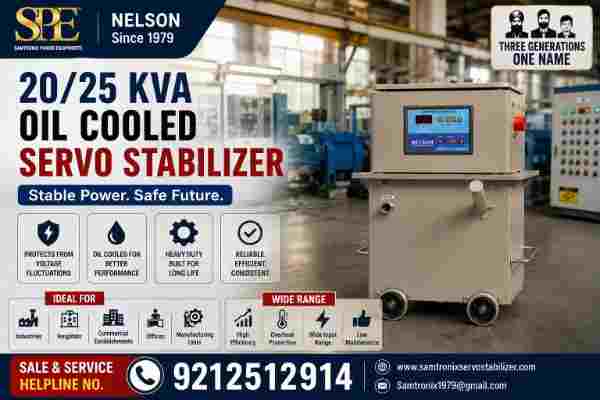
Voltage fluctuations are one of those problems that businesses often ignore until they become expensive. And that's exactly why a 20/25 KVA Oil-Cooled Servo Stabilizer can be an important investment for businesses that depend on reliable electrical equipment.
But let's forget the complicated electrical language for a moment.
The real question is simple:
Can stable voltage help your business save money and protect productivity?
The answer can be yes—when the stabilizer is correctly selected for the application.
The Electricity Bill Isn't the Only Cost of Power
When we talk about electricity costs, most businesses immediately think about the monthly electricity bill.
But there is another cost that doesn't appear on the bill.
Downtime.
A voltage fluctuation can cause equipment to trip, production to pause or electrical components to experience unnecessary stress. Even a short interruption can affect the workflow.
Let's say your production line loses one hour because of an electrical issue.
What did that one hour actually cost?
It could mean lost production, idle employees, delayed orders, additional maintenance work and sometimes unhappy customers.
Now imagine losing that hour several times throughout the year.
Suddenly, voltage isn't just an electrical problem.
It's a business expense.
One Small Voltage Problem Can Create a Bigger Chain Reaction
This is where things get interesting.
A voltage fluctuation doesn't always end with the machine stopping.
The machine stops → production stops → employees wait → maintenance checks the machine → production restarts → the schedule gets delayed.
And sometimes there is another problem.
A component may need to be replaced.
Now you've paid for downtime + maintenance + replacement + lost productivity.
The original voltage fluctuation may have lasted only a few seconds.
The financial impact can last much longer.
So, What Does a Servo Stabilizer Actually Do?
A servo stabilizer is designed to regulate incoming voltage and provide a more stable output to connected equipment within its specified operating range.
It continuously monitors changes in the incoming supply and makes the necessary correction through a motorized mechanism.
Think of it as a system that doesn't simply accept whatever voltage comes in.
When the voltage changes, it works to correct it.
For businesses operating machinery for long hours, this can help create a more consistent electrical environment.
And that consistency is valuable.
Why the 20/25 KVA Rating Matters
You may have seen stabilizers described as 20 KVA, 25 KVA or other capacities.
But KVA isn't just a number you pick randomly.
It needs to match the electrical load you're planning to connect.
A business should consider its connected load, peak demand, motor starting current and future expansion before selecting the stabilizer.
This is especially important when motors and heavy machinery are involved because starting requirements can be considerably higher than normal running requirements.
So, don't think:
"Bigger is always better."
Think:
"Correctly sized is better."
And What About the Oil-Cooled Design?
Here's another important part of the story.
Industrial equipment often works for long hours. When electrical equipment operates continuously, heat becomes something you can't ignore.
An oil-cooled stabilizer uses insulating oil to help with cooling and electrical insulation.
This type of design can be useful for demanding applications where the stabilizer is expected to operate for extended periods.
From a business point of view, it's not really about the oil itself.
It's about supporting dependable operation under the conditions the equipment was designed for.
Stable Voltage Can Mean Fewer "Why Did the Machine Stop?" Moments
Every business has those frustrating moments.
"Why did the machine stop?"
"Why did it trip again?"
"Why is this component heating up?"
"Why are we calling the technician again?"
Sometimes the reason may be mechanical. Sometimes it may be related to the machine itself. And sometimes unstable voltage can be part of the problem.
A servo stabilizer cannot solve every electrical or mechanical issue. But when voltage variation is a concern, proper voltage regulation can help reduce one important source of disruption.
That's where the practical value begins.
Now Let's Talk About ROI
ROI sounds like a complicated financial term, but the idea is actually pretty simple.
You invest money.
You receive value.
The question is whether the value you receive justifies the investment.
With a stabilizer, the return may not come from making additional sales directly.
It can come from avoiding unnecessary losses.
For example:
If stable voltage helps prevent an hour of downtime, that's value.
If it helps reduce certain voltage-related repairs, that's value.
If it helps keep expensive equipment operating more consistently, that's value.
If it helps production stay on schedule, that's value.
In other words:
The ROI may come from the problems you don't have to pay for.
Let's Put Some Numbers Behind It
Imagine a business calculates that one hour of downtime costs approximately ₹10,000.
Now suppose voltage-related interruptions contribute to 10 hours of downtime in a year.
That's potentially ₹1,00,000 in lost operational value.
And we're not even counting repair expenses.
Now the stabilizer investment starts looking different.
Instead of thinking about it as another expense, the business can ask:
"How much of this loss can we potentially avoid?"
That's a much smarter way to evaluate the investment.
Your Machinery Is an Investment. Treat It Like One.
Modern industrial machinery isn't cheap.
A business may spend lakhs of rupees on a single machine because it expects that machine to work productively for years.
But buying the machine is only the beginning.
You also need to think about the conditions under which it operates.
Voltage regulation can be one part of that protection strategy.
Of course, a stabilizer is not a magic shield against every electrical problem. Proper earthing, circuit protection, surge protection and other safety measures may also be required depending on the installation.
But maintaining suitable voltage conditions can help support the equipment you're already investing in.
The Hidden Cost of Calling Maintenance Again and Again
Here's something businesses sometimes overlook.
Maintenance has a cost even when the repair itself is small.
Someone has to identify the problem.
Someone has to inspect the equipment.
Someone has to order a component.
Someone has to install it.
And during all of this, the machine may not be producing anything.
If recurring voltage fluctuations are contributing to these problems, improving voltage regulation may help reduce some avoidable interruptions.
That can mean fewer emergency calls and more predictable maintenance.
What About Input Voltage Range?
This is one specification you shouldn't ignore.
Different locations can experience different levels of voltage variation. Some businesses may have relatively stable incoming power, while others may face significant fluctuations throughout the day.
The stabilizer's input voltage range tells you how much variation it is designed to handle.
A suitable wide input range can be particularly useful in areas where voltage changes are frequent.
But don't assume every stabilizer has the same range.
Always check the actual specifications of the model you're considering.
Who Can Benefit From a 20/25 KVA Stabilizer?
The answer isn't limited to one type of business.
Depending on the electrical load and application, a 20/25 KVA oil-cooled servo stabilizer may be considered for manufacturing units, industrial facilities, offices, hospitals and commercial establishments.
But there is an important "if."
The load must be appropriate.
A factory with motors and production machinery will have different requirements from an office full of computers.
So before buying, understand the electrical requirement first.
Don't Make the "Cheapest One" Mistake
When businesses buy electrical equipment, the first comparison is often price.
That's understandable.
But the cheapest option isn't automatically the most economical one.
Suppose a low-cost stabilizer isn't properly matched to your load. Or its input range isn't suitable for your location. Or its operating requirements don't fit your application.
The money saved during purchase may not remain a saving for very long.
Instead, look at the bigger picture:
Capacity + suitability + reliability + maintenance + operating cost + expected service life.
That's where real value comes from.
Your Stabilizer Should Be Chosen Around Your Business
Every business has a different power story.
One company may experience frequent voltage drops.
Another may have high starting currents because of motors.
Another may be planning to add machinery next year.
Another may operate its equipment almost continuously.
That's why the right stabilizer should be selected after understanding the actual electrical conditions.
A proper load assessment can help determine whether a 20/25 KVA unit is suitable and what specifications are required.
Don't Wait for a Breakdown to Start Thinking About Protection
This is probably the biggest lesson.
Businesses often start thinking about voltage regulation after something goes wrong.
A machine fails.
A component burns.
Production stops.
A large repair bill arrives.
Only then does someone ask, "Could we have prevented this?"
Sometimes prevention is far more economical than repeated recovery.
If your business is already experiencing frequent voltage fluctuations, unexplained trips or recurring electrical interruptions, it may be worth assessing the power supply before the problem becomes more expensive.
Stable Power Is Really About Business Continuity
At first glance, a servo stabilizer looks like electrical equipment.
But look at it from the business side.
It can support machinery.
Machinery supports production.
Production supports orders.
Orders support revenue.
And revenue supports the business.
That makes power stability part of a much bigger chain.
Stable power → reliable equipment operation → fewer avoidable interruptions → better productivity → stronger operational ROI.
Of course, the actual benefits depend on the site's electrical conditions, equipment and correct stabilizer selection.
The Smartest Question to Ask Before Buying
Don't begin with:
"How much does the stabilizer cost?"
Start with:
"How much are voltage-related problems costing us right now?"
Calculate your downtime.
Look at maintenance expenses.
Review equipment failures.
Estimate the value of lost production.
Understand your voltage conditions.
Then compare that cost with the investment required for an appropriate stabilization solution.
That gives you a business decision—not just a purchasing decision.
Final Thought: Sometimes the Best Investment Is the Problem You Prevent
Nobody celebrates a machine that didn't stop.
Nobody sends an invoice for a production hour that wasn't lost.
Nobody notices a repair that never had to happen.
But those things still have value.
That's the real story behind a 20/25 KVA Oil-Cooled Servo Stabilizer.
When correctly selected for the application, it can help businesses manage voltage fluctuations and create a more stable electrical environment for their equipment.
And the potential ROI isn't only about saving money on repairs.
It's about protecting something even more valuable:
your productive time.
Because machines can be repaired.
Components can be replaced.
Money can be spent again.
But a lost production hour is gone forever.
7 Short FAQs
1. What is a 20/25 KVA Oil-Cooled Servo Stabilizer?
It is a voltage-regulation system designed to provide a more stable output voltage for suitable electrical loads.
2. Why do businesses need voltage stabilization?
Frequent voltage fluctuations can contribute to equipment interruptions, downtime and electrical stress, making voltage regulation important for suitable applications.
3. How does a servo stabilizer work?
It monitors incoming voltage and uses a motorized mechanism to make corrections within its specified operating range.
4. Why is the stabilizer oil-cooled?
Insulating oil helps manage heat and provides electrical insulation during operation.
5. Can it improve business ROI?
It can potentially improve ROI by helping reduce voltage-related downtime, certain maintenance expenses and avoidable operational losses.
6. Is 20/25 KVA enough for my business?
It depends on your connected load, peak demand, starting currents and future requirements. A proper load assessment is recommended.
7. What should I check before purchasing?
Check the KVA capacity, input voltage range, output requirements, connected load, starting current, operating conditions and maintenance requirements.